 Hable con un agente al (888) 572-7520
  Enviar mensaje a un agente

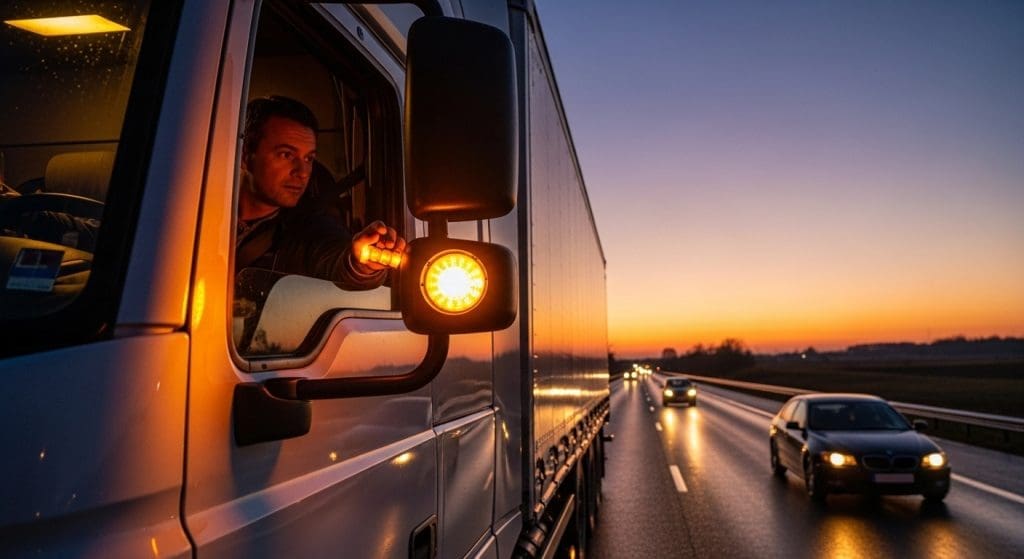

In the age of satellite navigation, digital maps, and real-time traffic alerts, it might seem that technology has solved most of the challenges of driving long distances. Modern trucks are equipped with advanced telematics, GPS routing systems, and sensors capable of monitoring everything from tire pressure to braking performance.
Yet on the highways of the United States, there is another communication system that continues to play a crucial role in road safety. It does not depend on satellites, cellular coverage, or complex software. It operates through something far more basic and powerful: human cooperation.
Truck drivers call it the “Code of the Asphalt”—a shared language of turn signals, headlights, and hand gestures that allows drivers to warn each other about dangers long before they appear on any screen.
Far from being informal or mysterious, this system functions as a form of collective intelligence on the road, developed over decades by professional drivers who understand that safety often depends on quick communication.
A Language That Predates the GPS

Long before digital navigation systems existed, truck drivers traveling across vast rural highways needed ways to communicate with one another. In many parts of the United States—particularly in mountain corridors, desert regions, and remote stretches of interstate—cell service was unreliable or nonexistent.
Drivers learned to rely on visual signals.
A quick flash of headlights could mean “your trailer lights are off.”
A hand motion from the cab window could warn of debris or an accident ahead.
A turn signal used at the right moment could allow another driver to safely pass.
Over time, these gestures evolved into a shared professional culture, understood by experienced drivers across states and companies.
Even today, when GPS and navigation apps provide constant updates, these human signals remain essential. Technology can warn about traffic congestion miles away, but it cannot always detect a tire blowout on the shoulder, an animal crossing the road, or cargo that has fallen from a vehicle minutes earlier.
A driver already on the scene can.
The Role of Turn Signals in Safe Passing

One of the most recognized elements of the road code involves turn signals used by truck drivers to assist overtaking vehicles.
On long rural highways or two-lane roads, passing a heavy truck can be risky. Visibility may be limited, and judging distances at high speed is difficult for passenger vehicles.
Experienced truck drivers often help reduce that risk by using their turn signals as a courtesy signal.
When the right turn signal is activated after a vehicle has begun overtaking, it usually means the lane ahead appears clear and the driver may complete the pass safely.
Conversely, when the left signal remains active, it often indicates that the truck driver sees oncoming traffic or another hazard ahead, suggesting the overtaking vehicle should wait.
This informal communication helps coordinate movements between large trucks and smaller vehicles, reducing the chances of dangerous passing maneuvers.
According to several U.S. highway safety studies, improper passing remains one of the contributing factors in serious rural road accidents, particularly on two-lane highways. Clear communication between drivers can significantly lower that risk.
Signals That Warn of Danger
Beyond passing signals, drivers also use gestures and light flashes to warn colleagues about immediate hazards.
A hand moving up and down like a pendulum often means there is a serious obstacle ahead, such as an accident scene, debris, or stopped traffic.
Fingers pointing downward toward the road typically indicate potholes or damaged pavement.
Repeated headlight flashes may signal that a vehicle has a mechanical issue, such as unsecured cargo, a dragging chain, or a malfunctioning light.
These quick signals allow drivers behind to slow down or change lanes before encountering the problem.
On highways where vehicles may travel at 65 miles per hour or more, even a few seconds of early warning can prevent a crash.
Why Human Communication Still Matters
Technology has transformed modern logistics. Fleet management platforms can track trucks in real time, route optimization software reduces delays, and driver-assist systems can monitor lane positioning and braking distance.
However, technology cannot fully replace human awareness.
Satellite data may update every few minutes. Road sensors cover only certain corridors. Even the most sophisticated navigation system cannot interpret every unpredictable event on the road.
Human drivers, on the other hand, observe constantly.
They see the unexpected load shifting in a trailer ahead.
They notice smoke from a tire before sensors detect overheating.
They recognize subtle signs of danger long before a digital alert appears.
The asphalt code is therefore not a relic of the past. It is an example of proactive safety culture among professional drivers.
A Culture of Solidarity
For many truck drivers, these signals represent more than convenience. They reflect a long-standing sense of solidarity within the profession.
Truckers often spend days or weeks on the road, navigating changing weather, heavy traffic, and tight delivery schedules. Communication between drivers becomes a form of mutual protection.
A warning about a fallen object can prevent a collision.
A signal allowing a safe pass can avoid a risky maneuver.
A quick flash of headlights can alert someone to a problem before it becomes dangerous.
This informal network functions like an invisible social platform, connecting drivers who may never meet but still look out for one another.
Why It Matters for Safety and Insurance
From a safety and risk-management perspective, understanding these signals has real value.
A driver who recognizes and uses these communication codes is typically more attentive to surrounding traffic and more aware of potential hazards.
For insurers, that awareness matters.
Professional driving is not only about maintaining a vehicle or complying with regulations. It also involves situational awareness, communication, and prevention.
The best safety strategy does not begin with an insurance policy. It begins with small decisions made every mile—slowing down when another driver signals danger, checking mirrors before signaling a pass, and warning colleagues when a hazard appears.
In that sense, the asphalt code reflects a simple but powerful principle:
Prevention is not only written in the policy. It lives in every gesture that warns a fellow driver about danger ahead.
Visual Road Dictionary
Drivers across North America commonly recognize several visual signals used on highways:
• Right turn signal – Indicates it is likely safe for a following vehicle to complete a pass.
• Left turn signal – Suggests traffic or danger ahead; do not pass yet.
• Hand swinging downward – Warns of potholes or road damage.
• Pendulum hand motion – Signals a major obstacle or accident ahead.
• Repeated headlight flashes – Alerts another driver to a mechanical issue or urgent situation.
Understanding these signals helps both professional drivers and everyday motorists share the road more safely.
 Business hours: Monday to Friday from 8:00 AM to 5:00 PM. California time