 Hable con un agente al (888) 572-7520
  Enviar mensaje a un agente

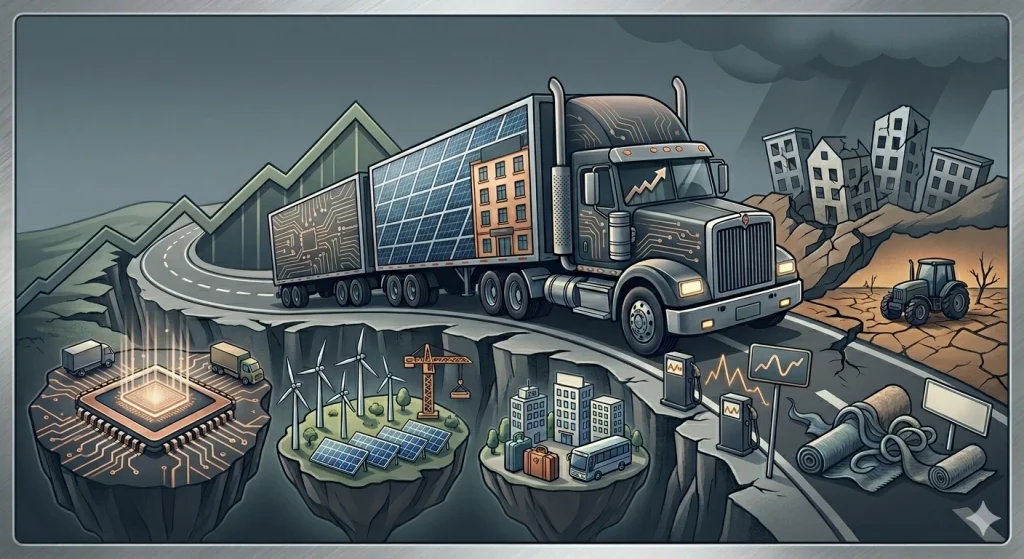

The country started 2016 with its foot on the gas, but not all lanes have been clear. If truckers and carriers have felt that freight is moving differently or that the numbers don’t add up the same way as in December, it’s not just a coincidence. The official data for the first quarter is now available, and it tells a story of stark contrasts. The U.S. economy has shown a resilience that many didn’t expect, but as always, some are celebrating at the top while others are praying they don’t run out of fuel halfway up the hill.
According to the Bureau of Economic Analysis (BEA), Gross Domestic Product (GDP) maintained a steady pace, driven primarily by household spending and fixed investment, which continues despite interest rates.
At the start of this year, three sectors took the top prize while others bit the dust. The crown jewel was, without a doubt, semiconductor and advanced computing technology. According to the Commerce Department’s economic outlook report, “global demand for artificial intelligence infrastructure catapulted advanced manufacturing output to record levels in the first quarter,” meaning more high-value cargo moving along our roads.
Secondly, the renewable energy sector experienced a giant leap thanks to the expansion of solar farms in the Sun Belt. Finally, domestic tourism and recreational services took off, filling hotels and keeping consumption strong.
But be warned: it wasn’t all rosy in the U.S. economy, as the residential real estate sector continues to suffer from construction costs. Agriculture also had a quarter to forget due to erratic weather patterns in the Midwest, and the traditional textile sector continued its retreat in the face of competition from cheaper imports.
Transportation in the Mirror of Data
What happened with transportation? These first three months were a rollercoaster ride for those who live on wheels. The Bureau of Transportation Statistics (BTS) was very clear in its latest quarterly report, stating that “the freight transportation services index showed moderate volatility, reflecting a stabilization in supply chains following the logistical adjustments of late 2025.”
In simpler terms, this means there was no shortage of work, but profit margins are tighter than a rusty nut. The surge in demand for transportation in the technology sector offset the drop in agricultural grain shipments, saving the season for many of us. The key takeaway here is that the U.S. economy continues to rely on trucking to move 70% of the value of its goods, and that provides a sense of security, even though fuel prices continue to cause some anxiety at the pump.

For transportation companies, the advice is to closely examine contracts with the energy sector. The transition to green infrastructure is moving heavy equipment that we didn’t previously see on dispatch lists.
The Federal Reserve Board, in its March “Beige Book“, highlighted that “economic activity in most districts continued to expand at a slight to moderate pace,” which is a sign that we’re not facing a sudden halt, but rather a shift in gears. The key to surviving 2026 will be flexibility: those who only know how to move one thing will be left behind. The U.S. economy is evolving toward digital and sustainable practices, and the most efficient fleets must be ready to carry whatever the future demands.
Keep your eyes on the road and your hands firmly on the wheel, because the rest of the year promises to be an intense journey with many twists and turns. On that mission, sometimes looking in the rearview mirror is also important. But this is less true for a carrier or business owner, who needs to see what lies ahead, relying, of course, on the most recent reports from the organizations that influence the global economy.
Projections for the Second Half of the Year
Most official institutions agree that the U.S. economy will reach mid-2026 with positive momentum, although with a key warning: the brakes must be applied. The International Monetary Fund (IMF), in its Article IV Consultation concluded in April 2026, projects that GDP growth will accelerate modestly to 2.4% annually.
According to the aforementioned organization, “the projected growth is supported by strong productivity and the private sector’s ability to adapt to changes in trade policies.” This suggests that, by July, cargo volume should remain stable, especially due to investment in digital infrastructure and data centers.
For its part, the Federal Reserve (Fed) maintains a cautiously vigilant stance. In its March 2026 statement, the Federal Open Market Committee (FOMC) noted that, while they expect convergence toward equilibrium, “the elevated readings reflect goods-sector inflation driven by the effect of tariffs.”
By mid-year, the Fed estimates that core inflation (PCE) will be close to 2.7%, which could keep interest rates in the current range of 3.5% to 3.75% for some time, making loans for fleet renewal more expensive.
Finally, the Congressional Budget Office (CBO), in its February 2026 economic outlook report, warns about the burden of debt, projecting that the federal deficit will reach $1.9 trillion this fiscal year.
For the trucker, this means the government will have less room to maneuver for direct stimulus, but as the CBO quotes, “economic growth strengthens in 2026 before moderating in later years,” giving us a window of opportunity between now and December to consolidate business before activity slows down in 2027.
 Business hours: Monday to Friday from 8:00 AM to 5:00 PM. California time