 Hable con un agente al (888) 572-7520
  Enviar mensaje a un agente

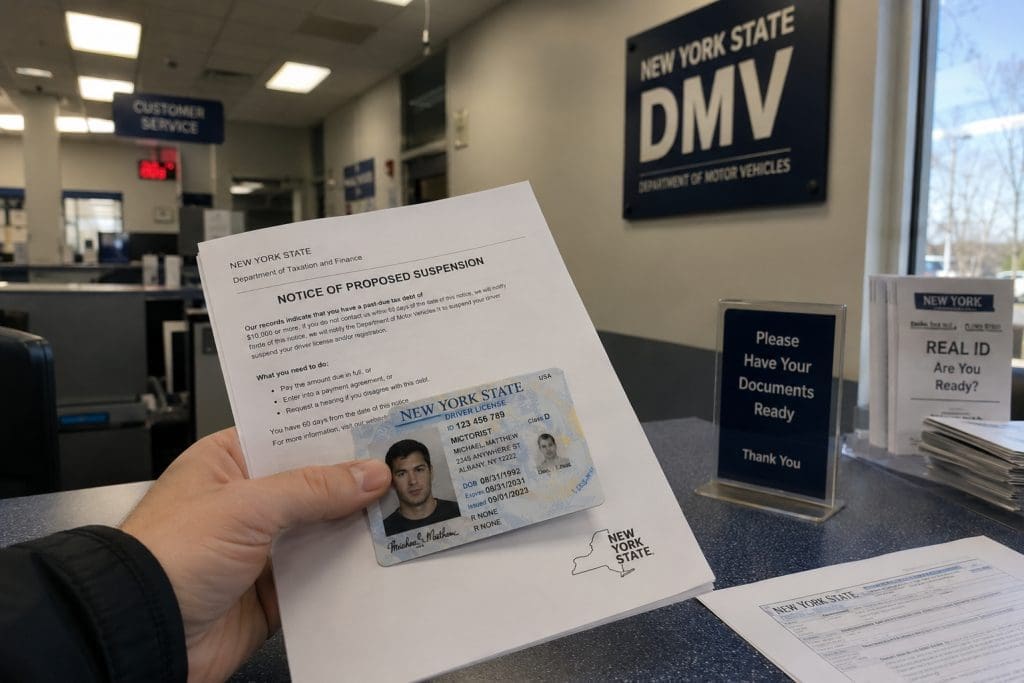

In the United States, a driver’s license is more than personal mobility. For millions of workers — especially in transportation and logistics — it is an essential work tool. That is why New York’s policy allowing driver’s license suspensions over unpaid state tax debt is raising concerns among truck drivers, delivery workers, and freight-related employees.
Under the policy, any resident with overdue state tax debt of $10,000 or more may face license suspension.
Although the measure has existed for years, its impact is drawing renewed attention amid inflation, rising operating costs, and growing financial pressure on independent workers and small carriers.
For the logistics industry, the issue is far from minor.
When Losing a License Means Losing a Job
In sectors such as trucking, delivery, construction, and passenger transportation, a driver’s license is at the center of daily operations. A suspension can immediately stop someone from working.
The policy particularly affects people who rely on a vehicle to generate daily income.
For commercial drivers holding a CDL (Commercial Driver’s License), the consequences may be even more serious.
Many transportation companies routinely monitor drivers’ records. A suspended license can quickly become a compliance issue, affect insurance coverage, or even lead to job loss and canceled contracts.
For owner-operators and independent contractors, the financial risks are even greater. A driver pulled off the road because of a suspension may temporarily lose access to loads, deliveries, and scheduled routes while also facing additional penalties.
Driving with a suspended license can also result in more severe legal consequences, including fines, criminal charges, and vehicle impoundment.
In other words, a tax issue can rapidly turn into an operational and employment crisis.

How the Suspension Process Works
The process begins when a taxpayer receives a “Notice of Proposed Suspension” issued by the New York State Department of Taxation and Finance.
From that moment, the individual has 60 days to respond before the case is referred to the Department of Motor Vehicles (DMV), which can officially suspend the license.
One of the most important aspects of the system is that many suspensions occur simply because people ignore official notices or fail to respond within the required timeframe.
For transportation workers who spend long hours on the road, this can become a recurring issue. Address changes, missed notifications, or delayed paperwork responses can accelerate the process before the driver fully understands the seriousness of the situation.
The procedure applies exclusively to overdue state tax debt and does not include mortgages, credit cards, or personal loans.
The Impact on Hispanic Workers and Urban Transportation
The impact may be particularly significant within New York’s Hispanic community.
This is closely tied to the labor structure of many U.S. cities, where a large portion of delivery drivers, private transportation operators, construction workers, and urban service employees come from immigrant communities.
Over the past several years, app-based delivery and transportation platforms have expanded rapidly in cities such as New York. Many workers operate as independent contractors and rely entirely on an active driver’s license to maintain daily income.
A suspension does not only affect someone’s ability to work. It can also disrupt rent payments, insurance obligations, fuel expenses, and vehicle maintenance costs.
Civil rights organizations have also warned that measures like these may deepen existing financial difficulties among vulnerable workers.
The Good News: Suspensions Are Not Permanent
Unlike some other administrative penalties, these suspensions can be reversed.
According to the Department of Taxation and Finance, drivers may recover their licenses if they:
- pay the debt in full,
- enter into a payment agreement,
- or prove the debt is inaccurate.
The state also allows monthly payment plans adjusted to the taxpayer’s financial situation.
For many drivers, these alternatives may be critical to avoiding the loss of their ability to work.
However, specialists recommend acting quickly and not waiting for the DMV to formally enforce the suspension.
What Professional Drivers Should Do
For transportation workers and CDL operators, the situation also serves as a reminder of how important it is to keep both documentation and tax obligations under control. Key recommendations include:
- Keeping contact information updated with state agencies.
- Regularly reviewing tax and administrative notices.
- Resolving pending tax disputes quickly.
- Responding to official notices before deadlines expire.
- Avoiding driving if the license has already been suspended.
In an industry where every day off the road means lost revenue, an administrative suspension can create far greater consequences than many drivers initially expect.
And at a time when transportation and logistics are already dealing with higher costs, tighter regulations, and operational uncertainty, the status of a driver’s license can become just as critical as truck maintenance or fuel prices.
 Business hours: Monday to Friday from 8:00 AM to 5:00 PM. California time