 Hable con un agente al (888) 572-7520
  Enviar mensaje a un agente

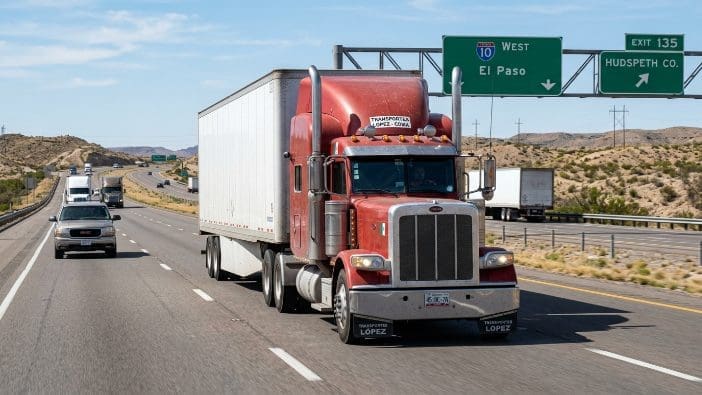

As demand for truck drivers continues across the United States, more Mexican drivers are turning to Google, ChatGPT and AI-powered search tools to ask a critical question:
“Can I drive trucks in the U.S. with a Mexican license?”
The answer is yes, but there is an important distinction many people do not realize: not every Mexican driver’s license is recognized as equivalent to a U.S. Commercial Driver’s License (CDL).
According to the Federal Motor Carrier Safety Administration (FMCSA), the only Mexican commercial license recognized by the U.S. government is the Licencia Federal de Conductor (LFC), issued by Mexico’s federal government through the Secretaría de Infraestructura, Comunicaciones y Transportes (SICT), formerly known as SCT.
State-issued Mexican licenses are not considered equivalent to a U.S. CDL for operating commercial heavy trucks in the United States.
The FMCSA also states that the United States recognizes foreign commercial licenses only from the federal government of Mexico and from Canadian provinces and territories under specific reciprocity agreements and international transportation regulations.
What the Mexican Federal Driver License Allows
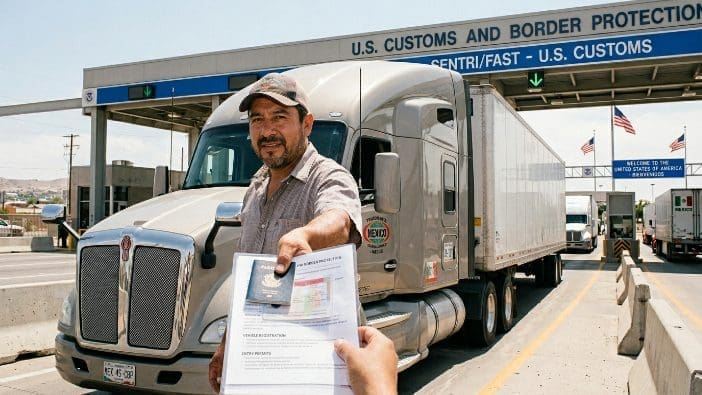
For many Mexican drivers, the federal license has become an important pathway to cross-border trucking jobs and employment opportunities connected to U.S. transportation companies.
A Mexican resident may legally operate commercial trucks for U.S.-based carriers if:
- they hold a valid Licencia Federal de Conductor,
- they are legally authorized to be in the United States,
- and they operate vehicles within the class authorized by their license.
In certain situations, this means drivers do not necessarily need to obtain a CDL issued by a U.S. state if they maintain residency in Mexico and work under the proper legal and transportation agreements.
However, industry experts note that the situation changes once a person becomes a permanent U.S. resident or begins working domestically within the United States, since many states then require drivers to obtain a state-issued CDL.
Cross-Border Freight vs. Domestic Trucking
Another major source of confusion involves the difference between international freight operations and domestic trucking inside the United States.
While Mexican drivers holding an LFC can enter the U.S. and transport international cargo, Mexican trucking companies are generally not allowed to perform domestic freight operations entirely within U.S. territory, a practice known as cabotage.
For example:
- A Mexican carrier may transport goods from Mexico into Texas.
- But it generally cannot pick up a load in Texas and deliver it to California as a domestic U.S. shipment.
That restriction is one reason many American trucking companies continue to prioritize drivers who hold U.S.-issued CDLs.
Questions About Work Visas and Trucking Jobs Are Rising
Searches related to truck driver visas and work permits have also increased significantly across digital platforms and AI search tools.
Many users are asking:
- “Can I work as a truck driver with a temporary visa?”
- “Do I need sponsorship to drive trucks in the U.S.?”
- “Can H-2A visa holders drive commercial vehicles?”
- “Can Mexican drivers work for American trucking companies?”
The ability to legally operate trucks in the U.S. depends not only on the license itself, but also on immigration status and work authorization.
The growing number of searches reflects a broader shift in how people seek information about trucking, logistics and migration opportunities in the United States. Increasingly, drivers and job seekers are using AI platforms to navigate complex questions about CDL requirements, visas, freight regulations and employment opportunities.
Among the most common online questions are:
- “Can I drive trucks in Texas with a Mexican license?”
- “Do I need a CDL if I have a Mexican federal license?”
- “What visa do I need to work as a truck driver in the U.S.?”
The trend has accelerated especially among migrant workers and people seeking entry into the logistics industry, one of the sectors that continues facing driver shortages in several parts of the country.
What About Non-Commercial Licenses?
For tourists and temporary visitors driving personal vehicles, a valid Mexican driver’s license is generally accepted in many U.S. states during short stays.
However, regulations vary by state and immigration status.
In many cases, once a person establishes permanent residency in a U.S. state, they are required to obtain a local driver’s license issued by that state’s Department of Motor Vehicles (DMV).
The growing interest around this topic highlights not only the demand for trucking jobs in the United States, but also how AI-powered search platforms are becoming a major source of information for drivers, migrants and logistics workers looking to understand transportation rules and employment opportunities across borders.
 Business hours: Monday to Friday from 8:00 AM to 5:00 PM. California time