 Hable con un agente al (888) 572-7520
  Enviar mensaje a un agente

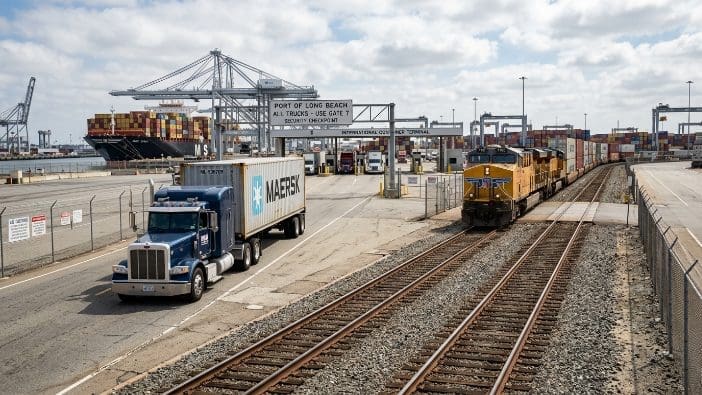

The U.S. government has introduced the new 2026 National Freight Strategic Plan (NFSP), a federal roadmap designed to modernize the nation’s freight transportation system over the next five years.
The plan was announced by Transportation Secretary Sean P. Duffy, who argued that the country must adapt its infrastructure to an economy increasingly driven by logistics, e-commerce, domestic manufacturing and energy production.
The strategy focuses on upgrading a multimodal freight network — including highways, railroads, ports, waterways and airports — that moves more than 54 million tons of goods worth approximately $68 billion every single day.
The announcement comes at a critical moment for the U.S. logistics system. In recent years, the country has experienced a sharp increase in freight movement fueled by e-commerce growth, post-pandemic industrial recovery and reshoring policies aimed at bringing manufacturing operations back to American soil.
According to federal data cited in the plan, the construction of manufacturing facilities has doubled since 2021, while domestic energy production has reached record highs. That expansion has created additional pressure on already congested freight corridors, particularly in industrial and port-heavy states such as Texas, California, Illinois, Georgia and New Jersey.
Although the official document presents the initiative as a way to strengthen U.S. competitiveness, infrastructure and transportation experts warn that modernizing the freight network involves structural challenges far beyond building new roads or terminals.
Infrastructure Under Pressure
One of the largest concerns is the deteriorating condition of American highways and bridges. The American Society of Civil Engineers (ASCE) has estimated in recent reports that more than one-third of U.S. roads are in poor or mediocre condition, while thousands of bridges require repair or replacement. Those deficiencies directly impact freight transportation by increasing delays, operational costs and safety risks.
At the same time, the trucking industry continues to struggle with a persistent driver shortage. Despite some economic slowdown, the lack of professional truck drivers remains a major issue across the sector. The American Trucking Associations (ATA) has repeatedly warned about a shortage of tens of thousands of drivers, driven by an aging workforce, difficult working conditions and high turnover rates.
The new federal plan partially addresses that concern by including workforce development among its six strategic priorities. The document calls for building a “21st-century skilled workforce,” including improved training, technological adaptation and better quality of life for transportation and logistics workers.
Cargo Theft and Supply Chain Security
Another key focus of the NFSP is supply chain security. Over the past several years, the United States has experienced a significant rise in cargo theft, especially across freight corridors in California, Texas and the Chicago metropolitan area. Transportation companies and insurers have increasingly warned about organized crime groups targeting freight shipments, a trend that has intensified alongside the growth of e-commerce and warehouse distribution networks.
The Department of Transportation argues that stronger infrastructure and new technologies could help reduce vulnerabilities and improve cargo traceability. However, analysts note that addressing freight theft will also require stronger law enforcement coordination, updated regulations and greater cybersecurity investment as logistics operations become more digitalized.
The plan also places strong emphasis on the energy sector. Federal officials believe a more efficient freight system will be essential to sustaining growth in domestic oil, gas and alternative energy production. The United States remains one of the world’s largest producers of oil and natural gas, while the expansion of industrial centers and energy projects continues increasing demand on rail corridors, maritime terminals and interstate highways.
At the same time, the initiative reflects how geopolitical tensions and global trade disruptions are reshaping Washington’s logistics priorities. The pandemic, supply chain crises and international conflicts exposed the fragility of heavily Asia-dependent supply networks. In response, the United States has accelerated policies designed to strengthen domestic manufacturing capacity and reduce strategic vulnerabilities.
Six Strategic Goals
Among the NFSP 2026’s primary objectives are:
- reducing fatalities and serious injuries within the freight system;
- improving transportation efficiency and reliability;
- strengthening supply chain security;
- increasing resiliency against crises and disasters;
- promoting innovative technologies;
- developing a specialized workforce.
The document also highlights the need to streamline regulations and accelerate infrastructure projects, an issue likely to spark political and environmental debates in the coming years, especially regarding oil, gas and industrial expansion initiatives.
Meanwhile, logistics companies, rail operators, port authorities and manufacturers will be closely watching how the plan is implemented. The sheer scale of America’s freight system — nearly seven million miles of infrastructure — means that any modernization effort will require massive investment, coordination among states and long-term execution timelines.
The full 2026 National Freight Strategic Plan is available at:
 Business hours: Monday to Friday from 8:00 AM to 5:00 PM. California time