 Hable con un agente al (888) 572-7520
  Enviar mensaje a un agente


For years, the tech industry pushed a narrative that seemed almost inevitable: artificial intelligence would rapidly replace millions of jobs. CEOs, investors, and major technology companies repeatedly claimed that administrative work, customer service positions, and many office roles would soon disappear as generative AI systems became more advanced.
But now, one of the most influential figures in the industry is beginning to change the conversation.
OpenAI CEO Sam Altman recently said during a conference in Sydney that he no longer believes AI will cause a near-term “job apocalypse.” He even admitted that he expected the impact on junior and administrative positions by 2026 to be far greater than what has actually happened so far.
The shift in tone immediately drew attention across Silicon Valley. Not only because OpenAI played a central role in promoting the idea of large-scale automation, but also because Altman’s comments come at a time when the AI industry is facing enormous financial pressure, growing operational costs, and increasingly cautious investors.
For years, the promise that AI would replace workers helped justify massive valuations and billions of dollars in investment. If a technology can eliminate entire departments, investors are willing to pay extraordinary amounts to be part of the business. But when reality shows that humans are still essential, those expectations begin to change.
The Problem Many Companies Are Discovering
One of the biggest concerns emerging inside the tech sector is that replacing employees with AI is not always cheaper.
Bryan Catanzaro, Vice President of Applied Deep Learning at Nvidia, recently acknowledged that the computing power required to operate advanced AI models can cost more than many human salaries.
The issue becomes especially clear in industries where human interaction still matters. Customer service, technical support, sales, administration, and business relationships continue to depend heavily on real people, even as automated assistants become increasingly sophisticated.
Several companies experimented with layoffs supported by AI systems, only to run into operational problems, customer complaints, and internal overload.
One of the most discussed cases happened in Australia. Commonwealth Bank attempted to replace part of its customer service workforce with AI-powered voicebots. The company expected the technology to reduce thousands of weekly calls. Instead, the opposite happened: complaints increased, resolution times worsened, and managers reportedly had to answer customer calls themselves to deal with the overflow.
Eventually, the bank was forced to bring employees back and admit it had underestimated the value of human interaction in complex situations.
The episode became an important warning sign for the entire market: full automation still faces major limitations when empathy, communication, and unstructured problem-solving are involved.
AI Infrastructure Is Costing Billions
Another factor reshaping the AI conversation is the enormous cost of infrastructure.
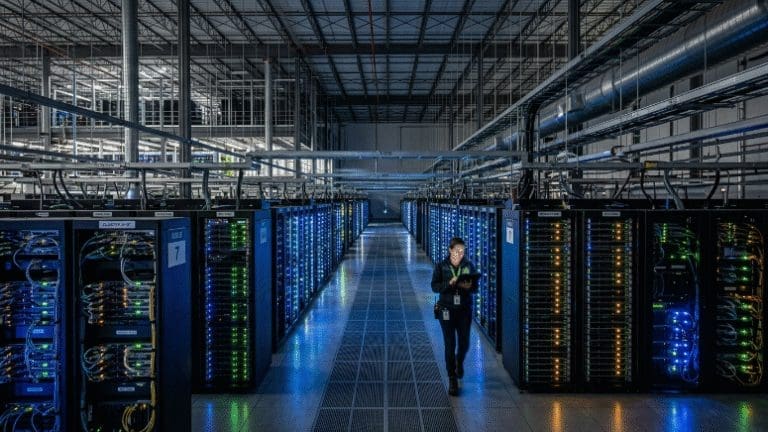
Advanced AI models require massive data centers, highly specialized chips, permanent cooling systems, and extremely high energy consumption. Companies such as Microsoft, Google, Amazon, and OpenAI are investing billions of dollars simply to maintain the infrastructure needed to train and operate these systems.
The problem is that many businesses are beginning to realize that automating simple tasks with AI can actually cost more than keeping traditional human teams — especially when the systems require constant supervision or produce frequent errors.
There is also another reality behind artificial intelligence that is often ignored: many AI systems still rely heavily on human labor behind the scenes. Moderators, data trainers, reviewers, and human operators remain essential for correcting outputs, improving responses, and preventing failures.
In other words, AI often does not eliminate jobs entirely — it changes the kind of work people do.
The Labor Market Has Not Collapsed
While some forecasts predicted that AI would destroy millions of jobs within a few years, economic data tells a far more moderate story.
A report from the Yale Budget Lab analyzed the impact of AI on the U.S. labor market since 2023 and concluded that there is still no clear evidence of large-scale job destruction directly caused by artificial intelligence.
Even sectors considered “highly exposed” to automation have not shown significantly worse deterioration than the rest of the economy.
That does not mean AI is not transforming industries. It clearly is. But the process appears far slower, more expensive, and more complicated than Silicon Valley promised just two years ago.
Artificial intelligence is already changing workflows, accelerating repetitive tasks, and reshaping how companies operate. However, the vision of fully automated offices and mass worker replacement still appears to be a long way off.
Silicon Valley Is Starting to Recalibrate
Sam Altman’s shift in tone reflects something many technology companies are quietly beginning to accept: artificial intelligence will likely transform the labor market, but not in the sudden and total way that was originally predicted.
Full automation still faces economic, technical, and human limitations.
And as the cost of operating AI systems continues to rise, more companies are discovering something unexpected: in many cases, human workers are still more efficient, more adaptable — and ultimately, less expensive.
 Business hours: Monday to Friday from 8:00 AM to 5:00 PM. California time