 Hable con un agente al (888) 572-7520
  Enviar mensaje a un agente



The J. J. Keller Center for Market Insights has completed its sixth annual study analyzing the evolving challenges facing fleet management. These findings serve as a key resource for the industry, providing a clearer view of fleet managers’ priorities and pressures, enabling more informed discussions and better outcomes for the future.
According to the Center, throughout the six years this research has been conducted, the issues that have consistently represented major challenges for fleet managers have been: driver training, compliance with the Federal Motor Carrier Safety Administration (FMCSA), overall safety, new vehicle technologies, vehicle maintenance, and company expense management.
However, as fleets increasingly focus on prevention and visibility, managers have reported notable year-over-year increases across three categories:
- FMCSA compliance
- Vehicle maintenance
- Driver knowledge and skills
“In 2026, fleets are deliberately shifting from reactive solutions to prevention, visibility, and early intervention—a practical response to tight margins and the high cost of a preventable crash, regulatory violation, or equipment failure,” said Daren Hansen, Senior Regulatory Compliance Specialist at J. J. Keller & Associates, Inc., in the company’s official report.
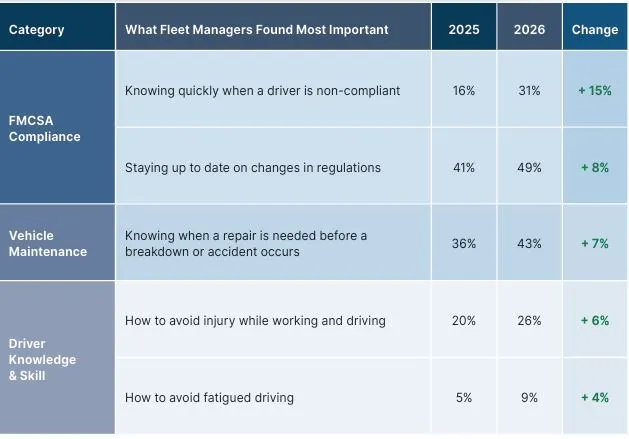
Top Concerns for Fleet Managers
The survey was conducted from January 7 to January 22, 2026, and included 550 unique respondents. Eighty-six percent work in fleets with fewer than 100 trucks, and 64% work in fleets with 25 trucks or fewer.
1. FMCSA Compliance
In 2026, there was a 15% increase in the number of respondents who identified quickly determining whether a driver is compliant as their top concern regarding FMCSA regulations. The analysis indicates that regulatory oversight and real-time compliance visibility are defining themes for 2026.
While maintaining accurate records remains important, fleet managers are shifting their focus toward immediately identifying non-compliant drivers and understanding how regulatory changes affect daily operations. This reflects a broader industry trend moving from documentation toward rapid detection and corrective action.
2. Driver Knowledge and Skills
The ability to safely and properly operate a specific type of vehicle remains the most important driver competency, according to the analysis (30%). However, attention is shifting toward distraction prevention (29%) and injury prevention (26%). According to J. J. Keller & Associates, Inc., this suggests that fleets are doubling down on practical, high-frequency risks while reinforcing fundamental habits that reduce incidents across all vehicle types and operating environments.
Additionally, in 2026 the primary training priority is providing instruction that develops fully qualified, compliant drivers. At the same time, there has been a notable decrease in emphasis on ensuring that drivers apply what they learn and on tasks involving large amounts of documentation.
3. Vehicle Maintenance
Finally, the analysis indicates that maintenance priorities in 2026 continue to focus on prevention and early detection. Fleets are prioritizing routine preventive maintenance and identifying repair needs before they result in breakdowns or out-of-service (OOS) situations.
At the same time, the urgency surrounding immediate damage detection has declined compared with 2025, indicating a shift toward long-term vehicle reliability rather than reactive repairs.

Visible Leadership Alignment
Fleet managers continue to operate under constant pressure, although the intensity has eased slightly compared with the previous year. Sixty-seven percent describe their role as either very or moderately challenging. Day-to-day operations remain busy and complex, though somewhat less intense than last year.
However, respondents prioritize ensuring that employees feel valued, that safety comes first above all else, and that safe decisions are made consistently across all scenarios. The 2026 focus reflects the belief that a stronger safety culture—and visible alignment from leadership—drives more reliable day-to-day safety decisions than policies alone.
 Business hours: Monday to Friday from 8:00 AM to 5:00 PM. California time