 Hable con un agente al (888) 572-7520
  Enviar mensaje a un agente

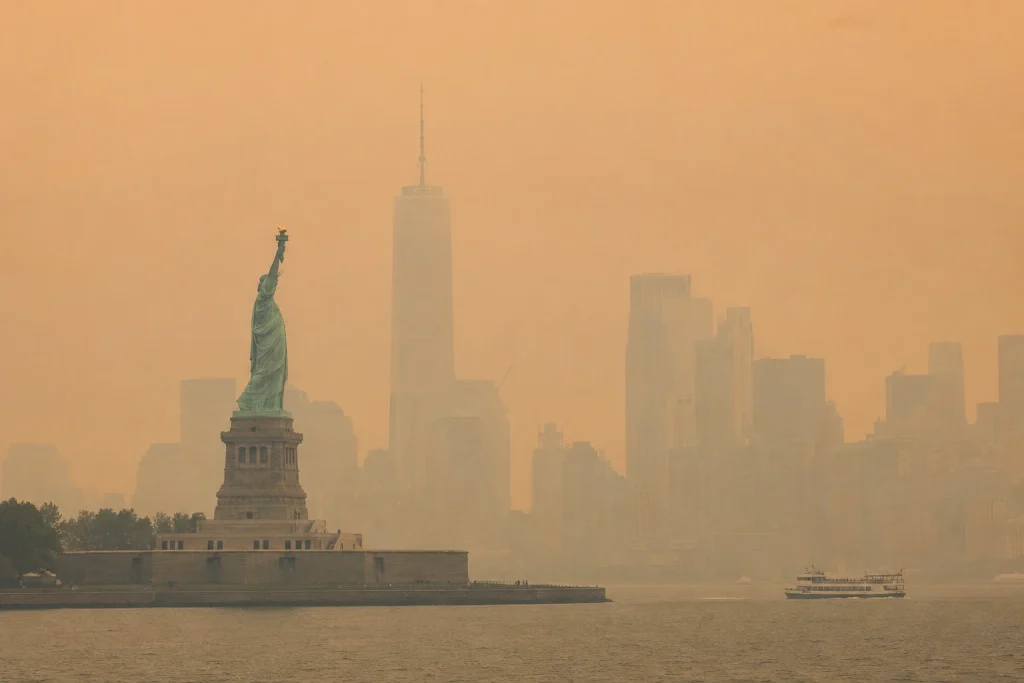

With only two days remaining before the 2026 FIFA World Cup Final, smoke drifting south from Canada’s massive wildfire season has become both a public health concern and a logistical challenge across the northeastern United States.
Argentina and Spain are scheduled to meet on Sunday, July 19, at 3:00 p.m. ET at New York New Jersey Stadium in East Rutherford, New Jersey, in front of more than 82,500 fans. The match will be the 104th and final game of a tournament that featured 48 national teams competing across 16 host cities in the United States, Canada, and Mexico.
In the days leading up to the championship, however, a massive plume of wildfire smoke spread from Canada into the American Midwest and Northeast, affecting cities including Chicago, Detroit, Philadelphia, and New York.
The smoke has reduced visibility, increased concentrations of fine particulate matter, and prompted health officials to urge residents to limit outdoor activities.
As wildfire smoke continues to blanket the region, a hazy, blood-red sun hangs beside the Chrysler Building in New York City. pic.twitter.com/66eZxMRMCO
— The Weather Channel (@weatherchannel) July 16, 2026
More Than 800 Active Wildfires Across Canada
According to the Canadian Interagency Forest Fire Centre (CIFFC), Canada was battling approximately 836 active wildfires by mid-July, with more than 3,400 fires reported since the beginning of the year.
The fires had already burned nearly 1.9 million hectares, an area larger than many U.S. states combined. Canada’s National Preparedness Level remained at Level 4 out of 5, indicating exceptionally high demand for firefighters, aircraft, and emergency resources nationwide.
Many of the largest fires have been concentrated in western Ontario. Prevailing winds carried smoke southeast across the border, allowing fine particles to settle near the surface throughout portions of the northeastern United States.
Breathing NYC's smoky air is equal to puffing 10 whole cigarettes, expert warns https://t.co/7znoARIY8o pic.twitter.com/LgPF30i78a
— New York Post (@nypost) July 16, 2026
New York Air Quality Reaches Unhealthy Levels
The New York City Emergency Management Department confirmed that smoke from the Canadian wildfires mixed with surface-level air, pushing air quality into unhealthy ranges across portions of the metropolitan area.
On Thursday, July 16, forecasts projected an Air Quality Index (AQI) of up to 200, driven primarily by elevated concentrations of PM2.5 fine particulate matter.
An AQI between 151 and 200 falls within the “Unhealthy” category, meaning even healthy individuals may begin experiencing adverse health effects—not just sensitive populations.
In response, New York City kept hundreds of cooling centers open and began distributing KN95 masks through more than 200 libraries, transit hubs, police precincts, and fire stations.
Officials advised residents to:
- Stay indoors whenever possible.
- Limit strenuous outdoor activity.
- Keep doors and windows closed.
- Set air-conditioning systems to recirculation mode.
The smoke event has been compounded by a regional heat wave, creating additional strain on the respiratory and cardiovascular systems.
Why Wildfire Smoke Is Dangerous
🚨🇺🇸 New York has been engulfed in smoke from the Canadian wildfires just TWO DAYS before the World Cup final. 🌫️😳
— Football Tweet ⚽ (@Footballtweet) July 17, 2026
⚠️ Authorities are urging residents to avoid going outside unless it is absolutely necessary. pic.twitter.com/aO6dgHFTE0
The greatest health risk comes from PM2.5, microscopic particles measuring less than 2.5 microns in diameter—roughly 30 times smaller than the width of a human hair.
These particles penetrate deep into the lungs and can enter the bloodstream.
New York was covered in smoke from wildfires in Canada
— NEXTA (@nexta_tv) July 17, 2026
A thick layer of smog blanketed the city’s sky, while the smell of burning spread through the streets. A massive smoke plume from large-scale wildfires in neighboring Canada covered a huge area and worsened air quality.
New… pic.twitter.com/3cEwU0icJC
Exposure may cause:
- Eye and throat irritation
- Persistent coughing
- Difficulty breathing
- Headaches
- Fatigue
- Reduced concentration
Wildfire smoke can also worsen asthma, chronic obstructive pulmonary disease (COPD), and cardiovascular conditions.
Children, older adults, pregnant women, and people with heart or lung disease remain the most vulnerable. However, once AQI levels exceed 150, health officials warn that even otherwise healthy people may develop symptoms.
Unlike typical urban pollution, wildfire smoke contains not only burned vegetation but also soil, biological material, plastics, fuels, metals, vehicles, and structural debris consumed by the fires, making its chemical composition significantly more complex.
A World Cup Final Expected to Draw More Than 80,000 Fans
The situation raises additional concerns because New York New Jersey Stadium is an open-air venue and will host more than 82,500 spectators on Sunday afternoon.
Beyond the fans inside the stadium, the event will generate enormous traffic from suppliers, vendors, broadcasters, emergency personnel, hospitality workers, and transportation providers throughout the weekend.
Roadways, airports, bridges, tunnels, and public transit systems across New York and New Jersey are expected to experience significantly heavier-than-normal demand.
Supporting an event of this scale requires continuous deliveries of food, beverages, audiovisual equipment, official merchandise, medical supplies, fuel, and security resources.
Any reduction in visibility or workforce health can directly affect scheduled freight operations.
Expert warns that breathing New York City’s smoke-filled air is equivalent to smoking 10 cigarettes. pic.twitter.com/dxy7J7a1LD
— Breaking911 (@Breaking911) July 16, 2026
Freight Transportation Faces Additional Challenges
For commercial truck drivers, prolonged exposure to wildfire smoke may cause respiratory irritation, headaches, fatigue, and reduced alertness—conditions that can compromise safe driving during long shifts.
Smoke can also sharply reduce visibility, decreasing reaction time when approaching congestion, crashes, or disabled vehicles.
The busiest freight corridors expected to experience increased pressure this weekend include:
- I-95
- New Jersey Turnpike
- I-80
- I-78
- Garden State Parkway
- George Washington Bridge approaches
- Lincoln Tunnel
- Holland Tunnel
Heavy event traffic is also expected around East Rutherford, Secaucus, Newark, and Manhattan.
Wildfire smoke can affect vehicle performance as well. Fine particles accumulate inside air filters, radiators, and HVAC systems. During extended smoke events, fleets may require more frequent inspections and filter replacements to maintain engine efficiency and cab air quality.
Recommendations for Fleets and Drivers
As wildfire smoke combines with extraordinary World Cup traffic, trucking companies and drivers should consider several precautions:
- Check local AQI forecasts before every trip. Air quality can change rapidly as wind patterns shift.
- Keep windows closed and use cabin air in recirculation mode whenever possible.
- Wear N95 or KN95 respirators when working outside the truck. Cloth or surgical masks do not adequately filter PM2.5 particles.
- Minimize time spent loading and unloading outdoors whenever operationally possible.
- Schedule breaks indoors. Drivers experiencing headaches, dizziness, breathing difficulties, or severe irritation should seek clean indoor air immediately.
- Increase following distance, especially in areas where visibility may deteriorate quickly.
- Inspect cabin air filters and ventilation systems regularly during prolonged smoke exposure.
- Avoid stadium access routes during peak arrival and departure periods on Sunday whenever possible.
- Maintain constant communication between dispatchers and drivers regarding changing traffic conditions, air quality alerts, and local restrictions.
The 2026 FIFA World Cup Final will place New York and New Jersey at the center of the sporting world. But while Argentina and Spain compete for soccer’s biggest prize, thousands of freight carriers will be navigating one of America’s busiest transportation corridors under a blanket of wildfire smoke drifting south from Canada.
Contact us with any questions about insurance
 Business hours: Monday to Friday from 8:00 AM to 5:00 PM. California time