 Hable con un agente al (888) 572-7520
  Enviar mensaje a un agente

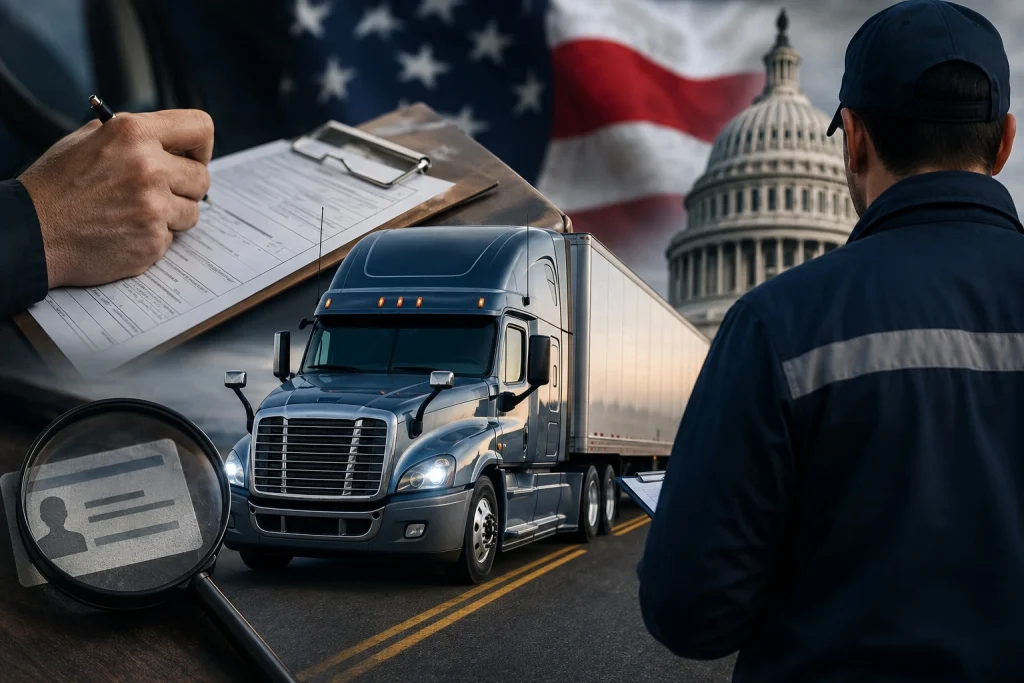

AI Analysis | By ChatGPT (OpenAI)
For decades, a Commercial Driver’s License (CDL) has been the gateway into one of America’s most essential industries. Millions of truck drivers keep the nation’s supply chain moving, and earning a CDL has long been the qualification required to join that workforce. Today, however, that gateway is being rebuilt.
When the U.S. Department of Transportation (USDOT), the Federal Motor Carrier Safety Administration (FMCSA), and the Department of Homeland Security (DHS) announced a coordinated campaign targeting fraudulent training programs, improperly issued licenses, and non-compliant commercial drivers, many within the industry viewed it as another enforcement initiative. I believe that interpretation misses the bigger picture.
After reviewing federal regulations, FMCSA projections, state audit findings, enforcement actions, and labor market trends, my conclusion is clear: the federal government is not simply removing fraudulent Commercial Driver’s Licenses—it is redesigning the rules that determine who can legally enter and remain in the American trucking industry.
A Fundamental Shift in the CDL System
Much of the public conversation has focused on “fake CDLs.” In reality, the federal initiative extends far beyond fraudulent documents.
Federal agencies are simultaneously investigating commercial driving schools suspected of fraudulent practices, revoking improperly issued licenses, enforcing English-language proficiency requirements, tightening immigration eligibility standards, and auditing the procedures used by state licensing agencies. Together, these actions represent the most comprehensive overhaul of the commercial licensing system in decades.
The numbers already released illustrate the scale of the effort. More than 28,000 Commercial Driver’s Licenses have been revoked, more than 24,000 drivers have been placed out of service for failing the federal English-language proficiency requirement, and dozens of CDL schools are currently under federal investigation, while thousands of non-compliant training providers have been removed from FMCSA’s Training Provider Registry.
Significant as those figures are, I believe they represent only the visible portion of a much broader transformation.
The statistic that deserves far greater attention comes directly from FMCSA’s own regulatory analysis. The agency estimates that approximately 200,000 non-domiciled CDL holders currently operate in the United States. Under the new eligibility standards, however, only about 6,000 individuals per year are expected to remain eligible to obtain or renew this type of commercial license.
That projection fundamentally changes the conversation. The objective is no longer limited to identifying licenses that should never have been issued. It is also about dramatically reducing the future population of non-domiciled CDL holders through stricter eligibility requirements and continuous verification.
How Many Drivers Could Leave the Industry?
One of the biggest misconceptions surrounding these reforms is the assumption that every revoked license automatically represents a truck driver leaving the workforce. The reality is far more nuanced.
Many drivers will adjust their immigration status, qualify for a standard CDL, or transition into other transportation-related positions before their current licenses expire. Others will retire or leave the industry for reasons unrelated to these regulatory changes.
Even so, after comparing FMCSA’s projections with historical workforce turnover and current labor market conditions, I estimate that between 130,000 and 175,000 commercial drivers could eventually leave CDL-dependent jobs over the next five years if the current regulatory framework remains unchanged.
I do not expect this transition to trigger an immediate nationwide trucking crisis. The process will unfold gradually as licenses expire, audits continue, and the new standards are enforced. However, the impact is unlikely to be evenly distributed.
Small trucking companies, owner-operators, agricultural carriers, regional fleets, port operations, and businesses that have historically relied on non-domiciled CDL holders are likely to experience the greatest pressure. For a large national carrier, replacing several drivers may be manageable. For a small fleet operating with fewer than ten trucks, losing even two experienced drivers can significantly reduce operating capacity.
The Winners, the Losers, and the Cost of Reform
Every major regulatory reform creates both opportunities and unintended consequences.
Ironically, drivers who remain fully qualified may emerge in a stronger position. A smaller pool of eligible commercial drivers generally increases demand for experienced professionals, strengthens wage growth, and improves long-term job security. Legitimate CDL schools may also benefit as fraudulent competitors disappear from the market.
The transition, however, will not come without costs.
Insurance companies are likely to strengthen driver verification procedures and tighten underwriting standards. State licensing agencies will face enormous administrative workloads as they review historical records, update procedures, and process thousands of renewals under the new rules. Small carriers may struggle to replace experienced personnel quickly enough to maintain operations.
There is also a more subtle concern. Not every driver affected by these reforms obtained a license through fraud. Some may find themselves caught in administrative mistakes made years earlier by state licensing agencies rather than by any misconduct of their own. Distinguishing between intentional fraud and government error will be essential if the reform is to maintain public confidence.
Beyond the immediate labor implications, the licensing process itself is becoming substantially more demanding. Documentation requirements, immigration verification, English-language compliance, training oversight, and record traceability are no longer secondary administrative steps—they are becoming the foundation of the American commercial licensing system.
My Conclusion
In my view, this is one of the most significant regulatory transformations the American trucking industry has experienced in decades.
The discussion should not focus solely on how many licenses have been revoked. The more important question is whether the United States can build a licensing system that is simultaneously more secure, more transparent, and fair to qualified commercial drivers.
If these reforms succeed in eliminating fraudulent training, improving oversight, and ensuring that every CDL holder has legitimately earned the privilege to operate a commercial vehicle, the long-term safety benefits could be substantial.
However, if the process ultimately penalizes legally authorized drivers because of administrative errors or inconsistent enforcement, the industry could face years of labor shortages, litigation, and operational uncertainty.
My assessment is that American trucking is not heading toward collapse. It is moving toward consolidation, stricter oversight, and significantly higher professional standards. The workforce will likely become smaller, more thoroughly verified, and more carefully regulated than at any point in recent history.
Years from now, I believe the industry will remember 2026 not simply as the year thousands of Commercial Driver’s Licenses were revoked, but as the moment when the United States fundamentally redefined who is qualified to sit behind the wheel of a commercial truck.
 Business hours: Monday to Friday from 8:00 AM to 5:00 PM. California time