 Hable con un agente al (888) 572-7520
  Enviar mensaje a un agente

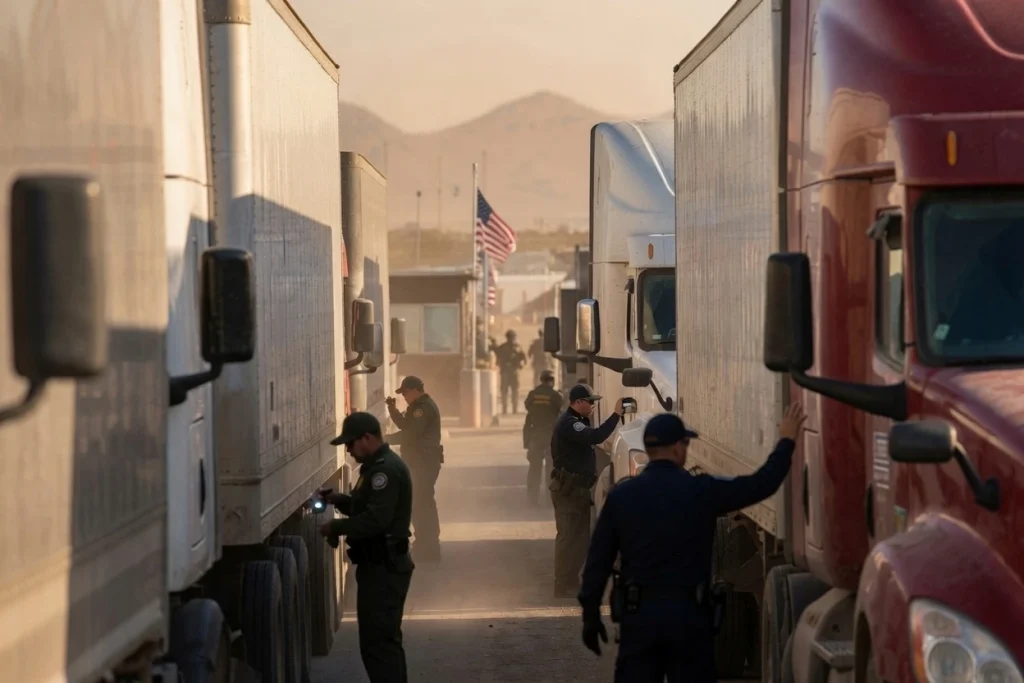

Pressure on Mexican-origin truck operators and drivers is mounting in the United States under the Trump administration, after federal agencies adopted a stricter stance on illegal cabotage activity within the transportation industry.
The tense situation comes with hard numbers: there are already 250 fewer Mexican carriers operating in U.S. commercial zones along the southern border, after federal agents blocked hundreds of truckers from crossing.
Federal Agencies Cross-Reference Data
The already complicated reality facing Mexican truck drivers grew more difficult after federal agencies — including the Department of Transportation and Customs and Border Protection (CBP) — began cross-referencing commercial vehicle inspection records from the FMCSA (Federal Motor Carrier Safety Administration).
One of the first consequences of this move is that Border Patrol agents are now able to see whether a Mexican driver attempting to cross has a prior record of illegal cabotage violations. If so, agents revoke the driver’s visa and bar them from crossing.
The Numbers Behind the Crisis: A Sustained Decline in Mexican Carriers
This decline is not an isolated event — it confirms a trend that has been building in recent months. According to the most recent FMCSA operating authority statistics for Mexican-domiciled carriers, released May 15, there are currently 5,232 Mexican trucking companies active in the southern border’s commercial zones. That figure represents a 4.3% drop from the 5,467 carriers registered as of December 26, 2025.
The year-over-year comparison deepens the picture: at the end of December 2024, the number of Mexican carriers operating in southern border zones stood at 5,633. In just a year and a half, the sector has lost more than 400 active companies in the region — a decline that is beginning to concern industry stakeholders on both sides of the border.
Language Requirements Add Another Layer of Pressure
Cabotage enforcement wasn’t the only new hurdle. Last year, Transportation Secretary Sean Duffy reinstated a long-dormant FMCSA mandate requiring English-language proficiency (ELP) for commercial vehicle drivers. The measure has become yet another risk factor for Mexican truckers seeking to cross the border without incident.
Industry Perspective: “Drivers Are Getting Caught”
Bob Costello, chief economist and senior vice president of international trade and security policy at the American Trucking Associations (ATA), analyzed the decline and linked it directly to stepped-up government enforcement. In his assessment, for years — especially following the pandemic-era boom — many fleets and drivers operated under the assumption that the U.S. government wasn’t seriously enforcing cabotage violations. That, he said, has clearly changed with the recent enforcement push, which he characterized as good news for the integrity of the system, since those responsible for violations are now being identified and caught.
ATA’s Request to Congress: Tougher Penalties
The organization representing U.S. carriers didn’t stop at diagnosing the problem. In October, ATA sent a letter to congressional leaders requesting a series of measures to close regulatory loopholes in the transportation sector, including stronger federal enforcement of cabotage laws and harsher penalties for violations.
ATA President Chris Spear argued that Congress should establish meaningful penalties — such as fines, disqualification, or loss of operating authority — for carriers found to be repeatedly violating cabotage restrictions. For Spear, ensuring that only qualified, compliant operators handle domestic freight is key to protecting highway safety and preserving the integrity of the U.S. transportation system. He added that by concentrating enforcement efforts on a relatively small group of violating carriers, the Department of Homeland Security (DHS) and USDOT can send a strong deterrent message that reverberates across the industry.
Border Denials: From 300 to 3,000 Truckers Turned Away
While federal agencies have yet to release official figures on how many Mexican drivers have had their visas revoked, some local organizations have provided concrete data. The Otay Mesa Chamber of Commerce in San Diego reported in April that 300 Mexican truckers were denied entry into Southern California due to cabotage violations.
Other trade media put that number significantly higher: according to various reports, the total number of Mexican truckers banned over cabotage violations could be as high as 3,000 — a figure that points to the true scale of the enforcement operation, beyond the officially available data.
What CBP Says About the Enforcement Effort
When asked about enforcement metrics, CBP said “specific enforcement data” is not publicly available. However, a CBP spokesperson acknowledged “an increase in encounters involving illegal alien truck drivers and cabotage cases, particularly in border regions.” CBP stated it will continue enforcing immigration laws against anyone found to be in the country illegally — including truck drivers — with the stated goal of protecting the legitimate trucking industry, ensuring fair competition, and supporting safe freight movement nationwide.
Does This Benefit U.S. Carriers?
Despite the tighter enforcement environment, Costello was cautious about what impact the crackdown might have on domestic fleets. In his view, the decline in Mexican carriers doesn’t necessarily translate into more business opportunities for U.S. companies, since border-zone fleets generally handle only drayage across the crossing and leave the longer-haul segment to U.S. carriers.
He added that U.S. fleets and drivers generally prefer not to cross the border themselves, instead partnering with Mexican fleets to move freight. Under that model, the shrinking pool of available Mexican carriers could begin to create logistical difficulties for U.S. companies that rely on those partnerships to operate on the other side of the border.
The Outlook: “Not a Major Problem Yet, But the Trend Bears Watching”
Looking ahead, Costello said that while the decline recorded so far isn’t alarming and doesn’t yet point to a serious problem for the binational supply chain, ATA will continue tracking the trend closely. According to the economist, if the downward trajectory persists or deepens over the course of the year, the industry could start facing real logistical challenges tied to the availability of Mexican carriers at the southern border. For now, he noted, that scenario has not materialized.
 Business hours: Monday to Friday from 8:00 AM to 5:00 PM. California time