 Hable con un agente al (888) 572-7520
  Enviar mensaje a un agente



Although many people still picture truck drivers shifting gears with a large stick lever, the reality in the United States is very different. Today, most new heavy-duty trucks leave the factory equipped with Automated Manual Transmissions (AMTs), a technology that improves fuel efficiency, reduces operating costs, and makes driving significantly easier. Meanwhile, manual gearboxes continue to be widely used in many other parts of the world.
For decades, mastering a 10-, 13-, or even 18-speed manual transmission was considered an essential skill for professional truck drivers. Smoothly selecting the correct gear without losing momentum was both a necessity and a mark of experience behind the wheel.
That changed dramatically over the past decade.
Today, the majority of new Class 8 trucks sold in the United States come equipped with Automated Manual Transmissions (AMTs). These systems retain the mechanical efficiency of a traditional manual gearbox while electronically controlling both the clutch and gear selection.
In practice, the driver simply accelerates and brakes. The truck automatically selects the appropriate gear based on vehicle speed, payload weight, road grade, fuel efficiency, and even GPS data.
Are They Automatic Like a Car?
Although many drivers simply refer to them as “automatic,” modern heavy-duty trucks generally do not use conventional automatic transmissions.
Instead, they rely on Automated Manual Transmissions (AMTs).
While a passenger car’s automatic transmission uses a hydraulic torque converter, an AMT is fundamentally a traditional manual gearbox operated by computers, sensors, and electronic actuators.
The result is a driving experience that feels similar to an automatic car while maintaining the mechanical efficiency of a manual transmission.
For trucking companies, the advantages are substantial:
- Lower fuel consumption
- Reduced clutch wear
- Less driver fatigue
- More precise and consistent gear changes
What Happens When Taking the CDL Test?
Even though the industry has largely transitioned to automated transmissions, learning to drive a manual truck is still highly recommended.
Many CDL training schools continue teaching both systems because professional drivers may encounter different types of trucks throughout their careers depending on the employer.
The type of transmission used during the CDL skills test can also affect future job opportunities.
Drivers who pass the CDL road test in a manual-transmission truck are authorized to operate both manual and automated vehicles.
However, those who complete the test using an automated transmission receive the “E Restriction,” which prohibits them from operating manual-transmission commercial vehicles until they successfully retake the skills test in a manual truck.
For this reason, many CDL students still invest time learning manual shifting, even though they will likely spend most of their careers driving automated trucks.
Why Did the United States Adopt This Technology So Quickly?
Several factors contributed to the rapid transition.
One of the biggest reasons is the ongoing shortage of professional truck drivers.
By eliminating the complexity of operating multi-speed manual gearboxes, carriers can train new drivers more quickly.
AMTs also make long workdays considerably more comfortable, reducing fatigue, especially in heavy traffic or on routes requiring constant speed changes.
Fuel savings represent another major advantage.
Every perfectly timed shift helps reduce diesel consumption—an important benefit for trucks that often travel more than 150,000 miles per year.
Modern transmissions continuously analyze hundreds of operating parameters to keep the engine running within its most efficient range.
Much of the World Still Uses Manual Transmissions
Although automation continues to expand, manual gearboxes remain common across many regions.
They are still widely used throughout Latin America, Africa, and much of Asia.
The primary reasons include:
- Lower purchase cost
- Greater availability of repair shops
- Simpler mechanical repairs
- Preference among experienced drivers
Europe falls somewhere in between.
Large fleets increasingly operate automated transmissions, but many manual trucks remain in service.
The United States, however, has already completed much of this transition.
Major Fleets Have Already Standardized on AMTs
Large carriers such as Schneider, Werner, Swift, Knight-Swift, and J.B. Hunt have equipped much of their newer fleets with automated manual transmissions.
Automation delivers benefits beyond fuel savings.
It also reduces mechanical wear, simplifies driver training, and improves overall fleet productivity.
Today’s transmission systems select the ideal gear by considering:
- Vehicle weight
- Road grade
- Vehicle speed
- Instant fuel consumption
- GPS information
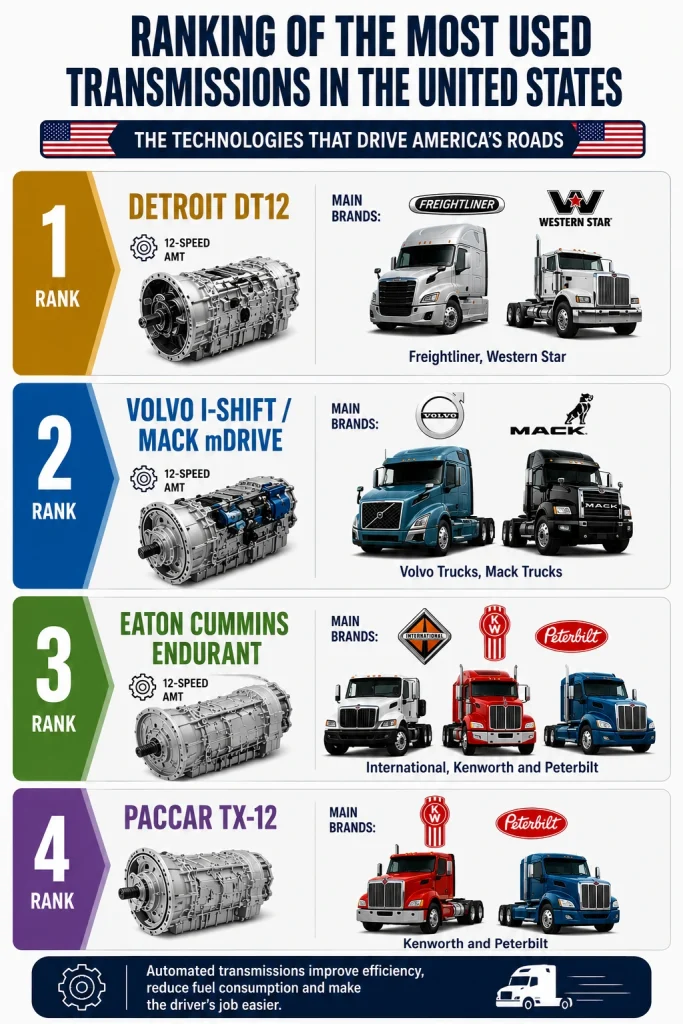
The Four Most Common Truck Transmissions in the United States
1. Detroit DT12
Primary brands: Freightliner and Western Star
The DT12 is the flagship transmission used in the Freightliner Cascadia, America’s best-selling heavy-duty truck.
It is fully integrated with Detroit DD13, DD15, and DD16 engines and includes features such as eCoast, which disengages the drivetrain on gentle downhill grades to save fuel, along with GPS-assisted predictive cruise control.
2. Volvo I-Shift
Primary brands: Volvo Trucks and Mack Trucks (mDRIVE)
Widely regarded as one of the world’s most advanced truck transmissions, the I-Shift includes the I-See system, which memorizes road topography and automatically prepares gear changes before hills and descents, improving fuel economy while reducing engine strain.
3. Eaton Cummins Endurant
Primary brands: International, Kenworth, and Peterbilt
The Endurant is among the most versatile transmissions available in the U.S. market.
Its lightweight aluminum construction, extended maintenance intervals, and broad parts availability have made it a favorite among large commercial fleets.
4. PACCAR TX-12
Primary brands: Kenworth and Peterbilt equipped with PACCAR MX engines
The TX-12 was specifically engineered to work with PACCAR engines.
Features such as Creep Mode and Urge-to-Move allow precise, smooth maneuvering in loading docks and distribution yards, providing a driving experience similar to an automatic passenger vehicle.
Most Popular Truck Transmissions in the United States
| Rank | Transmission | Main Brands |
|---|---|---|
| 1 | Detroit DT12 | Freightliner, Western Star |
| 2 | Volvo I-Shift / Mack mDRIVE | Volvo Trucks, Mack Trucks |
| 3 | Eaton Cummins Endurant | International, Kenworth, Peterbilt |
| 4 | PACCAR TX-12 | Kenworth, Peterbilt |
A Technology That’s Here to Stay
Although learning to operate a manual transmission remains a valuable skill—particularly for drivers who want to avoid CDL restrictions and maximize employment opportunities—the U.S. trucking industry has clearly embraced automated manual transmissions as its standard.
The integration of engines, transmissions, electronic controls, and GPS technology allows today’s trucks to shift gears with a level of precision that would have been impossible just two decades ago.
What was once a task that depended entirely on the driver’s experience is now handled by sophisticated systems capable of analyzing terrain, payload, and driving conditions in real time.
While manual gearboxes continue to dominate in many parts of the world, the United States has entered a new era in which automation is no longer the future of trucking—it is the present.
Whether your truck has an automated transmission or a manual gearbox, always drive protected.
 Business hours: Monday to Friday from 8:00 AM to 5:00 PM. California time