 Hable con un agente al (888) 572-7520
  Enviar mensaje a un agente

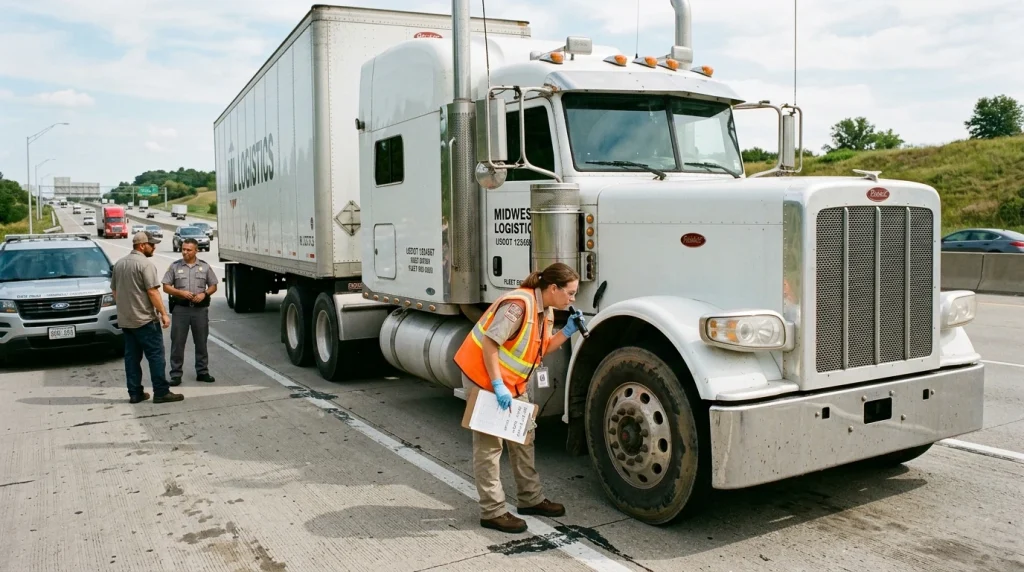

for any commercial driver in the United States, a Department of Transportation (DOT) inspection is part of the job. These inspections, conducted by certified Commercial Vehicle Safety Alliance (CVSA) inspectors, are designed to ensure that both the driver and the commercial vehicle comply with the federal safety regulations established by the Federal Motor Carrier Safety Administration (FMCSA).
While inspections can be stressful, they should not be viewed solely as enforcement actions. They are also an opportunity to demonstrate that the vehicle is safe to operate and that the carrier is meeting federal safety requirements. Every inspection also has a direct impact on a company’s Compliance, Safety, Accountability (CSA) score—one of the FMCSA’s primary tools for evaluating a motor carrier’s safety performance.
What Are the Main DOT Inspection Levels?
Not all DOT inspections are the same. Depending on the situation, inspectors may perform different types of inspections.
Level I: The Most Comprehensive Inspection
The Level I Inspection, officially known as the North American Standard Inspection, is the most thorough roadside inspection and the one most commonly performed.
During this inspection, both the driver and the vehicle are examined.
The driver inspection includes verification of:
- Commercial Driver’s License (CDL)
- Valid Medical Examiner’s Certificate
- Electronic Logging Device (ELD) records
- Seat belt compliance
- Signs of fatigue or drug/alcohol impairment
The vehicle inspection covers critical safety components, including:
- Brake system
- Tires
- Steering
- Suspension
- Lighting system
- Coupling devices
- Chassis
- Undercarriage components
Because it is the most detailed inspection, it can identify both mechanical defects and regulatory violations.
Level II: Walk-Around Driver/Vehicle Inspection
A Level II Inspection is similar to a Level I but is less comprehensive.
The inspector reviews the driver’s documentation and performs a walk-around inspection of the vehicle without crawling underneath the truck.
Although quicker, any violations discovered during a Level II inspection still affect the carrier’s CSA score.
Level III: Driver-Only Inspection
A Level III Inspection focuses almost entirely on the driver rather than the vehicle.
Inspectors typically verify:
- CDL
- Medical certificate
- ELD records
- Hours of Service (HOS) compliance
- Seat belt use
- Drug and alcohol regulation compliance
Many violations found during Level III inspections involve paperwork errors or incomplete documentation rather than mechanical issues.
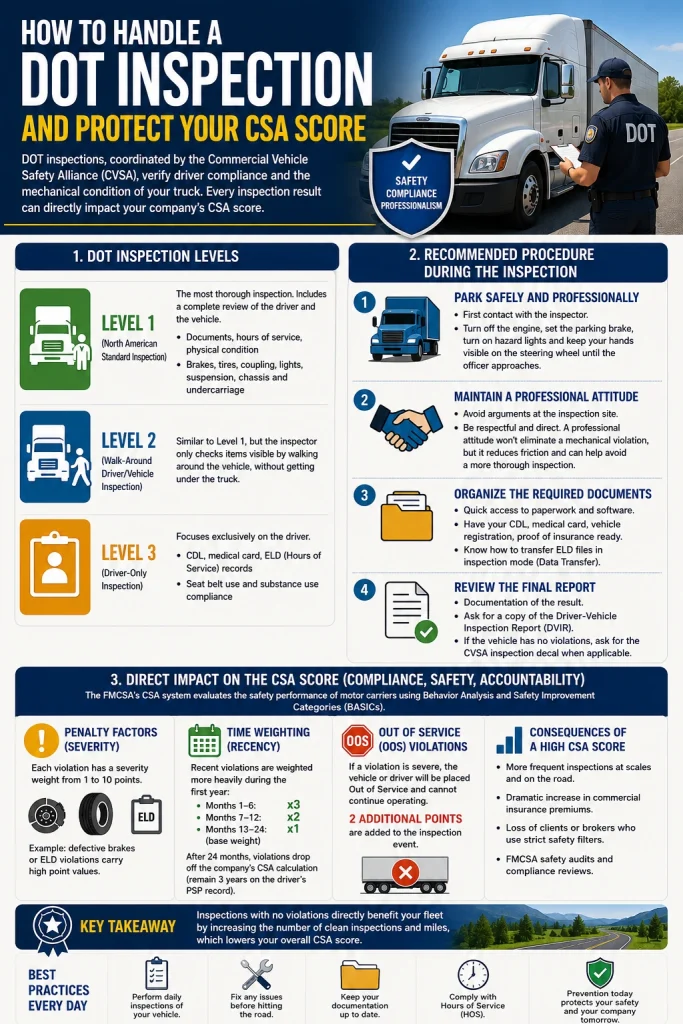
How Should Drivers Handle a DOT Inspection?
A driver’s attitude during an inspection also matters. While professionalism will not eliminate a mechanical violation, it helps the inspection proceed efficiently and respectfully.
Park Safely
When instructed to pull over:
- Park in a safe location.
- Turn off the engine.
- Set the parking brake.
- Activate hazard lights if appropriate.
- Keep your hands visible on the steering wheel until the officer approaches.
These simple steps help create a safe environment for both the driver and the inspector.
Remain Professional
Answer questions respectfully, avoid arguments, and respond only to what the inspector asks.
If you believe a violation was issued incorrectly, there are formal procedures available to challenge it later. The roadside inspection is not the appropriate place to dispute the inspector’s decision.
Have Your Documents Ready
Being able to quickly provide the required documentation helps speed up the inspection process.
Drivers should always have immediate access to:
- CDL
- Medical Examiner’s Certificate
- Vehicle registration
- Proof of insurance
- ELD inspection mode and knowledge of how to transfer electronic logs to the inspector
Delays caused by missing or disorganized paperwork can unnecessarily extend the inspection.
Request the Final Inspection Report
Once the inspection is complete, drivers should request a copy of the Driver-Vehicle Inspection Report (DVIR).
If the vehicle passes an eligible inspection without violations, the driver may also receive a CVSA decal, when applicable. Although it does not exempt the truck from future inspections, it indicates that the vehicle recently passed a comprehensive safety inspection.
How Does a DOT Inspection Affect Your CSA Score?
Every roadside inspection is recorded in the FMCSA’s Compliance, Safety, Accountability (CSA) program.
The CSA system evaluates motor carriers through several Behavior Analysis and Safety Improvement Categories (BASICs), including vehicle maintenance, hours of service, driver fitness, unsafe driving, and other safety-related categories.
The Severity of Each Violation
Every violation receives a severity weight ranging from 1 to 10 points.
Serious violations—such as defective brakes, unsafe tires, or major Hours of Service violations—carry much higher severity weights than minor administrative errors.
Recent Violations Carry More Weight
The CSA system also considers how recently a violation occurred.
- During the first six months, violation points are multiplied by three.
- Between months seven and twelve, they are multiplied by two.
- Between months thirteen and twenty-four, only the original severity value applies.
After two years, the violation is no longer included in the carrier’s CSA score. However, it may remain on the driver’s Pre-Employment Screening Program (PSP) record for up to three years.
Out-of-Service Orders Have Greater Consequences
If an inspector identifies a serious safety hazard, they may issue an Out-of-Service (OOS) order.
In these situations, the driver or vehicle cannot continue operating until the issue has been corrected. OOS violations also carry additional CSA consequences, increasing the inspection’s overall impact on the carrier’s safety score.
Why Is Maintaining a Good CSA Score Important?
A poor CSA score can have significant consequences for any trucking company, including:
- More frequent roadside inspections and weigh station inspections.
- Higher commercial insurance premiums.
- Lost business opportunities with brokers and shippers that require strong safety records.
- A greater likelihood of FMCSA audits and compliance reviews.
On the other hand, clean inspections directly benefit a carrier by increasing the number of violation-free inspections and improving its overall CSA safety profile.
Ultimately, prevention remains the best strategy. Conducting thorough pre-trip inspections, keeping documentation current, and correcting mechanical issues before hitting the road not only helps avoid violations and fines but also strengthens a company’s reputation and demonstrates an ongoing commitment to highway safety.
 Business hours: Monday to Friday from 8:00 AM to 5:00 PM. California time