 Hable con un agente al (888) 572-7520
  Enviar mensaje a un agente



When planning an interstate trip, most truck drivers and fleet operators focus on fuel costs, driving hours, weather, or traffic. However, another factor can completely change an operation: each state’s regulations.
In the United States, not every highway operates under the same rules. A truck that is perfectly legal in Michigan may require a special permit as soon as it crosses into another state. A trailer combination allowed in Idaho may be prohibited in California. Even the cost of traveling the same distance can vary by hundreds of dollars depending on toll roads and the payment system used.
Understanding these differences is essential to avoid violations, delays, and unexpected expenses.
The Federal Government Sets the Baseline, but States Have Flexibility
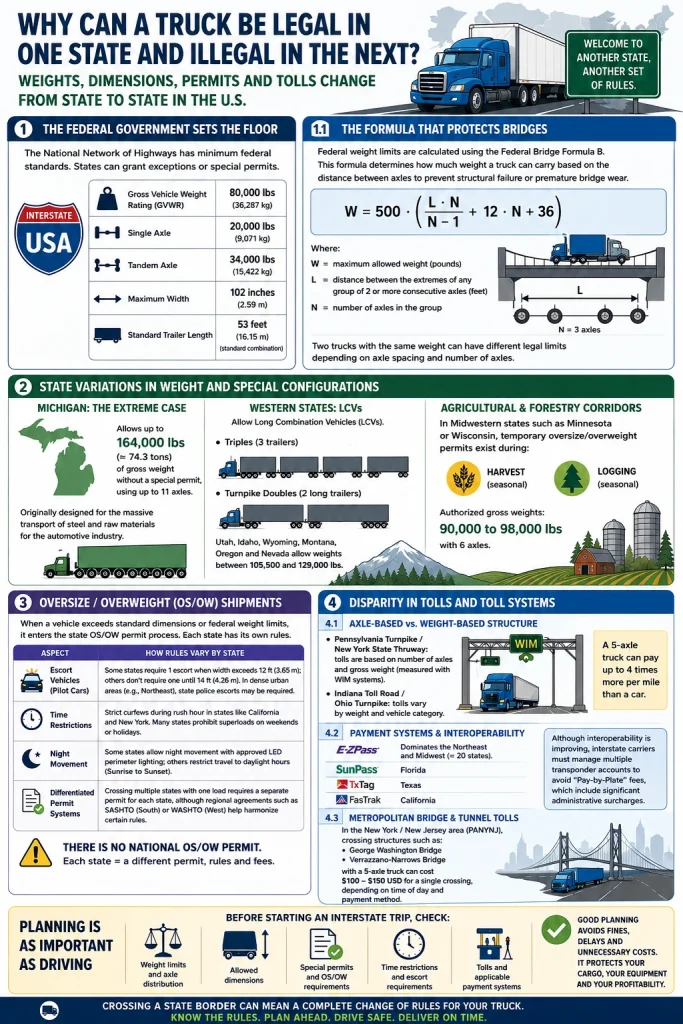
Federal regulations establish the basic standards for the National Network, the highway system where most commercial freight transportation operates.
The standard federal limits are:
- Maximum Gross Vehicle Weight: 80,000 pounds (36,287 kg)
- Single Axle Weight: 20,000 pounds (9,071 kg)
- Tandem Axle Weight: 34,000 pounds (15,422 kg)
- Maximum Width: 102 inches (2.59 meters)
- Standard Semi-Trailer Length: 53 feet (16.15 meters)
However, these limits are only the regulatory foundation. Each state may establish exceptions, issue special permits, or maintain historical grandfather rights that allow different vehicle configurations within its jurisdiction.
That means carriers cannot assume that a load approved in one state will automatically be legal in the next.
The Formula That Protects America’s Bridges
Contrary to what many people believe, the federal limit is not based solely on a truck’s total weight.
The United States uses the Federal Bridge Formula B, a mathematical formula that determines how much weight a truck may legally carry based on the distance between its axles.
Its purpose is to distribute weight properly, reduce stress on bridges, and prevent structural damage.
Simply put, two trucks with the same gross weight may have different legal weight limits depending on axle spacing and the number of axles.
For that reason, adding axles not only increases carrying capacity but also improves weight distribution and helps carriers comply with federal regulations.
Michigan: The Country’s Most Unique Case
One of the best-known examples is Michigan.
While most of the United States enforces the 80,000-pound limit, Michigan allows trucks weighing up to 164,000 pounds (approximately 74 metric tons) without requiring a special permit.
The condition is that the weight must be distributed across as many as 11 axles.
This exception was created decades ago to support the state’s automotive industry and the transportation of steel, raw materials, and industrial components.
Although the total weight is much higher, the pressure applied to the pavement is comparable to that of much lighter vehicles because the load is spread across more axles.
Western States Allow Massive Truck Combinations
Several western states also have unique operating rules.
Utah, Idaho, Wyoming, Montana, Nevada, and Oregon allow the operation of Long Combination Vehicles (LCVs).
These configurations include:
- Triple Trailers, consisting of three trailers.
- Turnpike Doubles, consisting of two long trailers.
Depending on the state, these combinations may legally operate at weights ranging from 105,500 to 129,000 pounds, well above the standard federal limit.
These exceptions primarily reflect lower traffic density, longer travel distances, and highway corridors specifically designed for these operations.
Seasonal Harvest Permits
Regulatory differences are also common in agricultural states.
During certain times of the year, states such as Minnesota and Wisconsin temporarily increase allowable weight limits to facilitate the transportation of grain, timber, and other agricultural products.
With special permits, trucks may legally operate at weights approaching 90,000 or even 98,000 pounds using six-axle configurations.
These seasonal exemptions reduce the number of trips required during harvest and improve overall logistics efficiency.
When a Load Exceeds Standard Limits
When a truck exceeds legal weight or dimensional limits, it falls into the Oversize/Overweight (OS/OW) category.
This is where one of the most complex aspects of U.S. trucking begins.
There is no national oversize permit.
Each state manages its own permitting system.
As a result, a shipment traveling from California to Florida may require separate permits from every state along the route.
Every State Has Different Rules
Operational differences exist in nearly every aspect of oversize transportation.
Some states require escort vehicles once a load exceeds 12 feet in width, while others don’t require escorts until the load reaches 14 feet.
In major metropolitan areas such as New York City, police escorts may also be mandatory.
Operating hours vary as well.
California and New York restrict truck movement during rush hours in many urban areas.
Other states prohibit oversize loads from traveling on weekends or federal holidays.
Nighttime travel rules also differ.
Some jurisdictions allow overnight movement using specialized LED lighting around the load, while others only permit travel between sunrise and sunset.
Toll Roads Have Their Own Rules
It’s not just regulations that vary.
Costs vary too.
Toll highways use different pricing systems depending on the state.
On facilities such as the Pennsylvania Turnpike and the New York State Thruway, toll rates are calculated based on both the number of axles and vehicle weight, often using Weigh-in-Motion (WIM) technology.
As a result, a five-axle truck may pay several times more per mile than a passenger vehicle.
Indiana and Ohio also classify tolls according to vehicle type and weight.
One Trip May Require Multiple Electronic Toll Systems
Interstate fleets face another challenge: interoperability.
The Northeast is dominated by E-ZPass.
Florida primarily uses SunPass.
Texas operates TxTag.
California relies on FasTrak.
Although compatibility between many systems has improved in recent years, many trucking companies still maintain multiple toll accounts to avoid violations and expensive Pay-by-Plate charges.
Crossing One Bridge Can Cost More Than $100
Major metropolitan crossings represent another significant operating expense.
In the New York and New Jersey region, crossing structures such as the George Washington Bridge or the Verrazzano-Narrows Bridge with a five-axle truck can cost more than $100—and sometimes over $150—for a single crossing, depending on the time of day and payment method.
For fleets making multiple daily trips, these costs have a direct impact on profitability.
Planning Is Just as Important as Driving
In today’s trucking industry, understanding the regulatory differences between states is no longer just an administrative detail.
It is a critical management tool.
Before starting an interstate trip, carriers should verify applicable weight limits, legal dimensions, special permit requirements, operating-hour restrictions, escort vehicle rules, and toll systems for every state along the route.
Proper planning helps avoid fines, reduce delays, protect infrastructure, and ensure freight reaches its destination without interruption.
In the United States, crossing a state line means much more than entering a new landscape—it can completely change the rules under which a truck is allowed to operate.
If you have questions, don’t hesitate to contact us.
 Business hours: Monday to Friday from 8:00 AM to 5:00 PM. California time