 Hable con un agente al (888) 572-7520
  Enviar mensaje a un agente

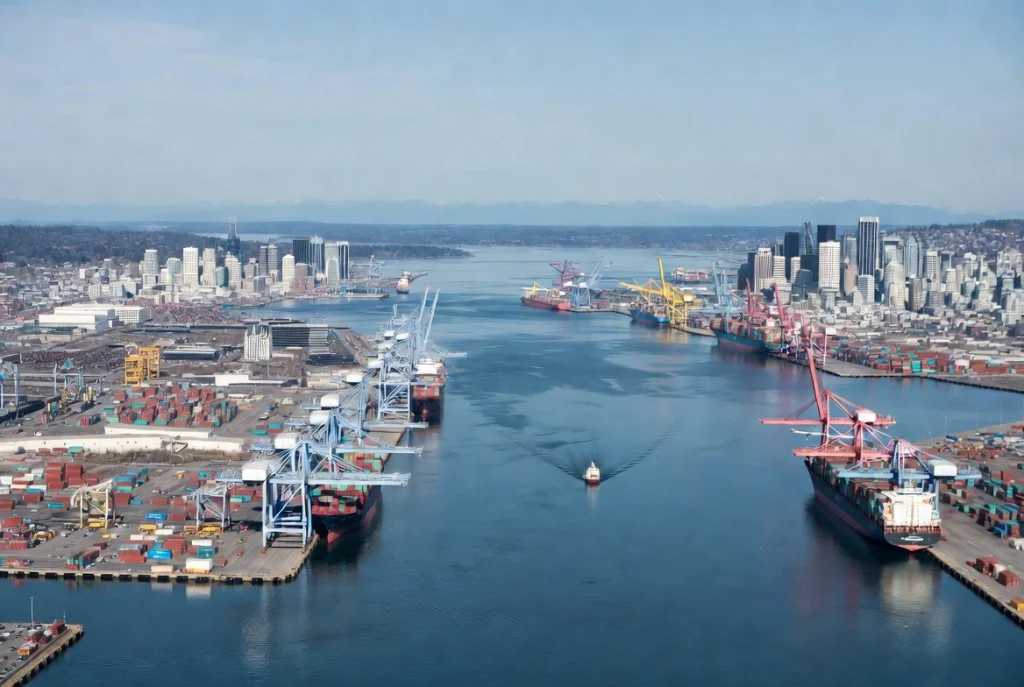

Port of Seattle vs Port of Tacoma no longer compete as separate ports. Since August 4, 2015, they operate as a single entity, the Northwest Seaport Alliance (NWSA), which combines the North Harbor (Seattle) and South Harbor (Tacoma) into one cargo system. In 2026, combined container volumes are below 2025 levels (down 12.4% year-to-date through June), while full exports remain above the five-year average. For drayage truckers, the key question is not “which port wins,” but the operational changes that took effect in January 2026 under the Clean Truck Program and the appointment dynamics at each terminal.
Port of Seattle vs Port of Tacoma: Does the “competition” question still apply?
For decades, Seattle and Tacoma competed for shipping lines and cargo volumes. Tacoma even surpassed Seattle in the early 2000s, attracting operators like Maersk, K Line and Evergreen Marine with more competitive rates and infrastructure.
That rivalry formally ended on August 4, 2015, when both ports created the Northwest Seaport Alliance, a joint operating partnership based in Tacoma. Since then, Seattle and Tacoma do not publish cargo statistics as competitors: they report combined volumes, split internally into the North Harbor (Seattle terminals T5, T18 and T30) and the South Harbor (Tacoma terminals Husky, Washington United Terminals, Pierce County Terminal and Matson Terminal).
How much cargo does the NWSA move in 2026?
According to official NWSA reports:
- Combined year-to-date volume through June 2026 reached 1,433,525 TEU (twenty-foot equivalent units), a 12.4% decline compared to the same period in 2025.
- Full loaded imports fell 13.9% year-to-date, while full loaded exports decreased just 1.2% and remain 1.8% above the five-year average.
- In June 2026 alone, total container volume was 262,546 TEU, 4.4% lower than in June 2025.
- Breakbulk cargo (project cargo, machinery, loose cargo) grew strongly: 222,529 metric tons year-to-date through June, up 22.1% due to robust industrial demand.
- The automotive segment declined 6.6% year-over-year, a drop the NWSA links to tariff impacts on the industry.
- Domestic trade (Alaska and Hawaii) also fell: Alaska -0.9% and Hawaii -3.3% year-to-date through June.
In short: the Seattle-Tacoma system is moving fewer containers than in 2025, but gaining ground in project cargo and maintaining exports above historical averages. Neither port “wins” separately because both report as a single alliance.

What this means for drayage truckers
For a drayage trucker — moving containers between port terminals and warehouses, yards or rail ramps — the relevant factors are not historical port competition, but three concrete operational changes in effect in 2026:
1. New Clean Truck Program requirement (effective January 1, 2026)
All trucks serving NWSA international and domestic container terminals must have:
- A registered and active RFID tag.
- A model year 2007 or newer engine, or an equivalent certified emissions control system.
Without meeting this requirement, trucks cannot access terminals in either the North Harbor or South Harbor. This is a critical point for owner-operators who have not yet updated their registration or equipment.2. Each terminal operates its own appointment system
Although Seattle and Tacoma report as a single alliance, in practice each terminal operates independently for appointments, gate hours and chassis availability:
Tacoma (South Harbor): Husky Terminal, Washington United Terminals (WUT), Pierce County Terminal (PCT) and Matson Terminal
Seattle (North Harbor): Terminal 5 (T5), Terminal 18 (T18) and Terminal 30 (T30).
This means a trucker may experience very different wait times and appointment availability depending on the specific terminal picking up or dropping off a container, even within the same combined “port”.
3. Incentives for zero-emission trucks
The NWSA, with funding from the Washington State Department of Transportation (WSDOT) through the Climate Commitment Act, launched an incentive program for zero-emission drayage trucks, with Zeem Solutions as the designated operator. The plan includes charging infrastructure near SeaTac Airport, with capacity for 250 vehicles per day and overnight parking for 70 units. For operators considering fleet renewal, this type of program can reduce transition costs toward newer, cleaner units.
Why this matters to Spanish-speaking owner-operators
For independent truckers working import/export cargo in the Seattle-Tacoma corridor, these three factors — RFID compliance, terminal-specific appointment management, and fleet renewal options — directly impact:
- Gate wait times and, therefore, the number of trips possible per day.
- Eligibility to operate without restrictions across any of the seven terminals in the NWSA system.
- Insurance and maintenance costs when deciding whether to renew a unit or keep the current engine.
Keeping truck documentation and engine specifications within Clean Truck Program requirements is not optional: it is the condition for access to cargo across the entire NWSA system, whether a container enters through Seattle or Tacoma.
Frequently asked questions
Do the Port of Seattle and Port of Tacoma compete today?
Not as separate entities. Since 2015 they operate as a single alliance, the NWSA, reporting combined volumes split into North Harbor (Seattle) and South Harbor (Tacoma).
Which moves more cargo, Seattle or Tacoma?
The NWSA does not publish TEU breakdown by harbor in its regular public reports; it reports the combined total. That is why talking about “which one wins” no longer reflects how the system currently works.
What does a truck need to enter terminals in 2026?
A registered RFID tag and a model year 2007 or newer engine (or equivalent certified emissions control), in compliance with the Clean Truck Program effective January 1, 2026.
Note: Volume data corresponds to official NWSA reports with figures accumulated through June 2026. We recommend verifying the most recent month’s data before publication.
 Business hours: Monday to Friday from 8:00 AM to 5:00 PM. California time