 Hable con un agente al (888) 572-7520
  Enviar mensaje a un agente

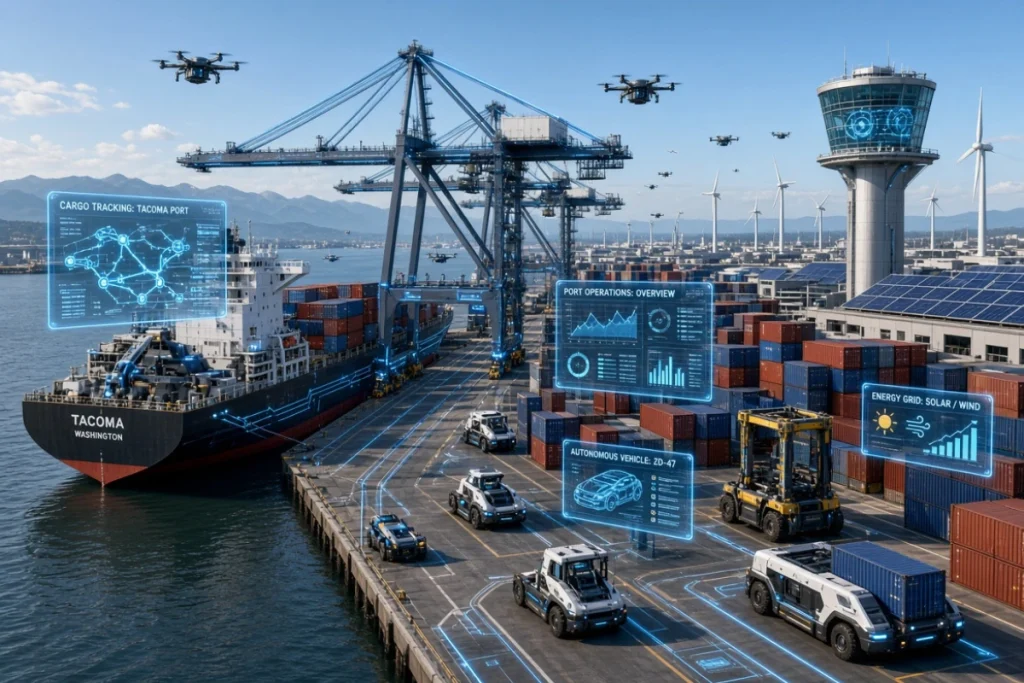

Washington’s smart ports—led by the Port of Seattle, the Port of Tacoma, and the alliance that connects them, the Northwest Seaport Alliance (NWSA)—are moving toward more automated, connected, and zero-emission operations. The main drivers of this transformation are private 5G networks for operating equipment and infrastructure in real time, electric trucks and cranes funded with federal grants, maritime innovation centers dedicated to new technologies, and data systems that optimize container movement. The region’s stated goal is to eliminate emissions from port operations before 2050.
What are smart ports, and why is Washington investing in them?
A smart port combines sensors, artificial intelligence, high-speed data networks, and automation to coordinate the movement of ships, cranes, trucks, and containers with fewer delays and lower emissions. Globally, ports such as Rotterdam and Singapore have been using automated cranes and sensor-guided vehicles for more than three decades, and this trend is accelerating worldwide with predictive analytics to manage crane movements, container yards, and truck appointments.
Washington is not starting from scratch: it is the state that developed one of the first formal “blue economy” strategies in the United States. Within that statewide strategy, “Smart Ports” are a specific focus under the port infrastructure pillar, known as “Working Waterfronts,” alongside infrastructure modernization and the regulatory climate.
The specific projects shaping the future of smart ports
1. Private 5G network at the Port of Tacoma
A private 5G network is already operating at the Tacoma docks, known as the Tacoma Tideflats. It is designed to provide coverage for port and industrial operations while making use of existing infrastructure, such as streetlights, to reduce costs. The project began as a pilot for a group of companies on the East Blair Peninsula and was designed to expand to more customers throughout Tacoma’s industrial corridor.
2. Zero-emission trucks and cranes
The Northwest Seaport Alliance—the partnership that jointly manages maritime cargo operations in Seattle and Tacoma—was selected to receive federal funding through the EPA’s Clean Ports Program. The funds are intended to electrify cargo-handling equipment and advance the design of shore power systems.
This is supplemented by additional funding from the U.S. Department of Transportation and the State of Washington to add fully electric drayage trucks, along with a charging center near the I-5 freeway exit south of Sea-Tac Airport. The facility is designed to serve dozens of vehicles per day.
3. Maritime Innovation Center at Fishermen’s Terminal
In 2026, the Port of Seattle is moving forward with the development of the Maritime Innovation Center at Fishermen’s Terminal. The facility is intended to incubate maritime technology and support the transition to clean fuels as part of the port’s modernization strategy for this year.
4. Data and operational automation
Across the port industry, the 2025–2026 trend is clear: artificial intelligence and predictive analytics are already being used to optimize crane movements, yard management, and truck appointments at port gates, reducing bottlenecks. Washington is following the same approach as part of its own “digital transformation” roadmap, one of the stated pillars of the state’s maritime innovation strategy.
Why this matters to the region
Together, the Seattle–Tacoma port complex is one of the main entry points for containerized cargo from the United States into the Asian market. According to figures released by the Port of Seattle, the combined activity of the NWSA, the Port of Tacoma, and the Port of Seattle supported more than 265,000 jobs and generated nearly $55 billion in economic output in 2023. Modernizing this infrastructure is not only an environmental issue; it is also a direct investment in maintaining competitiveness against other West Coast and Canadian ports.
In addition, the region has already experienced periods of severe congestion—with ships anchored offshore waiting to unload and a shortage of available trucks to move cargo out. This reinforces the case for more automated and predictive systems capable of anticipating and absorbing these demand peaks.
What to expect in the coming years
- Further electrification of yard equipment and drayage trucks, largely funded through federal and state grants that have already been allocated.
- Expansion of private 5G connectivity beyond the Tacoma pilot as new companies join the industrial corridor.
- Greater use of predictive analytics for truck appointments, yard management, and crane movements, following a trend already established at leading ports worldwide.
- Continued pursuit of the goal of achieving zero-emission port operations before 2050, jointly established by the NWSA, the Port of Seattle, and the Port of Tacoma.
Frequently asked questions
Which Washington ports are leading the transformation toward “smart ports”?
The Port of Seattle and the Port of Tacoma, coordinated through the Northwest Seaport Alliance (NWSA), are home to the state’s main technology modernization projects.
Does Washington have an official zero-emission port target?
Yes. The NWSA, the Port of Seattle, and the Port of Tacoma share the goal of eliminating emissions from all port-related activity before 2050.
What is the Northwest Seaport Alliance (NWSA)?
It is the partnership that has jointly operated the maritime cargo activities of the Port of Seattle and the Port of Tacoma since 2015. In terms of container volume, it is one of the largest port gateways in the United States.
Will port automation in Washington replace jobs?
Current investments are primarily focused on electrifying equipment and using data systems to reduce delays, rather than replacing port workers. In fact, the ports themselves highlight the creation of jobs related to the energy and technology transition.
 Business hours: Monday to Friday from 8:00 AM to 5:00 PM. California time