 Hable con un agente al (888) 572-7520
  Enviar mensaje a un agente

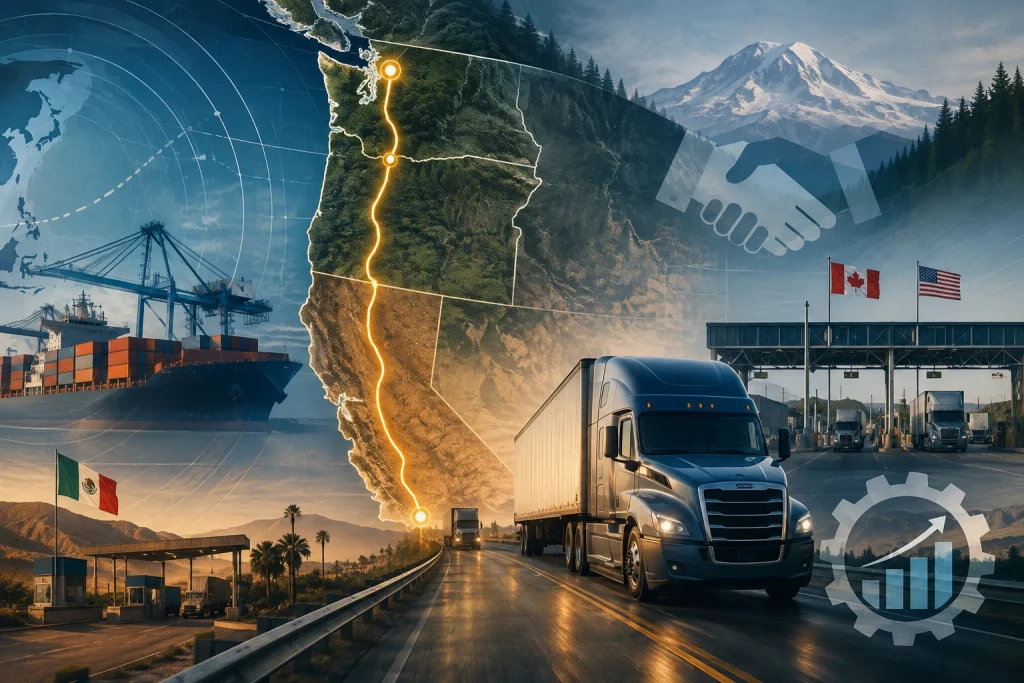

The freight transportation map on the U.S. West Coast is undergoing a profound transformation. Geopolitical tensions between the United States and China, coupled with armed conflicts in Europe and the Middle East, have disrupted global supply chains. Seaports from Los Angeles and Long Beach in California to the Northwest Seaport Alliance complex in Washington state are experiencing fluctuations in their import volumes.
However, the slowdown in transpacific trade does not mean the end of opportunities for trucking. The phenomenon of nearshoring is reshaping North American trade routes. For fleet owners and owner-operators, the geography connecting California, Oregon, and Washington maintains a strategic position within the United States-Mexico-Canada Agreement (USMCA).
1-Toward Intra-North American Trade
For decades, West Coast ports served as the primary gateway for goods manufactured in Asia. A significant volume of cargo entering through the Seattle and Tacoma maritime terminals in Washington state was distributed throughout the country via road and rail transport.
Tariff disputes and trade restrictions between Washington, D.C., and Beijing have altered this dynamic. According to data from the U.S. Census Bureau and the Bureau of Transportation Statistics (BTS), China’s share of total U.S. goods imports has shown a downward trend in recent years, surpassed by regional trading partners such as Mexico.
This contraction in traditional maritime trade directly affects the local or short-haul (drayage) transportation sector, responsible for moving containers from port terminals to regional warehouses. When the arrival of container ships decreases, the supply of equipment in port yards increases, and the pressure on daily rates rises.
Despite this scenario at maritime terminals, the total flow of goods has not disappeared; it has simply changed its origin and route. The need for continuous supply in Pacific urban centers requires maintaining active land distribution chains, shifting the point of origin of cargo toward the northern and southern land borders.
2-Moving Cargo from Border to Border
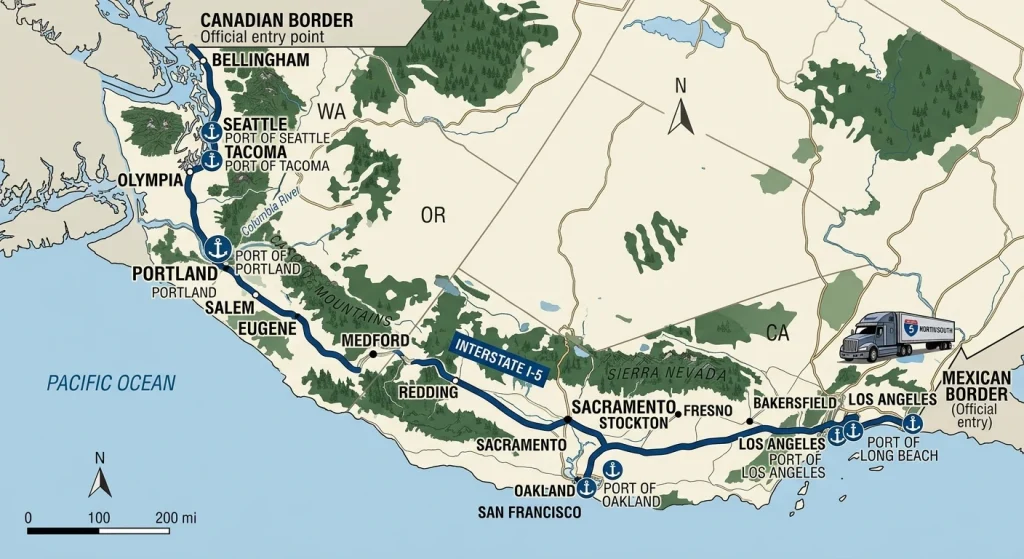
The Interstate 5 (I-5) corridor represents the fundamental logistics artery of the West Coast. Stretching over 1,300 miles from the Mexican border at San Ysidro, California, to the Blaine International Crossing in Washington State, this route facilitates the economic integration of the region.
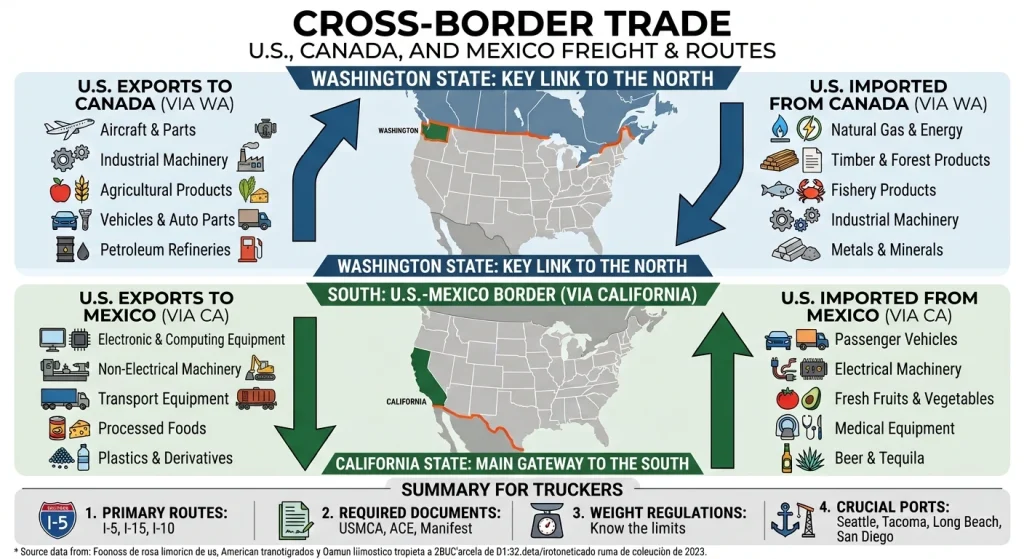
The development of nearshoring has boosted land-based trade within the USMCA trade bloc. According to reports from the U.S. Department of Transportation (USDOT), the value of cross-border trade transported by truck between the United States, Mexico, and Canada maintains a majority share of intermodal freight transport. Manufacturing plants located in Mexico ship automotive components, appliances, machinery, and consumer goods that enter through California and Arizona border crossings, where they are consolidated and then shipped north.
At the same time, Washington state maintains a key binational trade relationship with the province of British Columbia in Canada. The Blaine border crossing sees thousands of commercial freight vehicles pass through daily. Lumber, chemicals, and processed foods enter from Canada, while machinery, refrigerated agricultural products, and technology are exported from Washington’s agricultural valleys and industrial centers to the Canadian market.
This dynamic of bilateral trade at the northern and southern extremes benefits long-haul trucking fleets. Although Asian import cargo fluctuates at the docks of Seattle or Tacoma, the freight traffic along the I-5 corridor between California, Oregon, and Washington is driven by industrial and agricultural supply contracts that demand consistent transport capacity.
3-Operating Costs and Rate Balancing in the Region
For truck operators, understanding these macroeconomic changes is essential when calculating cost per mile (CPM). The cost structure on the West Coast presents specific challenges compared to other regions of the country.
Diesel fuel prices in the Pacific states, especially California and Washington, are typically higher than the national average reported by the U.S. Energy Information Administration (EIA). This is compounded by local fuel taxes and heavy-duty vehicle emissions regulations enforced by state environmental agencies, such as the California Air Resources Board (CARB) and the Washington State Department of Ecology.
To mitigate the impact of operating costs, independent carriers should pay attention to the relationship between spot market rates and long-term contracts:
Fuel Surcharge Management: Monitor EIA indices weekly to adjust pricing formulas on invoices issued to customers and brokers.
Deadhead Optimization: Avoid returning empty from the Pacific Northwest. Combining refrigerated produce (reefer) shipments out of eastern Washington with dry van shipments coming south from the Puget Sound area helps balance the operating cost per mile.
Efficient IFTA Claiming: Plan diesel refueling stops by analyzing the fuel tax credit at the California, Oregon, and Washington state lines.
4-An Adaptable Logistics Structure
The freight transportation market in the United States has historically demonstrated its ability to adapt to international crises. Geopolitical upheavals and global armed conflicts force a reconfiguration of supply chain logistics, but consumer demand on the West Coast requires trucks to keep moving.
The region’s potential does not depend solely on a single maritime trading partner or on imports from Asia. The area’s logistical strength lies in the interconnected infrastructure of its road network, the agricultural and industrial production of states like Washington and California, and the consolidated economic integration with Mexico and Canada.
For small fleets and owner-operators, the economic outlook requires caution in cash flow management, rigorous negotiation of rates with intermediaries, and strategic route selection. International trade is changing course, but the need to transport goods from the southern border to Washington state keeps activity on the roads of the American West.
 Business hours: Monday to Friday from 8:00 AM to 5:00 PM. California time