 Hable con un agente al (888) 572-7520
  Enviar mensaje a un agente

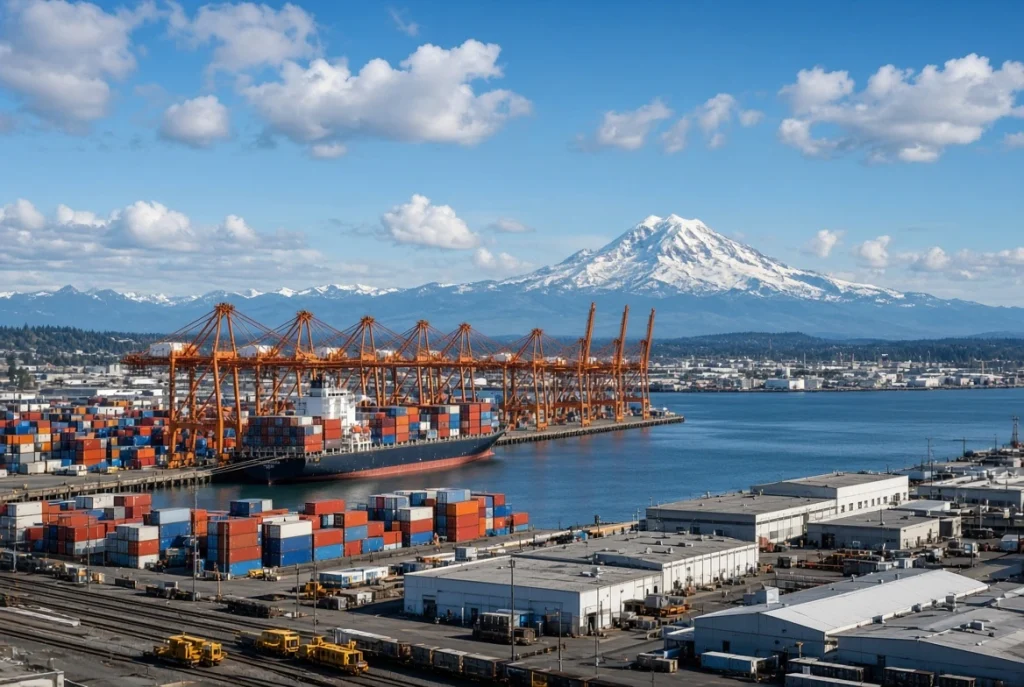

To pick up a container faster at the Port of Tacoma in 2026, a truck needs three current requirements: a valid TWIC for the driver, an active RFID fully registered in eModal—now mandatory also at Northwest Seaport Alliance (NWSA) domestic terminals since January 1, 2026, not just at international ones—and a confirmed appointment in eModal, first verifying that the container shows as available.
NWSA and Advent eModal also launched a Trucker Appointment Capacity Dashboard, a real-time panel showing aggregated appointment availability across all terminals in the Seattle-Tacoma gateway, specifically designed to reduce wait times and congestion at the gate.
Why speed in container pickup remains critical
The Port of Tacoma connects to the second-largest concentration of distribution centers on the U.S. West Coast, according to NWSA itself. It has operated jointly with the Port of Seattle since 2015, and that constant freight volume means any delay in picking up a container generates direct costs: demurrage charges from the shipping line or terminal, and detention charges if the container or chassis is not returned on time.
The requirement that changed in 2026: RFID also at domestic terminals
The most important change for 2026 is the expansion of the RFID requirement. Since 2019, NWSA required an active RFID tag to operate at international container terminals in Seattle and Tacoma. According to NWSA itself on its official page, as of January 1, 2026, that same requirement was extended to domestic terminals, which until then operated with a Clean Truck Program sticker system.
Those stickers are no longer valid for entry: any truck serving a terminal, international or domestic, needs an active RFID and a 2007 or later engine, or an equivalent certified emissions control system.
The process to obtain the tag, according to NWSA’s official guide, has five steps: register the company at eModal.com, upload driver and truck data, purchase the RFID tag ($103 plus additional fees, with a shipping time of at least five business days), register the tag once received, and physically install it on the vehicle.
NWSA explicitly warns about a common mistake: carrying more than one RFID tag on the same truck can generate a red light at the gate and entry denial, so it’s advisable to verify that the vehicle has only one active tag before presenting at the terminal.
The new appointment panel: Trucker Appointment Capacity Dashboard
Another relevant development to speed up container pickup is the Trucker Appointment Capacity Dashboard, launched by NWSA in partnership with Advent eModal—the world’s largest port community system for the intermodal supply chain.
According to NWSA’s official press release, this dashboard provides trucking companies and other port stakeholders with real-time access to aggregated appointment capacity data across all terminals in the Seattle-Tacoma gateway, allowing better planning of dual transactions.
Don Meyer, then NWSA co-chair and president of the Port of Tacoma Commission, explained that the tool aims to provide transparency and a common platform for trucking companies to plan their trips more efficiently, reducing wait times that increase transportation costs and negatively affect the environment near the port.
The initiative also aligns with a goal of the U.S. Federal Maritime Commission (FMC), which promotes transparency in port operations through technological solutions like this one.
How the appointment system currently works at Tacoma terminals
The eModal appointment system has concrete operational rules that vary by terminal, but share a common logic. At Terminal 18, for example, NWSA specifies that appointments must be booked before arrival, that drivers cannot wait at the dock for a next appointment, and that arriving within the assigned appointment window is recommended, defined as 45 minutes before or after the scheduled time; if the driver arrives before that window, they must wait outside the dock.
At Pierce County Terminal (PCT), appointments are enabled seven days in advance and it is recommended to book them before noon to ensure availability for the next day, with one-hour blocks per appointment. The general rule at most NWSA terminals is the same as previously in effect: a truck without an appointment to pick up an import will be rejected at the transaction, except for specific exceptions, and unused appointments are subject to cancellation.
The Port of Tacoma terminal map
The Port of Tacoma operates several independent docks, each with its own appointment system and specific rules. Among the most relevant container terminals are:
- Husky Terminal
- Washington United Terminals (WUT), on the Blair Waterway
- Pierce County Terminal (PCT)
- Matson Terminal
Each publishes its gate schedules and appointment rules, available centrally on the NWSA gate scheduling page, updated Monday through Friday. Some terminals, like Terminal 18, close their gates on Fridays unless otherwise announced, a key operational detail to avoid wasting time planning a pickup on a day when the terminal simply does not operate.
What NWSA requires before entering any terminal
According to the official Trucker Onboard List of requirements for drivers published by NWSA, before picking up or delivering cargo it is necessary to have: complete truck and chassis information (including weight in pounds for each), current Clean Truck registration (RFID in Seattle, and now also in Tacoma), and the driver’s TWIC.
At Washington United Terminals (WUT), specifically, drivers queuing in Lot F must wait for the security guard to approve both the TWIC and Clean Truck Program status before proceeding to the terminal.
Frequently asked questions
Is RFID mandatory at all Port of Tacoma terminals in 2026? Yes. As of January 1, 2026, active and registered RFID is mandatory at both international and domestic NWSA terminals. Clean Truck Program stickers are no longer valid for entry.
What is the Trucker Appointment Capacity Dashboard? It is a real-time panel developed by NWSA together with Advent eModal that shows aggregated appointment availability across all terminals in the Seattle-Tacoma gateway, to help trucking companies plan their pickups with more control and less wait time.
What happens if I carry more than one RFID tag on my truck? It can generate a red light at the gate and denial of entry to the terminal. NWSA recommends verifying that the vehicle has only one active RFID tag before presenting.
Do all Tacoma terminals operate on the same days? Not necessarily. Some terminals, like Terminal 18, close their gates on Fridays unless otherwise announced, so it’s advisable to check the specific schedule for each terminal before scheduling a pickup.
 Business hours: Monday to Friday from 8:00 AM to 5:00 PM. California time