 Hable con un agente al (888) 572-7520
  Enviar mensaje a un agente

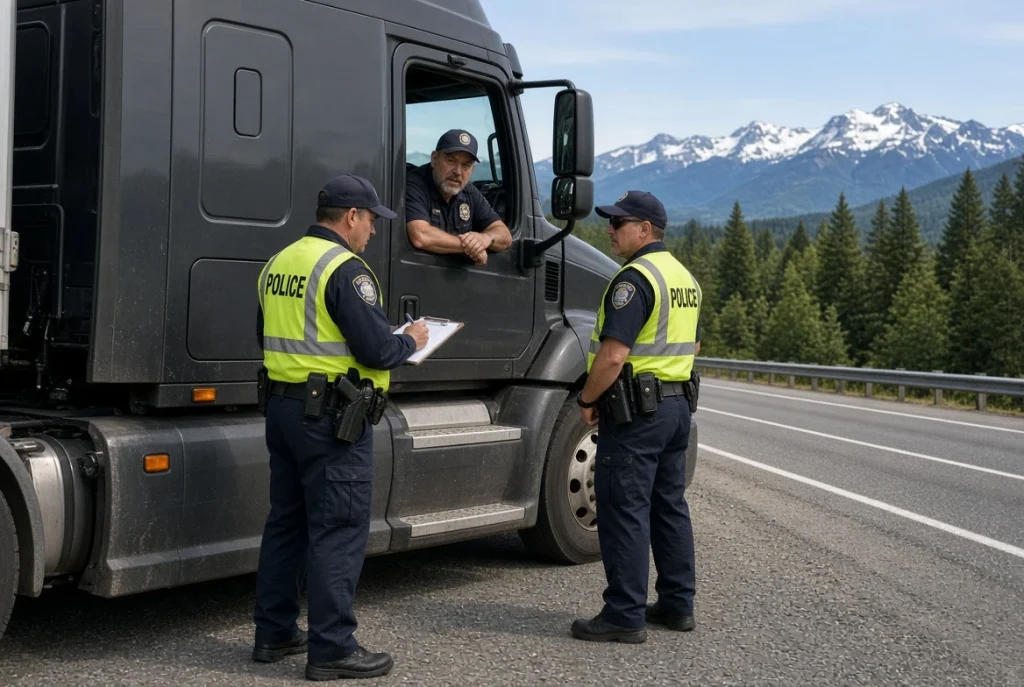

The mistakes that most frequently result in fines for a carrier in Washington are: operating overweight without the proper permit, using an expired oversize/overweight permit or violating its specific conditions (route, time, or authorized limit), and deviating from the permitted route.
According to electronic screening data from the Washington State Department of Transportation (WSDOT), out of more than 6.7 million commercial vehicles scanned at the state’s weigh stations in one year, more than one million potential violations were identified, led by unsafe carriers (ISS Inspect), credential or registration issues, overweight, speeding, and tailgating.
Overweight fines in Washington are calculated per excess pound and can exceed $2,500 in the most serious cases, as established by state law (RCW 46.44).
Overweight: the costliest and most cited error
Operating overweight—with or without a permit—is, according to various legal and technical sources in the state, the violation that generates the highest fines for a carrier in Washington. State law, specifically the Revised Code of Washington (RCW) 46.44.047, establishes a fine schedule that increases proportionally with the weight excess: from 3 cents per pound for excesses up to 4,000 pounds, up to 30 cents per pound plus a fixed charge of $2,640 for excesses over 20,000 pounds.
In practice, this means that a truck just 2,000 pounds over the limit could face an $80 fine, while one with 15,000 pounds of excess could receive a fine of several thousand dollars, as illustrated by law firms specializing in commercial traffic violations in the state.
The law itself adds an aggravating factor: if the same vehicle (the same power unit) repeats this type of violation within a twelve-month period, in addition to the corresponding fine, the court must suspend the vehicle’s registration for at least 30 days.
Operating without a permit, or violating the conditions of a valid permit
The second most common group of errors relates to oversize/overweight (OS/OW) load permits, managed by WSDOT through its online Self-Issue Permit System. According to the specialized publication Washington Trucking Online, the most frequent violations linked to these permits include: operating without an active OS/OW permit, exceeding the weight or dimensions authorized by the permit, using an expired or incorrect permit, failing to carry proof of the permit during operation, traveling on a route not authorized by that specific permit, and tampering with permit documentation or electronic records.
The law itself (RCW 46.44.105) is explicit about the consequences: any Washington State Patrol (WSP) officer or weight control inspector who finds a driver violating the conditions of a permit may confiscate it directly and forward it to WSDOT, which has the authority to return, revoke, cancel, or suspend it, without refund of the paid fee.
Deviating from the authorized route invalidates the permit
A mistake that many carriers do not fully appreciate is that a special load permit does not authorize travel on any road: it is tied to a specific route. As Washington Trucking Online explains, deviating from the permitted route can invalidate the permit entirely, which in practice is equivalent to operating without any valid permit if an officer stops the vehicle on that unauthorized segment.
Ignoring seasonal weight restrictions
Another frequent error, especially among carriers that do not regularly operate in the state, is failing to check seasonal weight restrictions. Washington does not apply a single statewide seasonal restriction period: WSDOT announces these restrictions as pavement conditions change, especially during freeze–thaw cycles or wet weather periods, when roadways are more vulnerable to damage.
A key point emphasized by the same source: even with a valid oversize/overweight permit, reduced weight limits due to a seasonal restriction may take priority over what the permit authorizes, and permits are only valid on approved routes that are not under such an active restriction.
How Washington detects these violations today
The Washington State Patrol (WSP) combines fixed weigh stations, mobile patrols, and automatic screening technology to identify violations. According to official data published by WSDOT itself, many of the state’s weigh stations operate under a “weigh and go” system, allowing compliant trucks to avoid a physical stop, while weigh-in-motion sensors and LED signs automatically direct suspected overweight vehicles to the scale.
In addition, the AUTOS (Automatic Truck Screening) system reads the truck’s USDOT number and checks the carrier’s weight history in real time, helping officers decide which trucks to weigh. According to WSDOT’s own Gray Notebook report, in a recent year more than 6.7 million commercial vehicles were electronically identified and scanned, of which 2.7 million entered with the scale open, generating more than one million potential violations. The most frequent categories detected were, in this order: carriers flagged as unsafe by the ISS Inspect system, credential or registration problems (for example, an expired license plate), overweight, speeding, and tailgating.
To cover secondary routes where a truck might try to avoid main weigh stations—common among logging trucks, rock haulers, or agricultural vehicles in rural areas—Washington also has Weight Enforcement Troopers who conduct surprise operations with portable scales.
Which agencies are involved and what they can do
Compliance oversight in Washington combines three agencies, as described in a specialized industry compliance guide for 2026: the WSP, through its Commercial Vehicle Enforcement Bureau, is primarily responsible for conducting roadside inspections, highway patrols, and targeted enforcement operations, with authority to issue citations, place vehicles out of service, and conduct carrier safety audits; WSDOT issues permits and administers the self-issue system (SIPS).
Likewise, the Washington Department of Licensing (DOL) oversees vehicle registration and each carrier’s operating authority, including the International Registration Plan (IRP) and the International Fuel Tax Agreement (IFTA).
Consequences beyond the immediate fine
As specialized law firms handling commercial traffic violations in Washington emphasize, an overweight fine does not end with the cost of the citation: it can cause operational delays, strain relationships with customers who depend on on-time deliveries, and—in the case of repeated violations—lead to increased regulatory scrutiny, audits, higher insurance premiums, or difficulties renewing permits. For an independent driver, a single severe overweight fine can represent a significant financial blow, especially when weight fines are combined with over-axle or over-gross weight surcharges, with the highest resulting fine always applied.
Frequently asked questions
What is the overweight fine for a truck in Washington? It is calculated per excess pound, on a progressive scale ranging from 3 cents per pound for minor excesses up to 30 cents per pound plus a fixed charge of $2,640 for excesses over 20,000 pounds, according to RCW 46.44.047. The minimum fine is $150.
What happens if I am stopped while operating with an expired permit or outside the authorized route? The permit may be confiscated by a WSP officer and forwarded to WSDOT, which can return, revoke, cancel, or suspend it without refund, effectively leaving the carrier without legal coverage for that load.
How does Washington detect overweight trucks without physically stopping them? Through weigh-in-motion sensors at weigh stations and the AUTOS system, which reads the USDOT number and checks the carrier’s history in real time to decide whether to direct the truck to the scale.
Which agencies enforce load permit compliance in Washington? The Washington State Patrol (WSP) conducts inspections and can issue citations; WSDOT issues and administers permits; and the Department of Licensing (DOL) oversees each carrier’s registration and operating authority.
 Business hours: Monday to Friday from 8:00 AM to 5:00 PM. California time