 Hable con un agente al (888) 572-7520
  Enviar mensaje a un agente

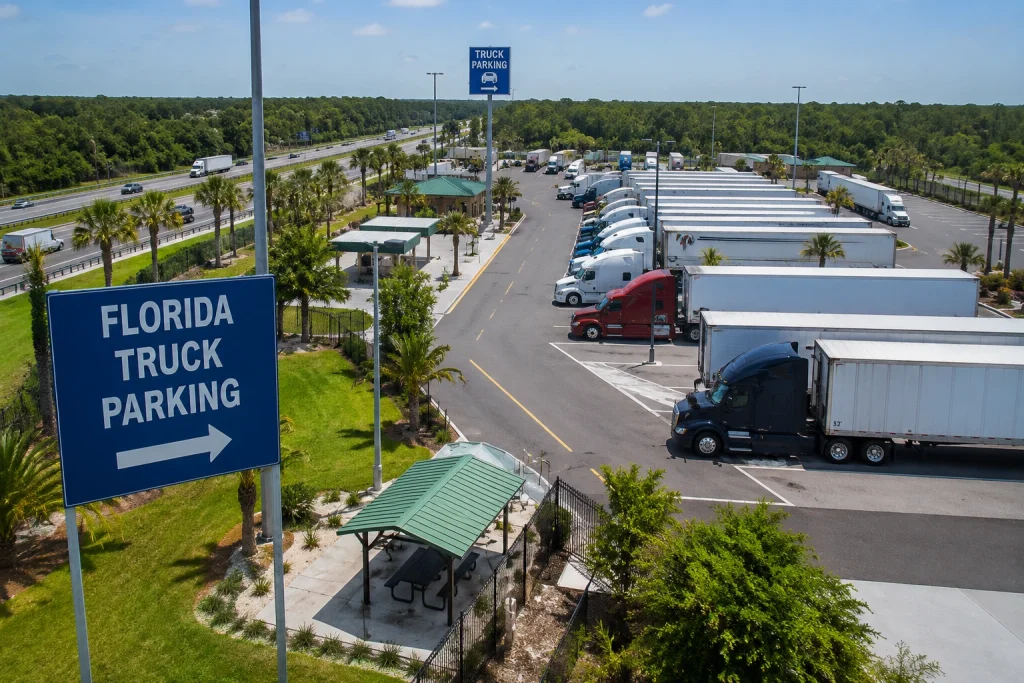

Finding a safe place to park a truck can become one of the biggest challenges of a workday in Florida.
Growth in freight movement and commercial vehicle traffic has increased pressure on available infrastructure, especially along major interstate corridors and around large metropolitan areas.
The problem is not new, but it remains a priority for the Florida Department of Transportation (FDOT). The agency has conducted multiple studies to determine where trucks park, which facilities experience the highest demand and where available capacity falls short. Some of that analysis has used commercial truck GPS data combined with traffic and parking-capacity information.
FDOT’s 2024 statewide update again identified pressure on key freight corridors, including I-4, I-75, I-95, I-10 and Florida’s Turnpike. The study examined both public and private facilities and compared available capacity with actual use.
Which parts of Florida have the highest truck parking demand?
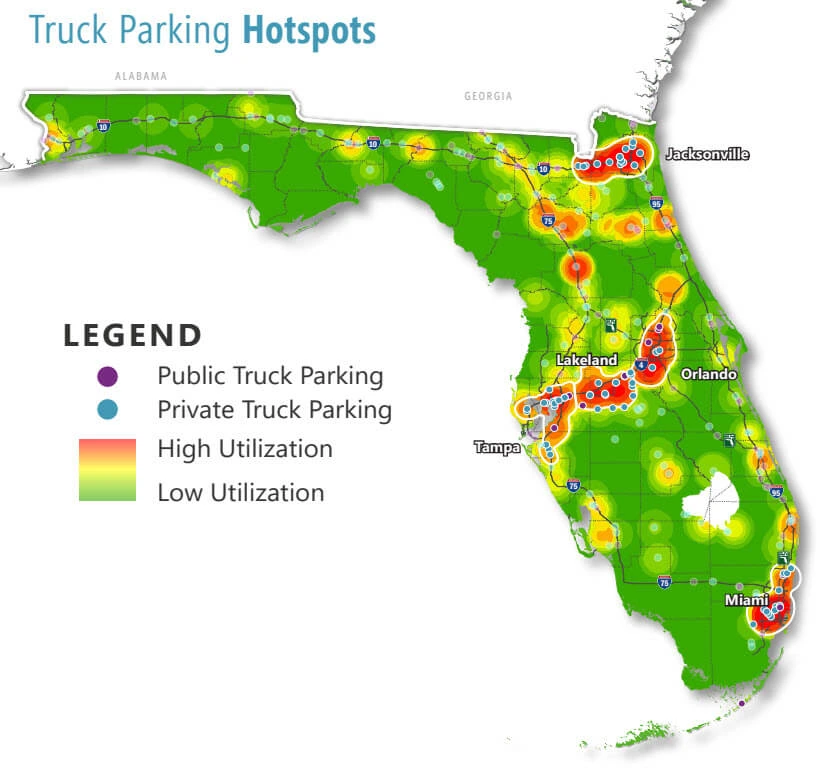
The answer is not limited to one highway. Parking pressure is concentrated primarily along major freight routes, metropolitan areas and logistics hubs.
FDOT has found that some parking facilities become overcrowded while others still have available spaces, making access to real-time information an important part of the solution. When drivers cannot find an authorized parking space, some end up stopping on interstate shoulders, entrance and exit ramps or vacant lots.
The corridors studied include I-4 through Central Florida; I-75, which runs across much of the state; I-95 along the East Coast; I-10 across North Florida; and Florida’s Turnpike. These routes are critical for connecting cities, ports, warehouses and distribution centers.
The growth in truck traffic helps explain the pressure. FDOT’s 2024 statewide study reported approximately 6.8 billion truck-miles traveled on Florida’s State Highway System in 2023, equal to about 18.6 million truck-miles per day.
That volume creates parking demand that does not always grow at the same pace as commercial traffic.
Why has I-4 become a critical corridor?
One of the most important examples is Interstate 4, the Central Florida corridor connecting the Tampa area with Orlando and Daytona Beach.
Parking pressure along I-4 has become significant enough that the corridor is now the focus of one of Florida’s largest truck-parking investments.
In June 2026, development began on five truck parking expansion projects along I-4. The program is supported by a $180 million federal INFRA grant and is expected to add 917 new truck parking spaces.
According to FDOT, I-4 carries approximately 95% of the consumer goods moving through the state, underscoring the strategic importance of increasing parking capacity for commercial vehicles.
The first projects are being developed in Seminole and Volusia counties, with completion expected around mid-2027. Additional projects in Osceola and Orange counties are expected to begin construction in 2027.
The scale of the investment shows that truck parking is no longer simply a convenience issue. It has become a freight infrastructure concern.
What happens when a trucker cannot find parking?
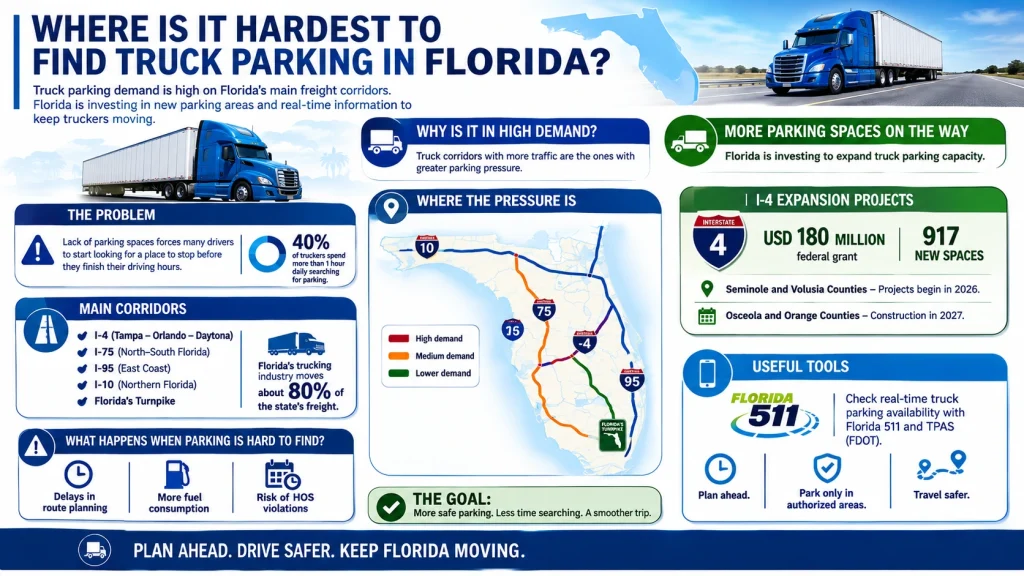
For professional drivers, parking is directly connected to Hours of Service planning.
Federal Hours of Service (HOS) rules limit how long drivers can remain behind the wheel and determine when mandatory rest periods must begin. If a driver is approaching the end of the available driving window and nearby facilities are already full, the options quickly become limited.
That is why many truckers begin searching for parking before they run out of legal driving time. FDOT has also linked parking shortages with HOS compliance and noted that overcrowded facilities can contribute to unsafe or unauthorized parking along interstate mainlines, shoulders, ramps and vacant lots.
There is also an economic cost. Time spent searching for parking means less time available to move freight, additional fuel consumption and potential disruptions to pickup or delivery schedules.
At the national level, federal officials said in June 2026 that approximately 40% of truck drivers spend more than one hour per day looking for parking. That loss of productive time was one of the factors cited in support of the new I-4 parking projects.
How can truckers check parking availability in Florida?
Florida is not addressing the problem only by building more spaces.
FDOT also operates the Truck Parking Availability System (TPAS), which provides drivers with information about parking availability at state-operated facilities.
Truckers can access this information through Florida 511, while availability information is also displayed through roadway signage in certain locations.
The goal is straightforward: help drivers determine in advance whether parking is available so they can plan their stops more effectively.
This is especially important because a shortage in one location does not necessarily mean every nearby facility is full. Some parking areas may be heavily overused while others remain below capacity. Better real-time information can help distribute demand more efficiently.
Florida will continue to need more truck parking
The I-4 expansion is part of a broader strategy. FDOT continues to evaluate and develop truck parking projects across the state, including initiatives along I-95, I-75, I-10, Florida’s Turnpike and additional sections of I-4.
The need reflects a structural reality: Florida depends heavily on trucking to move goods, and continued growth in freight traffic also increases demand for safe places where drivers can stop and complete required rest periods.
For carriers and owner-operators operating in Florida, parking should therefore be treated as part of route planning with the same importance as fuel, Hours of Service and delivery schedules.
That is particularly important when traveling on high-demand corridors such as I-4, I-75, I-95, I-10 and Florida’s Turnpike. Waiting until the final minutes of available driving time to search for parking can mean arriving at a facility that is already full.
Florida is responding with a combination of additional spaces, real-time information and better planning tools. With 917 new spaces planned along I-4 alone, the state is investing in a problem that directly affects the truckers responsible for keeping a major share of Florida’s freight moving.
 Business hours: Monday to Friday from 8:00 AM to 5:00 PM. California time