 Hable con un agente al (888) 572-7520
  Enviar mensaje a un agente



Trucking in the United States has always been an engine of the economy, but for independent owner-operators who travel across Washington state, the current landscape presents a golden opportunity to adapt and thrive. Economics doesn’t have to be a headache filled with complex financial terms; in fact, it’s the best tool for understanding where the best loads are and how to maximize every dollar spent on the road.
The Pacific Northwest is undergoing a dynamic transformation. Washington is solidifying its position as a hub for technology, international trade, and export agriculture. For the independent trucker, this doesn’t mean getting bogged down in numbers, but rather learning to read the market to their advantage: identifying the highest-paying routes, using technology to their benefit, and turning the flexibility of being their own boss into an unbeatable competitive advantage.
To transform every mile traveled into greater profitability along Interstate 5 or Interstate 90, the key is to stay ahead of the curve. Focusing on energy efficiency and diversifying freight strategy are the two pillars that allow Washington carriers to take control of their financial destiny.
Fuel: Be Smart
It’s true that fuel is one of the biggest expenses on any owner-operator’s sheet, and Washington has advanced environmental regulations that impact the price of diesel at the pump. However, far from being an insurmountable obstacle, this context rewards strategic carriers who know how to manage their resources intelligently.
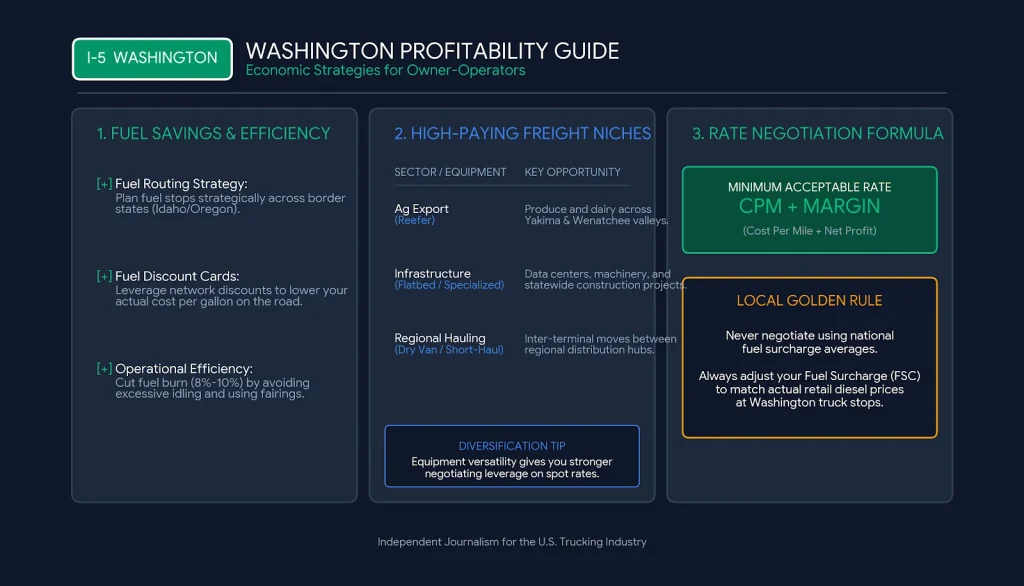
The first major opportunity lies in strategic fuel routing. Today, independent truckers have digital tools and fleet applications that allow them to map fuel stops with surgical precision. A savvy carrier can plan their stops by combining stations at strategic points in Idaho or Oregon with necessary stops in Washington, taking advantage of network discount programs (fuel cards) that offer savings of up to tens of cents per gallon.
Furthermore, Washington State’s transition to a cleaner logistics model is opening up incentives and grants for equipment upgrades. State and federal programs are designed to help small businesses finance aerodynamic technology, auxiliary power units (APUs) to prevent idling, and low rolling resistance tires.
Reducing fuel consumption by just 8% or 10% through efficient driving and optimized equipment translates to thousands of dollars in additional revenue each year. In practice, the money saved at the pump goes directly into the carrier’s bank account.
Where are the best opportunities?
The true strength of Washington State’s economy lies in its diversity. While other regions rely on a single sector for freight transport, here a vibrant production network offers constant opportunities for those who know how to position their truck in the right place.
To maximize revenue, the key is connecting with the highest value-added sectors within the state:
The export-oriented agribusiness boom: The Yakima, Wenatchee, and Skagit valleys generate unstoppable demand for refrigerated (reefer) transport. High-quality fruits, dairy products, and processed food cargo destined for ports require punctuality and care. Carriers who maintain impeccable cold chain standards are able to negotiate preferential rates with local packers and distributors, securing recurring contracts.
Infrastructure and technology projects: The constant growth of the Seattle, Tacoma, and Spokane metropolitan areas drives the construction of data centers and modern infrastructure. This opens up a highly profitable market for flatbed and specialized hauling. Moving machinery, steel structures, or technological components typically commands significantly higher rates than the general market average.
Consolidated freight and last-mile logistics: With the rise of e-commerce in the Northwest, intermediate distribution centers constantly need to move cargo between regional terminals. Owner-operators who offer flexibility for short or regional hauling routes can return home more often while maintaining high daily revenue rates.
By diversifying their options and not relying on a single freight broker or board, independent carriers gain significantly greater negotiating power. Learning to calculate the true cost per mile (CPM) allows them to select only the freight rates that offer an attractive net profit, passing up substandard offers.
Success on Washington’s highways depends not on luck or the ups and downs of the global economy, but on the daily decisions made in the cab. Viewing the market with a proactive, entrepreneurial mindset is a game-changer.
Washington State offers a dynamic economic environment, with a constant flow of goods and consumers with high purchasing power. Independent truckers who embrace fuel-saving technology, diversify their cargo types, and negotiate with a business mindset not only overcome the challenges of the road, but also build strong, profitable trucking companies poised for growth for many years.
 Business hours: Monday to Friday from 8:00 AM to 5:00 PM. California time