 Hable con un agente al (888) 572-7520
  Enviar mensaje a un agente



For truck drivers, calculating the cost of a route is about much more than adding up miles and fuel. Tolls can become one of the biggest variable expenses of a trip, especially when hauling freight through the Northeast.
There is also an important distinction when talking about the “most expensive” toll road. There is no single rate that applies to every truck. Toll costs can vary depending on the number of axles, distance traveled, vehicle height or class, time of day, and payment method.
Using a conventional five-axle tractor-trailer as a reference and the current or published rates from each toll authority, these are five highways truckers should pay close attention to when planning a load.
1. Pennsylvania Turnpike: a major hit to the budget
The Pennsylvania Turnpike (I-76/I-276) is one of the most expensive examples for long-haul commercial transportation.
In 2026, the Pennsylvania Turnpike Commission once again updated its toll rates. Vehicles are classified according to the number of axles and, on much of the Turnpike, their height. For a five-axle tractor-trailer, crossing Pennsylvania can cost hundreds of dollars, particularly without E-ZPass.
The payment method makes a major difference. The Turnpike uses electronic tolling, and E-ZPass rates are considerably lower than Toll By Plate rates.
For a carrier running the Ohio-Pennsylvania-New Jersey corridor several times a month, that difference is no longer a minor expense. It becomes part of the profitability calculation for every load.
2. New York State Thruway: the miles add up
The New York State Thruway, including long stretches of I-87 and I-90, is another major freight corridor where tolls can significantly affect trucking costs.
Rates effective January 1, 2026, also show a considerable difference between vehicles using a New York-issued E-ZPass and those paying through other methods.
For example, a Class 5H commercial vehicle traveling approximately 81.8 miles between Newburgh and Albany pays $19.51 with a New York E-ZPass, compared with $34.15 with an out-of-state E-ZPass or Tolls by Mail. That is a difference of roughly 75% for exactly the same trip.
For truckers traveling across large portions of the state, those individual toll segments quickly add up, making New York one of the places where calculating toll expenses before accepting a load is especially important.
3. New Jersey Turnpike: fewer miles, high tolls
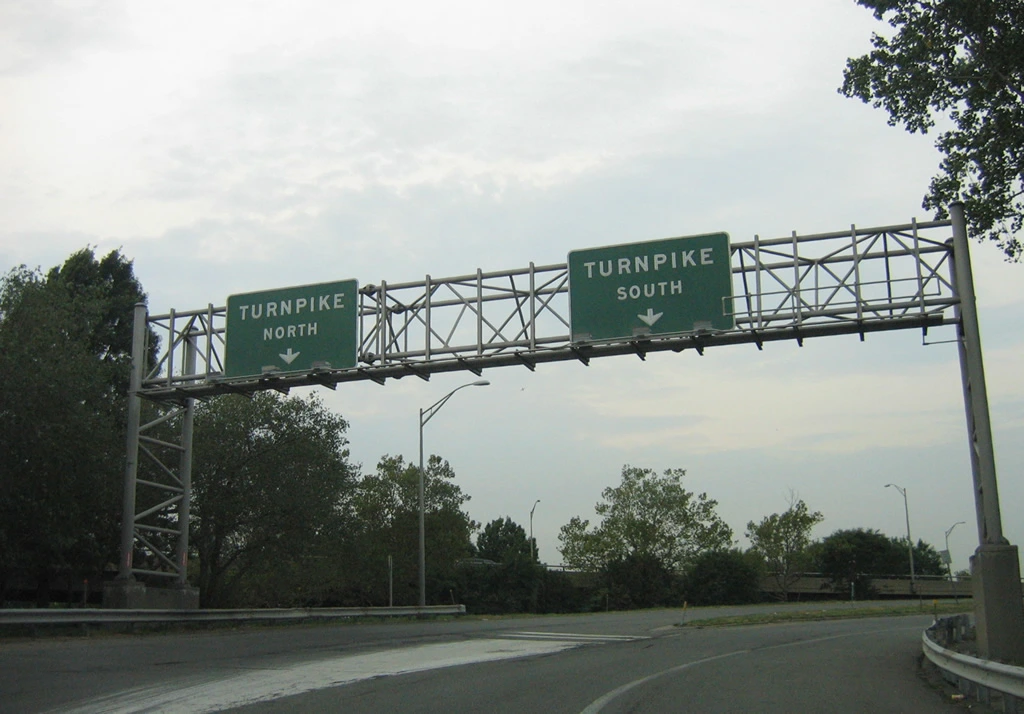
The New Jersey Turnpike (I-95) is much shorter than major toll corridors in Pennsylvania or New York, but its importance to the freight industry is enormous.
It is a critical route for reaching the New York-New Jersey metropolitan area, ports, warehouses, and distribution centers serving one of the largest logistics markets in the country.
Official New Jersey Turnpike Authority toll schedules illustrate how significant the cost can be for tractor-trailers. As a reference, 2025 toll schedules for Class 5 trucks — five-axle vehicles — showed rates exceeding $70 on certain longer trips from Interchange 1, depending on the exit and payment method.
For carriers, however, tolls are only part of the equation. In New Jersey, high toll costs can be combined with congestion, waiting times, and difficult access to some of the busiest logistics hubs in the Northeast.
As a result, the real operating cost per mile can be particularly high.
4. Ohio Turnpike: up to $74 to cross the state
The Ohio Turnpike (I-80/I-90) provides a particularly clear comparison because the Ohio Turnpike and Infrastructure Commission published its commercial toll rates for 2026.
Beginning January 1, Class 5 commercial vehicles pay a base rate of 22.6 cents per mile with E-ZPass and 28.4 cents per mile when paying by cash or credit card.
For the full 241-mile westbound trip from Pennsylvania to Indiana, a Class 5 commercial vehicle pays $58.75 with E-ZPass and $74 with cash or credit card.
Eastbound, the same full crossing costs $49.75 with E-ZPass and $62.75 with cash or credit card. The difference is related to the toll structure at Eastgate near the Ohio-Pennsylvania border.
It is a good example of why even the direction of travel can change the final cost of a load.
5. Florida’s Turnpike: every axle counts

In Florida, the situation is different. Florida’s Turnpike is part of an extensive toll-road network heavily used by commercial vehicles connecting South Florida, Central Florida, and major interstate freight corridors.
There is one fundamental rule truckers need to remember: the number of axles directly affects the price.
Florida’s Turnpike Enterprise generally calculates tolls according to the distance traveled and the number of axles on the vehicle. Sensors at tolling points detect the axles and automatically determine the applicable rate.
Using SunPass can also make a significant difference. Florida’s Turnpike Enterprise says SunPass customers pay the lowest available toll rate, with average savings of about 25% compared with TOLL-BY-PLATE. TOLL-BY-PLATE invoices may also include a $2.50 administrative charge.
That is why saying that Florida’s Turnpike simply costs $26 or $30 for a truck can be misleading. The actual amount depends on where the truck enters and exits, how many axles it has, and how the toll is paid.
One toll road can change the profitability of a load
For an owner-operator, $50, $100 or more in tolls directly affects the net income from a trip.
Consider a corridor that requires $80 in tolls each way. If a truck runs that route twice a week, that represents approximately $640 per month in tolls alone, before accounting for fuel, maintenance, insurance, parking, and other operating expenses.
On routes through Pennsylvania, New Jersey, and New York, several toll systems can also appear during a single trip. The accumulated cost can therefore be substantially higher than the price of traveling on just one toll road.
That is why truckers should calculate the entire cost of a route before accepting a load, rather than looking only at the number of miles.
E-ZPass and SunPass can make a major difference
The 2026 examples highlight another important factor: how you pay can matter almost as much as which route you take.
In Ohio, a full westbound commercial trip costs $58.75 with E-ZPass compared with $74 without it. In New York, certain rates for customers with a New York-issued E-ZPass are substantially lower than those charged to other vehicles. In Florida, SunPass provides the lowest available toll rates on state toll roads.
For a fleet covering tens of thousands of miles every month, those differences can translate into thousands of dollars in savings over the course of a year.
Do the math before taking the route
Tolls are part of the operating cost of trucking in the United States and should be included in the calculation before accepting a load rate.
Pennsylvania stands out for how expensive a long-distance trip can become. New York can charge significantly more depending on the type of E-ZPass being used. New Jersey combines high tolls with one of the busiest logistics markets in the country. Ohio can cost as much as $74 for a commercial vehicle crossing the state in one direction. And in Florida, distance, axle count, and payment method determine what a trucker ultimately pays.
The takeaway is simple: the shortest route is not always the cheapest route. Before hitting the road, checking tolls, comparing alternatives, and adding those dollars to the cost per mile can make the difference between a profitable load and a trip that leaves far less money in the driver’s pocket.
 Business hours: Monday to Friday from 8:00 AM to 5:00 PM. California time