 Hable con un agente al (888) 572-7520
  Enviar mensaje a un agente



Moving freight between Miami and Orlando means traveling through one of Florida’s busiest logistics corridors. For truckers, owner-operators, and fleets, the two main options are Florida’s Turnpike and the I-95 corridor, with several connections leading into Orlando and Central Florida.
But choosing a route is not just about mileage, tolls, or traffic. Truck weight, axle distribution, and restrictions for overweight or oversize loads can also determine which route makes the most sense.
Florida maintains 20 fixed weigh station locations and supplements that network with mobile enforcement using portable scales. According to the Florida Department of Transportation (FDOT), more than 20 million vehicles are weighed annually through the state’s enforcement system.
So, what should a trucker hauling freight between Miami, Fort Lauderdale, West Palm Beach, Fort Pierce, and Orlando keep in mind?
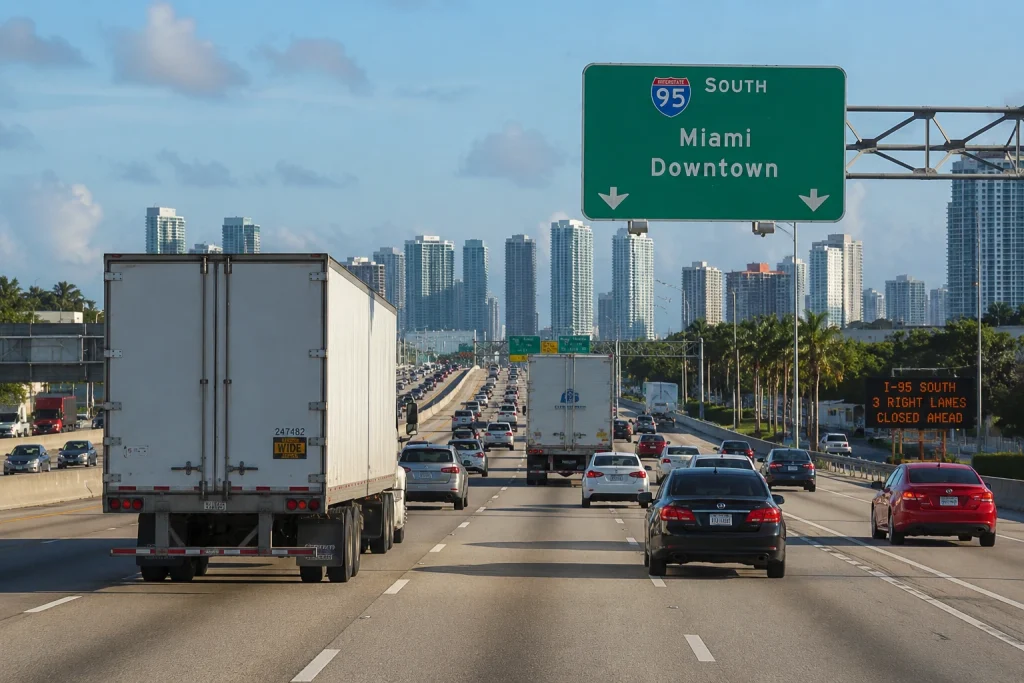
I-95: Pay Special Attention in Martin County
I-95 is the backbone of Florida’s East Coast and one of the most heavily traveled trucking corridors connecting Miami-Dade and Broward counties with Palm Beach, the Treasure Coast, and destinations farther north.
For fleets using this corridor, Martin County is particularly important because of the presence of weigh station facilities along I-95.
This affects both trucks heading north from Miami and Fort Lauderdale and those traveling south toward South Florida.
Weight enforcement is not limited to a truck’s gross vehicle weight. Load distribution matters because a truck can be within the applicable gross weight limit and still be overweight on an individual axle or axle group.
That is why scaling the truck before departure can help prevent problems hundreds of miles down the road.
Florida’s Turnpike: A Direct Route to Orlando Does Not Mean Fewer Weight Controls
For many truckers leaving Miami, Florida’s Turnpike is the most direct option for reaching Central Florida and Orlando.
However, traveling on a toll road does not eliminate the requirements associated with truck weight limits.
FDOT explains that its Motor Carrier Size and Weight program uses both fixed weigh stations and mobile enforcement with portable scales throughout Florida.
This is important because there is a common misconception that knowing the locations of permanent weigh stations allows drivers to anticipate every weight inspection.
It does not.
Mobile enforcement allows commercial vehicles to be checked away from permanent weigh stations. For a fleet, that means trip planning should be based on staying compliant throughout the entire route, whether the truck is traveling on I-95, Florida’s Turnpike, or a connection between the two.
West Palm Beach and Fort Pierce: A Corridor Where It Pays to Recheck the Load
The stretch from West Palm Beach to Fort Pierce deserves particular attention for trucks continuing north on I-95.
This does not mean that every city has a permanent weigh station. However, truckers traveling through this corridor may encounter weight enforcement at different points along the route, as well as mobile commercial vehicle enforcement operations.
For a reefer or dry van loaded in Miami-Dade County, traveling dozens or hundreds of miles can result in cargo shifting if the load was not properly secured.
Before continuing toward Central Florida, drivers should pay particular attention to axle weights, tandem position, and load securement.
Sliding the tandems can change how weight is distributed between the drive axles and trailer axles. A weight-distribution problem does not disappear simply because the truck’s gross weight is below the applicable maximum.
What Is the Truck Weight Limit in Florida?
For a standard commercial combination vehicle, 80,000 pounds is the figure many truckers use as the maximum gross vehicle weight without a special permit on the Interstate Highway System.
But relying on that number alone can be a mistake.
Compliance also depends on axle weights, axle configuration and spacing, and any restrictions affecting the roads and structures along the planned route.
For vehicles exceeding normal legal dimensions or weight limits, FDOT administers the Over-Weight/Over-Dimension (OW/OD) permit system for state-maintained highways. Trip permits, annual permits, and other options may be available depending on the type of movement.
FDOT also maintains Overweight Routing Maps, Weight Restrictions Charts, and a Posted Bridges system, which should be reviewed when planning certain heavy-haul movements.
Oversize and Overweight Loads: One Rule Truckers Should Not Forget
Loads operating under special permits require even more careful planning.
FDOT’s movement conditions updated in July 2026 are clear on one important point: vehicles operating under these permits cannot bypass an open weigh station.
Having a permit also does not mean that the truck can use any road.
The State Permit Office oversees oversize and overweight permits on state highways, and certain permits require a specific approved route.
That is why a fleet moving machinery, equipment, construction materials, or other heavy freight between Miami and Orlando should check current restrictions before dispatching the truck.
I-95 or Florida’s Turnpike From Miami to Orlando?
There is no single answer.
Florida’s Turnpike provides a direct connection from South Florida to Orlando and avoids much of the coastal route. I-95, on the other hand, is a strategic option when the load includes pickups or deliveries in Fort Lauderdale, West Palm Beach, Fort Pierce, or other East Coast markets before heading toward Central Florida.
From a weight-enforcement perspective, neither highway should be viewed as a route for “avoiding” inspections.
Florida combines permanent facilities, weighing technology, and mobile enforcement operations. Weigh-in-Motion (WIM) systems can weigh commercial vehicles while they are moving and use that information to determine whether additional inspection is necessary. FDOT explains that vehicles exceeding certain thresholds may be directed to certified static scales for further weighing.
What to Check Before Leaving Miami
Before dispatching a load toward Orlando, an owner-operator or fleet manager should verify the gross vehicle weight, individual axle weights, load distribution, tandem position, and load securement.
For an overweight or oversize load, the carrier should also confirm that the permit applies to the specific vehicle, load, and planned route, while checking current bridge and route restrictions.
FDOT warns that restrictions can change, which means trip planning should be based on current information rather than solely on experience from previous runs.
Miami-Orlando: Weight Can Help Determine the Route
Between Miami, Fort Lauderdale, West Palm Beach, Fort Pierce, and Orlando, I-95 and Florida’s Turnpike are essential parts of Florida’s freight network.
For truckers, knowing where weight enforcement may occur is useful. But what matters even more is understanding that Florida weigh stations and mobile enforcement are part of a statewide compliance system, rather than a handful of isolated checkpoints.
A properly weighed truck with correctly distributed and secured cargo can help prevent fines, delays, emergency load adjustments, and problems during an inspection.
Before beginning a run between Miami and Orlando, checking Florida truck weight limits, current route restrictions, and the condition of the truck and load should be just as routine as checking traffic or calculating fuel needs.
And for any commercial trucking operation, planning does not end with weight compliance: having the right insurance coverage helps protect the driver, truck, and cargo throughout the entire trip.
 Business hours: Monday to Friday from 8:00 AM to 5:00 PM. California time