 Hable con un agente al (888) 572-7520
  Enviar mensaje a un agente

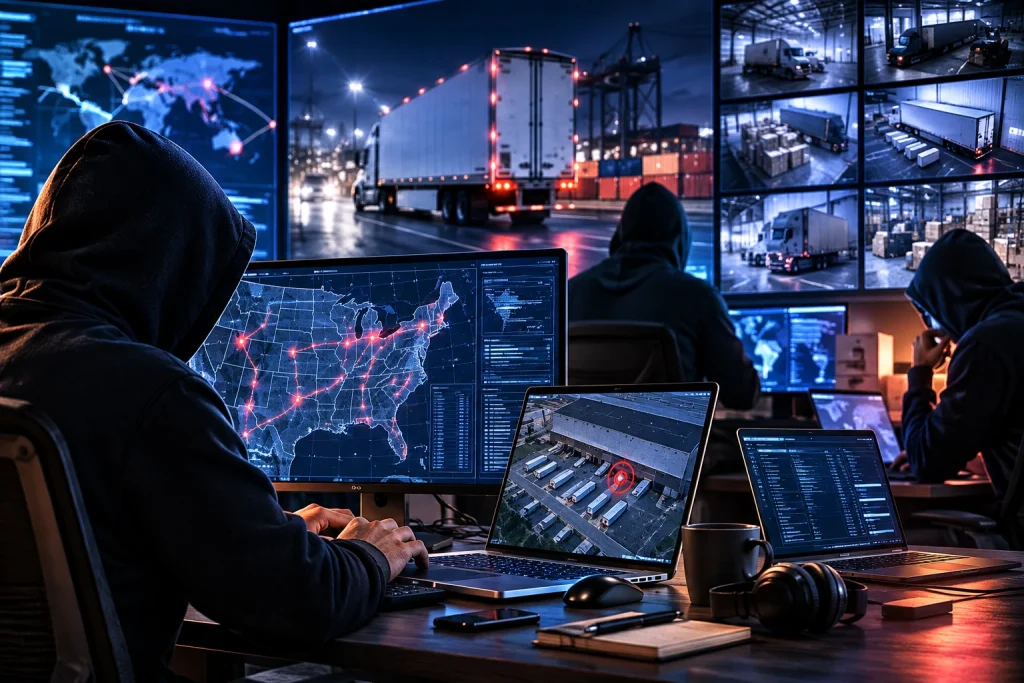

Cargo theft is changing across the United States, and Florida is part of that transformation. The state remains one of the country’s major hotspots for cargo crime, along with California and Texas, but the methods used by organized theft groups are becoming increasingly sophisticated.
The risk is no longer limited to a loaded trailer left unattended for hours at a truck stop. Some criminal organizations want to know in advance what a truck is carrying, how much the freight is worth, where it is being picked up and where it is headed. That information allows them to target the most profitable shipments and, in some cases, attempt to redirect them before they complete their journey.
Florida is particularly vulnerable because of the enormous volume of freight moving through its ports, warehouses, distribution centers and major logistics corridors. South Florida, including Miami-Dade, Medley and Doral, handles thousands of freight movements every day.
The shift in cargo crime can be summarized by two major changes: thieves are paying closer attention to the value of what trucks are carrying, while at the same time using digital tools to obtain information or interfere with legitimate freight operations.
Fewer Thefts, but Much Bigger Losses
Data from the second quarter of 2026 helps illustrate the trend nationwide. During that period, 677 cargo theft incidents were recorded across the United States and Canada, down 26% from the same quarter in 2025.
But the decline in the number of incidents came with a sharp increase in financial losses. Reported losses reached approximately $304.6 million, while the average reported value climbed to $564,009 per incident.
In other words, there were fewer thefts, but some of the hits were far more expensive.
Florida also presents an interesting signal. CargoNet detected a decline in organized theft activity involving loaded and unattended trucks in major metropolitan areas, including South Florida. That may sound encouraging, but it does not necessarily mean the risk has disappeared.
Part of the crime is simply changing its targets and methods.
Copper and Industrial Metals Are Attracting Thieves
One of the trends observed during 2026 is growing criminal interest in certain metal shipments. During the second quarter, CargoNet recorded 80 thefts involving metal commodities, compared with 54 during the same period a year earlier.
Copper topped the list, along with aluminum, nickel, tungsten and other specialized industrial metals.
Their appeal is tied both to their value and to the ability to move those materials back into different markets. For a criminal organization, knowing in advance that a trailer is carrying copper can make that truck a much more attractive target than another vehicle selected simply because an opportunity presents itself.
That is one of the biggest changes in modern cargo theft: selecting the right commodity is becoming increasingly important compared with stealing freight at random.
Hackers are becoming a growing threat to the logistics industry.
Technology Has Become a Target Too
Technology equipment fits into the same pattern. Servers, computers and enterprise networking equipment are among the commodities targeted by specialized theft groups. Criminal interest has also been detected in certain types of equipment used for cryptocurrency mining.
A trailer carrying these products can contain hundreds of thousands of dollars worth of merchandise. Depending on the type and quantity of equipment, the value can be significantly higher.
That helps explain why the financial cost of cargo theft can increase even when the overall number of incidents declines. If criminal organizations can identify and target higher-value shipments, they need fewer successful thefts to generate much larger losses.
But technology is not only found inside the trailers.
It is also being used to get to them.
A Cargo Theft Can Start Behind a Computer
The FBI has warned about cargo theft schemes facilitated by digital tools. In these cases, criminals attempt to infiltrate some part of a legitimate logistics operation by using information or identities that allow them to appear legitimate.
Methods include impersonating carriers or brokers, compromising email accounts, creating fraudulent websites, stealing business identities and changing pickup or delivery instructions.
The goal is to make sure a legitimate shipment ends up in the wrong hands.
For example, an apparently legitimate instruction may change the delivery location. Someone may arrive to pick up freight using the identity of a real carrier. A supposed last-minute update may also instruct the driver to take the trailer to a different warehouse.
In these situations, criminals do not need to break into a parking lot in the middle of the night or cut the lock off a trailer. If the deception works, the legitimate logistics operation itself may end up transporting the freight directly to a location controlled by the thieves.
By the time the fraud is discovered, the cargo could be hundreds of miles away from its intended destination or already transferred to other vehicles.
Why Florida Remains a Sensitive Cargo Theft Hotspot
The size of Florida’s logistics industry makes the state particularly relevant when examining these new theft methods. Miami-Dade and other parts of South Florida are home to warehouses, distribution centers, trucking companies and connections to some of the state’s busiest freight corridors.
Those facilities also handle electronics, food products, industrial materials and other high-value commodities.
A recent case in Medley illustrates how attractive technology shipments can be. Police investigated the theft of more than $31,000 worth of Apple products being transported in a FedEx truck. According to the investigation, the truck made an unauthorized stop and some of the merchandise was transferred to another vehicle.
In another operation conducted during 2026, Florida authorities dismantled an organization linked to approximately $7.8 million in stolen merchandise.
The methods investigated in each case may differ, but they demonstrate the financial scale cargo theft can reach in Florida.
What This Means for Florida Truckers
For drivers, owner-operators and fleets, physical truck security remains critical. Parking in secure locations and using GPS systems, alarms, immobilizers, seals and tracking technology continue to be basic components of cargo protection.
The difference is that security now has to extend to the information surrounding every load.
An unexpected change to a delivery address, a different phone number, a new broker contact or a last-minute modification should be independently verified before picking up, moving or delivering a shipment, especially when high-value freight is involved.
Drivers and carriers should also limit how much information they share about a trip. Details that may seem routine — including what is inside the trailer, the destination, expected schedules or planned stops — can be valuable to someone trying to locate a specific shipment.
Transportation security, therefore, no longer ends at the trailer doors. It also extends to emails, phone calls, credentials, load platforms and delivery instructions.
The New Cargo Theft Combines the Street With Technology
The transformation of cargo theft does not mean traditional theft has disappeared. Parked trailers, warehouses and rest areas continue to require close attention.
What has changed is that those traditional risks now coexist with criminal organizations capable of identifying high-value commodities and using digital information to get closer to them.
For truckers operating in Florida, particularly around Miami, Medley and South Florida’s major logistics hubs, that means combining two types of prevention: physically protecting the truck while carefully verifying the information that determines where a shipment is picked up, where it is going and who is authorized to receive it.
Because cargo theft can still begin at a truck stop or warehouse.
But increasingly, it can begin much earlier — behind a computer, with a message that looks completely legitimate.
 Business hours: Monday to Friday from 8:00 AM to 5:00 PM. California time