 Hable con un agente al (888) 572-7520
  Enviar mensaje a un agente

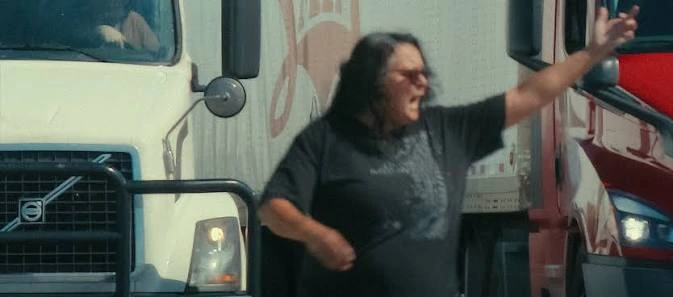

The life of a truck driver can look, from the outside, like an endless succession of highways, cities, and landscapes. But behind the wheel are days shaped by delivery schedules, long hours away from home, financial pressure, isolation, and a truck that often serves as both a workplace and a home.
That reality is at the heart of DRIVER, the documentary directed by Nesa Azimi that received an nomination at the 47th Annual News & Documentary Emmy Awards 2026 in the Outstanding Business and Economic Documentary category. The film was presented by American Documentary and POV and aired on PBS.
The nomination brought a story that is especially familiar to those working in the U.S. trucking industry to a much wider audience: what it really means to build a life on the road.
A truck driver at the center of the story
The documentary follows Desiree Wood, a Mexican-American long-haul truck driver from California who has spent 15 years in the industry and logged more than one million safe miles. But her role in trucking goes far beyond driving.
In 2010, she founded REAL Women in Trucking, an organization through which she became one of the most recognized advocates for women truck drivers and people entering the profession.
Her work focuses particularly on improving training for new drivers, combating harassment and sexual violence within the industry, addressing discrimination, advocating for safe truck parking, raising CDL training standards, and promoting better pay and working conditions.
Wood also serves as president of Truckers Emergency Assistance Responders (T.E.A.R.) and has participated in several transportation and highway safety committees, including advisory bodies in Florida and Nevada and a driver subcommittee of the Federal Motor Carrier Safety Administration.
Her firsthand experience on the road has also made her a resource for lawmakers, researchers, attorneys, and industry experts seeking to better understand the challenges facing American truck drivers.
But DRIVER does much more than simply follow her behind the wheel.
According to the official PBS synopsis, the documentary follows Wood as she tries to balance her own life on the road with her work leading a driver-led movement, while she and other women truckers navigate the challenges of an industry undergoing major change.
The film was shot over three years on the road, allowing Azimi to capture something that is difficult to understand from the outside: the everyday routine of people who spend a significant part of their lives inside a truck.
It is not simply about driving. The film explores the relationships that develop among drivers, time away from family, financial concerns, the search for safety, and the need to find community in a profession often defined by isolation.
“Seeing America is incredible, but it’s not a vacation”
One of the ideas running through the documentary captures that contradiction especially well.
During production, one of the truck drivers explains that seeing America from the road can be extraordinary, but immediately adds an important clarification: “it’s not a vacation.”
The comment was highlighted by the International Documentary Association (IDA) in an interview with Azimi about making the film.
It is a distinction any OTR driver understands.
The scenery may change every day, but behind it are still delivery schedules, fuel costs, parking, rest requirements, truck maintenance, and weeks spent away from home.
For Wood, financial pressure also plays an important role in the story. The documentary shows her trying to keep working while facing the possibility of having her own truck repossessed because she cannot keep up with the payments.
Women in a historically male-dominated industry
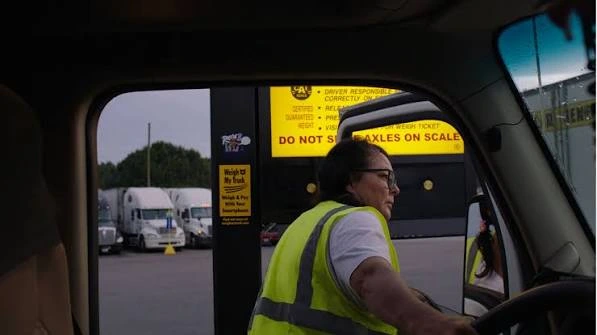
DRIVER places particular emphasis on the experiences of women in trucking.
Wood is not alone. She is joined by other long-haul drivers who have built a community within a profession that, by its very nature, keeps people separated for long periods of time.
The International Documentary Association, one of the organizations that supported the project, explains that the film also addresses safety concerns and sexual violence experienced by women in the industry.
Wood turned some of those experiences into advocacy.
She is the founder of REAL Women in Trucking, an organization created to give a voice to women working as professional drivers. In a later interview with PBS, she explained that she began by writing about her own experiences in trucking, and those stories eventually led her to advocate for other women drivers.
A camera inside OTR life
The director deliberately avoided turning the film into a conventional investigation of the industry’s problems.
Azimi explained that she had originally planned to approach the story from a more investigative perspective, but the project evolved into a much more intimate portrait of Wood and her community.
The result is a film that seeks to show truck drivers as people, rather than simply as another link in the supply chain.
“I wanted to make DRIVER to tell a universal story about work through the experience of Desiree and her fellow truck drivers,” Azimi explained when presenting the film, according to American Documentary.
To achieve that level of intimacy, the production team accumulated an enormous amount of footage. Wood later said that approximately 700 hours of footage were recorded over several years and ultimately condensed into a documentary running about 90 minutes.
From the trucking world to the Emmys
DRIVER premiered at the Tribeca Festival in 2024 and later reached U.S. television through POV. Its national PBS premiere took place on September 1, 2025, Labor Day, a date closely associated with American workers and the labor movement.
The production reached another major milestone in 2026.
The official list of nominees for the News & Documentary Emmy Awards included DRIVER among the five nominees for Outstanding Business and Economic Documentary.
The category is particularly significant because it recognizes the film not only as a personal story, but also as an examination of work and the economic realities surrounding the trucking industry.
The road behind the postcard
The Emmy nomination brought one of the most familiar settings for thousands of American truck drivers into an unusual spotlight: one of television’s most prestigious awards.
In DRIVER, the road is not simply a backdrop. It is where the people in the film work, eat, rest, build friendships, deal with problems, and spend a significant part of their lives.
And that may be one of the reasons the story feels so familiar to people who know trucking from the inside.
The United States depends on trucks to move much of what people use every day, yet the lives of the people behind the wheel often remain invisible to those who only see an 18-wheeler passing by on the highway.
DRIVER puts the camera exactly there: inside the cab and alongside the people who have made the road their workplace and, in many cases, their home.
 Business hours: Monday to Friday from 8:00 AM to 5:00 PM. California time