 Hable con un agente al (888) 572-7520
  Enviar mensaje a un agente

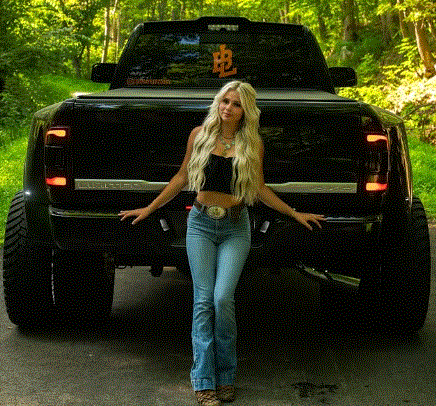

A customized semi, thousands of miles on the road and a smartphone can be enough to build an audience of hundreds of thousands. Social media has created a new generation of trucking influencers who have turned life behind the wheel into content.
TikTok, Instagram and YouTube are packed with videos about OTR trips, repairs, custom trucks, sleeper cabs, loads, truck stops and the everyday routines of people who spend much of their lives on the road. But some creators have taken it much further, turning that world into a personal brand that blends transportation, fashion, mechanics, entertainment and lifestyle.
The United States is home to some of the best-known examples, although the phenomenon has become increasingly international.
Katrina Drazdova: “From High Heels to Big Wheels”
Katrina Drazdova is one of the clearest examples of the crossover between fashion, personal image and heavy trucks.
Her content revolves around professional driving and life on the road, but with an aesthetic much closer to the influencer world than the traditional image of a truck driver.
Her motto, “From High Heels to Big Wheels,” sums up that identity: heels, fashion and modeling share the stage with articulated trucks and long-haul trips.
Drazdova has made that contrast a major part of her online presence and is a strong example of how the trucking lifestyle has found an audience that extends far beyond transportation professionals.
Lindsay Bercosky: Trucks, Mechanics and Modeling
Lindsay Bercosky occupies a different corner of the trucking creator world. She didn’t build her following primarily around OTR driving, but around trucks, modifications and hands-on mechanical work.
Her introduction is simple: “I work on trucks.”
And it works. Her TikTok account currently has around 1.18 million followers, with videos featuring transformations and mechanical projects generating millions of views.
Bercosky studied at Rosedale Technical College and has also worked as a model, two worlds that eventually came together in her digital presence.
Her videos feature installations, repairs, modifications and personal projects. Through Built By Lindsay LLC, she has also turned that online identity into a business.
Clarissa Rankin: Turning Trucking Into a Personal Brand
Clarissa Rankin is one of the most recognizable names among U.S. trucking influencers.
A professional truck driver, entrepreneur and content creator, Rankin has brought life behind the wheel to a massive audience through a combination of humor, personal style, family, travel and experiences from within the industry.
Her content has helped challenge the traditional image associated with truck drivers: makeup, fashion and an outgoing personality appear alongside trucks, highways and long working days.
But Rankin has turned her digital visibility into more than followers. She also created Road Knowledge Training Academy, which focuses on training new commercial drivers.
Her presence extends across Instagram, TikTok and YouTube.
Marissa Ortiz: Everyday OTR Life Becomes Content
Marissa Ortiz represents another side of the phenomenon: turning a driver’s everyday routine into content.
Trips, hours behind the wheel, stops, personal life and OTR experiences are all part of a format that has become especially popular on social media.
Big productions aren’t always necessary. One of the defining characteristics of trucking content is that situations that seem completely ordinary to a professional driver can be fascinating to millions of people who have never climbed into the cab of a semi.
That has turned the everyday reality of transportation into a genre of its own on TikTok, Instagram and YouTube.
Alex The Trucking Guy: More Than a Million YouTube Subscribers
The phenomenon isn’t exclusively female.
Alex The Trucking Guy is one of the clearest examples of how a truck driver’s experience can be transformed into digital entertainment.
His content covers trips, deliveries, life inside the semi, equipment and the realities of the profession. Videos about spending the night in the truck, handling a difficult delivery or simply documenting “a day in my life as a truck driver” can attract hundreds of thousands — and sometimes millions — of views.
In 2026, he has around 685,000 followers on TikTok, while his YouTube channel has surpassed 1.09 million subscribers.
His digital presence now also includes sponsorships, affiliate links and commercial partnerships, showing just how far trucking content can evolve into a business.
Daiane Cardoso: Brazil Has Its Own Trucking Stars
Outside the United States, Brazil has developed a massive digital community around its caminhoneiros.
Daiane Cardoso is one of its most visible figures.
A truck driver and content creator, she documents trips, mechanical problems, loads and everyday situations on Brazilian roads. Her posts blend work and lifestyle without hiding the difficulties that come with the profession.
Her following is substantial: she currently has around 490,000 TikTok followers, while her YouTube channel, Daiane Cardoso em Profissão Caminhoneira, has approximately 334,000 subscribers and more than 100 million views.
Some of her TikTok videos have generated several million views.
Felina Cristina Guerra: Brazilian Road Life and Lifestyle
Felina Cristina Guerra, @felina_cris is another representative of Brazil’s enormous community of truck-related creators.
Her content combines driving heavy vehicles with travel, everyday life and a lifestyle aesthetic connected to both the road and rural life.
Brazil is particularly interesting within this phenomenon because of its enormous trucking culture and the long distances that make life on the road a central part of the country’s transportation industry.
Social media has brought that traditional culture to a new and much more visual audience.
Lissy Reiterer and Her “Pink Lady”
Europe has its own trucker influencers, and Lissy Reiterer has become recognizable through a combination that’s hard to miss: international transportation, television and a customized truck known as the “Pink Lady.”
Reiterer gained exposure through European trucking-related content and television programs while building an identity around professional driving and her distinctive truck.
In her case, her digital appeal once again demonstrates the importance of the vehicle itself within a personal brand: color, accessories and customization make the truck almost as recognizable as its driver.
Vadim Tsagaraev: Heavy Logistics From Europe
Vadim Tsagaraey shows another side of the phenomenon.
His content is closer to that of a transportation entrepreneur and operator than a traditional model or influencer. Trucks, fleets, operations and trips are all part of a narrative built around European heavy logistics.
It’s an important distinction because it shows just how far this format has expanded: there is no single type of trucking influencer.
There are OTR drivers filming their workdays, models posing alongside heavy trucks, mechanics attracting millions of views by modifying vehicles and entrepreneurs turning their fleets into social media stars.
From the Truck Stop to the Algorithm
What these profiles have in common is the discovery that trucking is extraordinarily visual.
A customized truck can generate millions of views. So can a repair, a difficult maneuver, a sleeper cab transformation or something as ordinary as showing where a driver sleeps and cooks during an OTR trip.
Brands have found an audience there as well. Alex The Trucking Guy, for example, currently publishes sponsored content and uses affiliate links, while other creators have developed merchandise, their own businesses, training academies or commercial partnerships.
The phenomenon also crosses borders. The United States has an enormous community of trucking creators, but Brazil, Germany and other European markets have developed their own digital stars.
TikTok, Instagram and YouTube have done something that would have been difficult to imagine two decades ago: turning the inside of a semi, a repair shop or a truck stop into stages capable of reaching millions of people.
Trucking no longer lives only on the highway. It also lives — and increasingly thrives — in the algorithm.
 Business hours: Monday to Friday from 8:00 AM to 5:00 PM. California time