 Hable con un agente al (888) 572-7520
  Enviar mensaje a un agente



The federal government has changed one of the rules that has shaped vehicle design and availability for decades: the Corporate Average Fuel Economy standards, better known as CAFE.
The decision lowers the fuel economy targets automakers must meet for passenger cars and light trucks through 2031. It also changes the credit system manufacturers use to comply with the standards and revises the criteria used to determine which vehicles qualify as light trucks.
The Department of Transportation (DOT) announced the final rule on September 28 as part of its Freedom Means Affordable Cars initiative. The rule was issued by the National Highway Traffic Safety Administration (NHTSA), the agency that administers the Corporate Average Fuel Economy** (CAFE) program.**
The difference is substantial. Under the previous rule, finalized in 2024, NHTSA projected that the standards would bring the industry-wide average for passenger cars and light trucks to about 50.4 miles per gallon by model year 2031. The new rule projects an average of 34.9 mpg for that same model year, compared with 30.1 mpg for model year 2024.
That does not mean every new pickup will be required to get 34.9 mpg, nor is that necessarily the number drivers will see on a new vehicle’s window sticker. CAFE measures automakers’ compliance across their fleets using its own regulatory calculations. The 34.9 mpg figure is most useful as a measure of how far the federal target has been lowered from the previous standard.
For automakers, the change provides more flexibility in how they meet federal requirements and which technologies they incorporate into future models.
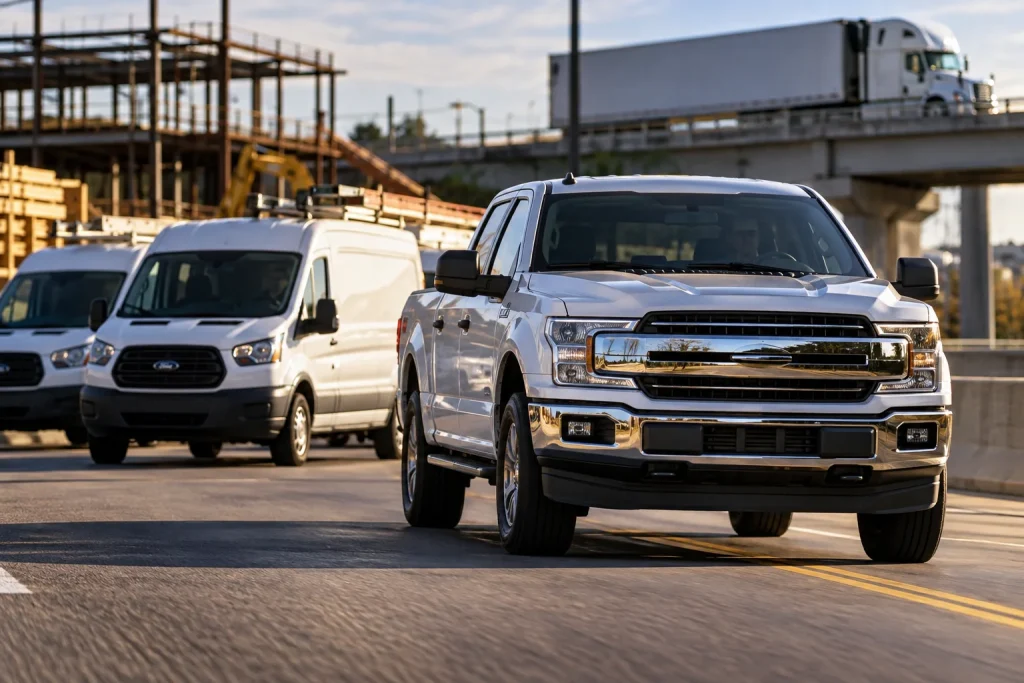
Vehicle prices are at the center of the change
The Trump administration argues that the previous targets required automakers to make investments that ultimately increased vehicle prices while accelerating the transition toward electric vehicles.
Under the new rule, the DOT estimates that the average price of a new vehicle could fall by about $1,300. The agency also projects $138 billion in total savings over the next five years.
Those are administration estimates. They do not mean a pickup priced at $50,000 today will automatically cost $1,300 less. The actual impact will depend on individual manufacturers, the vehicles they produce and broader market conditions.
For a commercial fleet, the purchase price is only one part of the equation.
Looser standards could reduce some of the costs associated with regulatory compliance, but they also allow the industry to meet a considerably lower fuel economy target than previously planned. For a work vehicle accumulating thousands of miles, differences in fuel consumption eventually show up in operating costs.
That will be one of the numbers worth watching as manufacturers introduce vehicles developed under the new standards: whether purchase prices actually come down, and what happens to fuel costs over the vehicle’s working life.
Pickups and vans — but not every truck
The word truck matters here because federal regulations divide vehicles into several different categories.
The new CAFE rule covers passenger cars and light trucks. That category includes many pickups, SUVs and vans, but not the large tractors hauling freight on the nation’s highways.
That leaves semitrucks and Class 8 tractors outside this particular rule, but the change is still relevant to the transportation industry. Many companies run mixed fleets, using pickups and vans alongside heavy trucks for maintenance, supervision, local operations and other jobs.
There is another important distinction. Class 2b and Class 3 heavy-duty pickups and vans are covered by separate standards. NHTSA established requirements for those vehicles for model years 2030 through 2035 in 2024 and, in January 2026, announced plans to reconsider those standards as well.
The rule announced this week, therefore, should not be confused with that process or with the standards governing heavy trucks.
CAFE credit trading is coming to an end
Lower fuel economy targets are not the only change. Beginning with model year 2028, NHTSA will eliminate the system that allows CAFE credits to be traded between manufacturers. Until now, an automaker with available credits could sell them to another manufacturer that needed them to meet its compliance requirements.
The new rule eliminates that trading between manufacturers, although the CAFE program retains other compliance mechanisms allowed under federal law.
The change matters because credits have developed into an economic tool within the regulatory system. The administration argues that eliminating credit trading will prevent manufacturers of conventional vehicles from depending on credits generated by other automakers to meet federal targets.
Beginning in 2028, automakers will therefore have fewer options to rely on another manufacturer’s credits to close a CAFE compliance gap.
The definition of a light truck is changing, too
Another less visible change — but one with potentially significant implications for the auto market — begins with model year 2030.
NHTSA will revise the criteria used to distinguish passenger cars from light trucks. According to the Department of Transportation, the current system has encouraged design changes that allowed certain crossover vehicles to be classified as light trucks and therefore become subject to different standards.
The federal government projects that the new criteria could substantially change the regulatory makeup of the vehicle fleet. Currently, roughly 70% of the fleet is classified as light trucks and 30% as passenger cars. DOT estimates the revised criteria could shift that balance to approximately 30% light trucks and 70% passenger cars.
That does not mean pickups, vans or SUVs are disappearing. The change affects which vehicles technically qualify for a regulatory category that has historically been treated differently under CAFE.
What happens to electric vehicles?
The White House and DOT have described the new rule as ending the “EV mandate.” That is the administration’s term for the effect it says the previous standards had on the auto market.
CAFE, however, did not require an individual driver or company to buy an electric vehicle. It set fleet-wide targets for manufacturers. The administration’s argument is that those targets were high enough that automakers effectively had to increase EV production to comply.
The new rule does not remove electric vehicles from the market, either. Manufacturers can continue offering EVs, hybrids and internal-combustion vehicles. What changes is the federal standard around which they will plan that mix.
For companies buying work vehicles, the calculation ultimately comes back to familiar numbers: acquisition cost, fuel, maintenance, capacity, utilization and resale value.
That is where the impact of the new rule will become clearer. Less stringent standards may give manufacturers room to offer lower-priced vehicles, as the administration argues, but the cost of a commercial vehicle does not end when it leaves the dealership.
For fleets running pickups and vans, the number that matters is what it costs to put each vehicle on the road and keep it working throughout its service life. The new CAFE standards change the regulatory environment in which those vehicles will be built. The next question is how automakers translate that additional flexibility into the pickups and vans fleets actually buy.
 Business hours: Monday to Friday from 8:00 AM to 5:00 PM. California time