 Hable con un agente al (888) 572-7520
  Enviar mensaje a un agente


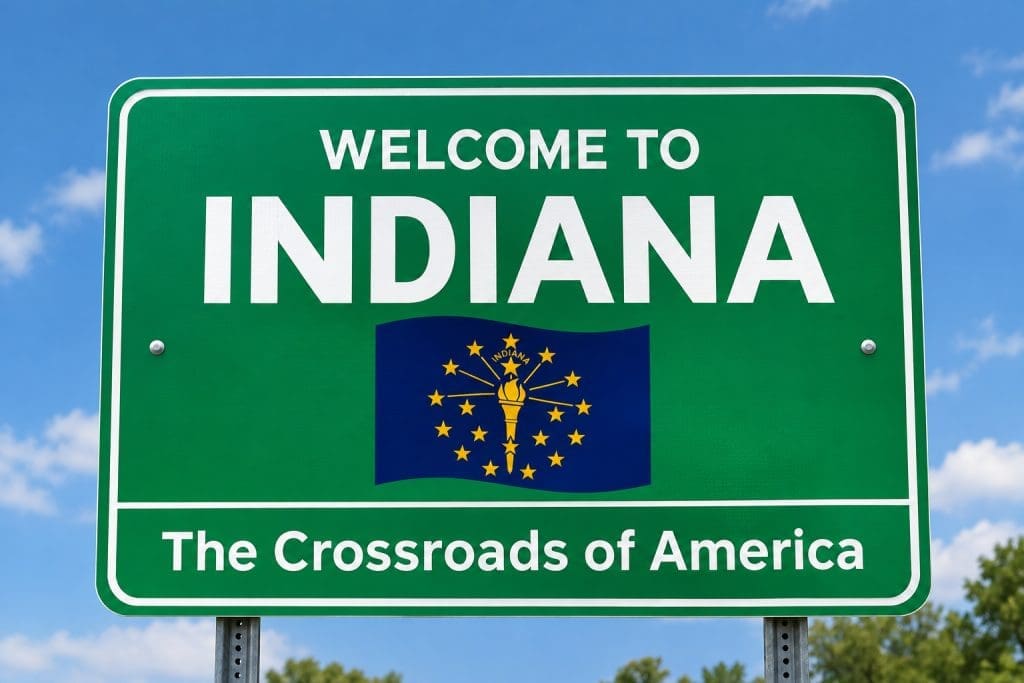
Crossroads of America is Indiana’s official nickname, reflecting the state’s strategic position in the U.S. transportation network.
Every day, thousands of trucks travel along its highways, carrying food, vehicles, machinery, raw materials, and manufactured goods between some of the nation’s largest economic centers.
According to the Indiana Department of Transportation (INDOT), the state ranks fifth nationally in commercial freight traffic, with approximately 724 million tons of goods moving through its territory each year.
Indiana’s importance extends far beyond the businesses operating within its borders. The state also serves as a major transportation corridor for truckers traveling between Illinois, Ohio, Michigan, Kentucky, and other parts of the country.
But behind those impressive numbers are some fascinating stories: a historic intersection that inspired the state’s nickname, an interstate highway that took decades to complete, a special right-of-way law for large trucks at roundabouts, and a city that helped revolutionize diesel engines.
The Intersection Where Crossroads of America Began
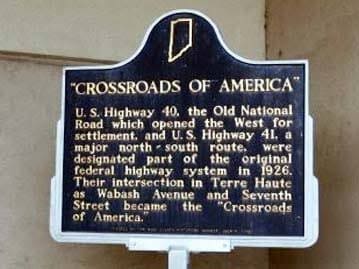
The story behind Indiana’s nickname begins at a particular intersection in Terre Haute.
That’s where U.S. Highway 40 and U.S. Highway 41 meet, two roads that played important roles in the expansion of American transportation.
US-40 follows part of the historic National Road, which helped open routes westward across the country. US-41 became a major north-south connection.
In 1926, both highways became part of the U.S. numbered highway system. Their intersection became known as Crossroads of America, a name that eventually came to represent the entire state.
The Indiana Historical Bureau preserves this history through an official historical marker in Terre Haute.
In 1937, the Indiana General Assembly formally adopted “The Crossroads of America” as the state’s motto.
The Highways Connecting Indiana to the Rest of the Country
According to the Indiana Secretary of State, Indiana has one of the highest concentrations of interstate highways per square mile in the United States.
Several major freight corridors cross the state:
- I-65: Connects the Chicago area with Indianapolis and Louisville, Kentucky.
- I-69: Links Michigan, northeastern Indiana, Indianapolis, and southwestern Indiana.
- I-70: Crosses Indiana east to west, connecting major markets in Ohio and Illinois.
- I-74: Provides connections between Indianapolis, Cincinnati, and central Illinois.
- I-80/I-90: Forms the Indiana Toll Road, one of the state’s most important northern freight corridors.
- I-94: Connects the Chicago metropolitan area with Michigan.
This extensive highway network allows trucks to reach industrial facilities, distribution centers, warehouses, and major consumer markets efficiently.
A historical estimate included in Indiana’s 2015 Multimodal Transportation Plan indicated that approximately 75% of the U.S. and Canadian population was within a one-day truck drive of Indiana. That figure reflects planning data published in 2015 and should not be considered an updated measurement for 2026.
Indiana Also Helped Revolutionize Diesel Engines
One of Indiana’s most interesting contributions to trucking involves the history of diesel engines.
In 1919, Clessie Cummins founded Cummins Engine Company in Columbus, Indiana. The company would eventually become one of the world’s leading diesel engine manufacturers.
During the 1930s, Cummins conducted demonstrations to prove that diesel engines could power road vehicles and offer advantages for long-distance transportation.
These experiments included trucks and automobiles equipped with diesel engines at a time when gasoline still dominated much of the American transportation industry.
The official history of Cummins documents how those early experiments contributed to the development of heavy-duty transportation.
Diesel technology did not become widespread overnight, but Indiana was closely connected to an innovation that would eventually transform the trucking industry.
An Unusual Law: Large Trucks Have Special Right-of-Way Rules at Roundabouts
Indiana has another feature that may surprise drivers from other states.
Since 2017, state law has provided special right-of-way protections for certain large commercial vehicles traveling through roundabouts.
Under Indiana Code Section 9-21-8-10.5, other drivers must yield to vehicles that are at least 40 feet long or 10 feet wide when traveling simultaneously within a roundabout or when there is an immediate danger of a collision.
This does not mean a truck can enter any roundabout without following normal traffic rules. The provision applies to specific circumstances and is designed to reduce risks associated with maneuvering large vehicles.
Semi-trucks require additional room to turn, particularly when pulling long trailers. Their blind spots and turning radius can create dangerous situations when passenger vehicles attempt to travel alongside them.
For professional truck drivers, this law is one of Indiana’s most distinctive traffic regulations.
Nearly 17,000 Trucking Companies Registered in Indiana
Trucking has a substantial business presence in Indiana, ranging from large fleets to small independent carriers.
The Indiana Department of Revenue’s 2025 Annual Report provides a revealing figure: during that fiscal year, the agency administered registrations for nearly 17,000 Indiana-based carriers under the Unified Carrier Registration (UCR) system.
The same report highlights the scale of commercial transportation activity:
- Approximately 10,000 active accounts under the International Fuel Tax Agreement (IFTA).
- Around 540,000 fuel tax decals issued through that program.
- Nearly 425,000 oversize and overweight vehicle permits issued during fiscal year 2025.
These numbers represent different administrative registrations and transactions. They should not be added together to calculate the total number of trucking companies or vehicles.
The high volume of permits also reflects the importance of specialized freight transportation, including industrial machinery, construction equipment, and oversized components.
The Interstate Highway That Took Decades to Complete
Another remarkable Indiana transportation story involves Interstate 69.
The highway’s development between Evansville and Indianapolis required decades of planning, environmental studies, and construction.
The project covered approximately 142 miles, divided into six sections. The final segment, known as the I-69 Finish Line, completed the interstate connection between the two cities in 2024.
According to INDOT, at the peak of construction in 2012, I-69 represented the longest continuously active new-terrain interstate highway construction project in the United States.
The completed connection improved freight transportation between southwestern Indiana, Indianapolis, and interstate corridors serving other markets.
Bridges Are Also Part of Indiana’s Trucking History
Indiana’s transportation network depends on major bridges that connect communities and neighboring states across important waterways.
One example is the Sherman Minton Bridge over the Ohio River, which connects New Albany, Indiana, with Louisville, Kentucky, along I-64.
Another is the Wabash Memorial Bridge on State Road 62 in Posey County. It connects Indiana with Illinois and plays an important role in agricultural freight transportation.
Bridge repairs, weight restrictions, and lane reductions can force trucking companies to adjust their routes.
INDOT maintains bridge restriction information and maps that help carriers identify load limitations and plan their trips.
The state is also advancing the I-69 Ohio River Crossing project, designed to improve transportation between Evansville, Indiana, and Henderson, Kentucky.
Indiana Has Roundabouts Designed for 76-Foot Semi-Trucks
Indiana’s roundabouts are notable not only for their special traffic laws but also for their engineering.
As part of the US-36 and Raider Road intersection project, INDOT presented vehicle simulations showing how a 76-foot semi-truck could navigate the roundabout.
The design includes a traversable inner surface that provides additional maneuvering space for large vehicles.
Engineers also studied the movement of oversized loads, including wind turbine components.
INDOT’s technical explanation illustrates how roundabout design can accommodate the operational needs of commercial trucks without eliminating the safety advantages these intersections can provide.
Where Truckers Can Rest While Crossing Indiana
With so many trucks traveling through the state, parking and rest facilities are essential.
INDOT operates 25 facilities, including rest areas, welcome centers, and truck parking locations, distributed across 17 interstate sites.
Some facilities serve both directions of travel, while others are accessible from only one side of the highway.
The official INDOT website provides information about rest areas and transportation facilities, including locations and closures related to construction or maintenance.
Indiana also participates in technology-based truck parking information systems that help drivers identify available spaces and plan mandatory rest periods.
For long-haul truckers, access to reliable parking information is particularly important when complying with federal hours-of-service regulations.
Fuel Taxes Come With Specific Rules for Trucking Companies
Commercial carriers traveling through Indiana must also understand the state’s fuel tax requirements.
For the period from July 1, 2026, through June 30, 2027, the Indiana Department of Revenue establishes a special fuel tax rate of 63 cents per gallon, while the Motor Carrier Fuel Tax rate for gasoline is 37 cents per gallon.
Tax filing requirements may apply to vehicles with a gross vehicle weight exceeding 26,000 pounds, certain vehicle combinations, and vehicles with three or more axles. Exceptions depend on the type of operation.
For companies operating across multiple states, understanding these requirements is an essential part of managing transportation costs and maintaining tax compliance.
Carriers can review current requirements through the Indiana Department of Revenue.
A Freight Corridor That Will Continue to Grow
Indiana’s importance to freight transportation goes beyond its current traffic volumes.
INDOT maintains a planning projection suggesting that freight movement could increase by 60% by 2040. This forecast highlights the need for continued investment in highways, bridges, and commercial vehicle services.
Infrastructure improvements also involve major corridors such as I-65, I-70, and I-69, along with projects designed to strengthen connections and reduce congestion.
Truck drivers can check construction activity, closures, and traffic alerts through TrafficWise, Indiana’s official traveler information service.
From the historic intersection in Terre Haute to its modern interstate highways, Indiana has built an identity closely tied to trucking and the movement of freight.
Its transportation history includes innovators who helped develop diesel engines, special traffic laws for oversized vehicles, strategically important bridges, and infrastructure used by thousands of commercial carriers.
That is why the nickname Crossroads of America continues to carry a very practical meaning: Indiana is not simply a state that trucks pass through. It is one of the places that keeps the American economy connected.
 Business hours: Monday to Friday from 8:00 AM to 5:00 PM. California time