 Hable con un agente al (888) 572-7520
 Enviar mensaje a un agente


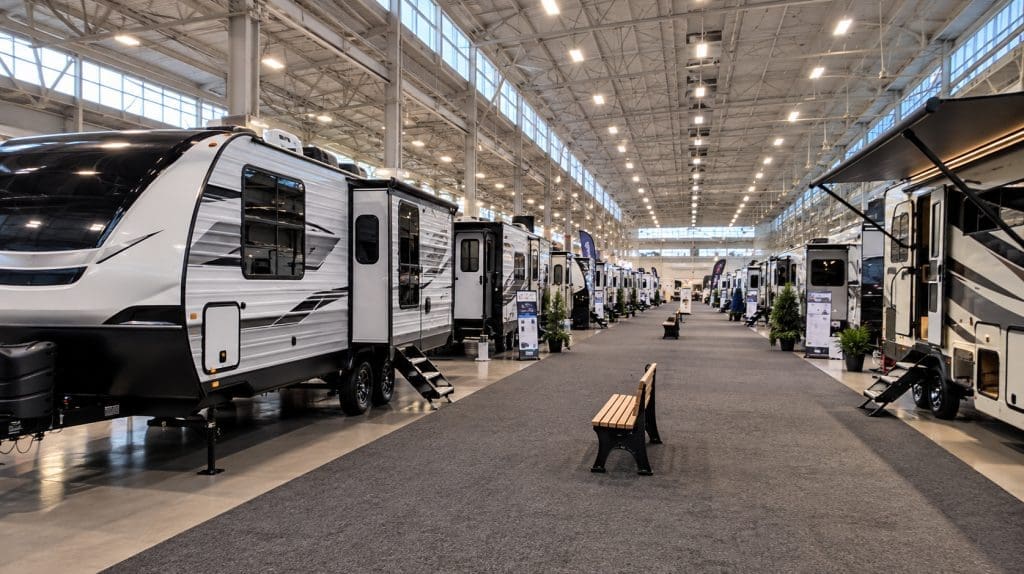

In northern Indiana, highways offer an unusual sight: pickup trucks towing massive travel trailers, brand-new recreational vehicles rolling straight from the factory, and drivers traveling hundreds or even thousands of miles to deliver RVs that haven’t yet been sold to customers.
Many of these trips begin in Elkhart, a city widely known as the RV Capital of the World.
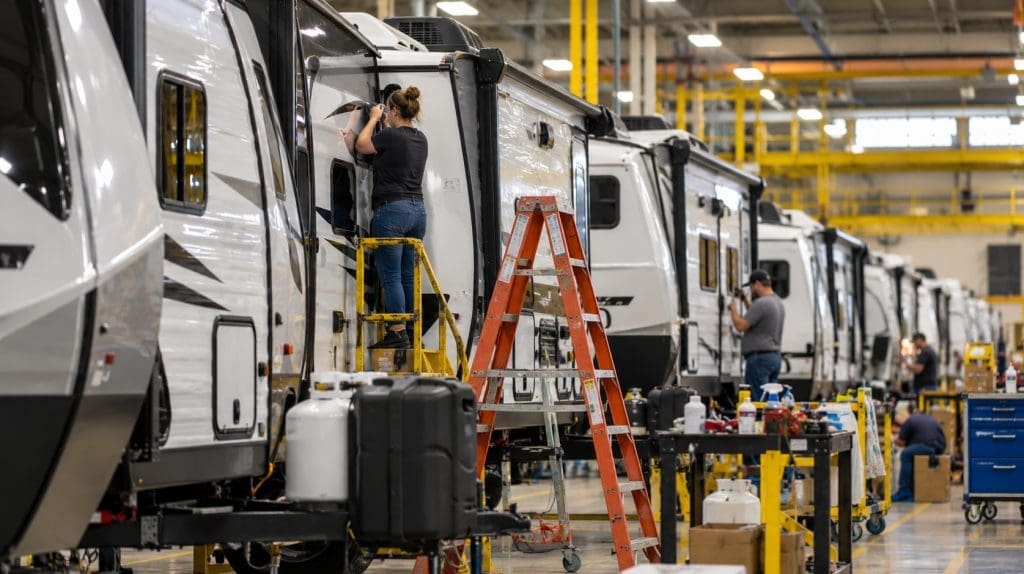
The Elkhart-Goshen region is home to one of the world’s largest concentrations of recreational vehicle manufacturers. Major companies such as THOR Industries, Forest River, Jayco, and Grand Design operate in the area, alongside hundreds of suppliers producing everything from furniture and electrical systems to frames, windows, and other components.
But beyond the assembly lines, another industry plays a critical role in keeping the RV business moving: transporting newly manufactured recreational vehicles from factories to dealerships throughout the United States and Canada.
Unlike many other commercial trucking jobs, not every driver making these deliveries needs a Commercial Driver’s License (CDL). Depending on the vehicle’s weight rating, configuration, and classification, some drivers can perform these deliveries with a regular driver’s license, although other federal and state requirements may still apply.
Elkhart: How an Indiana City Became the RV Capital of the World
The region’s RV industry began taking shape in the early decades of the 20th century, when small manufacturers in northern Indiana started building trailers that allowed travelers to sleep on the road without relying on hotels.
During the Great Depression, demand for affordable travel trailers created opportunities in a region already known for its skilled workers in woodworking, metalworking, and vehicle manufacturing.
Over the following decades, the industry expanded, turning Elkhart into the center of a manufacturing network serving customers across North America.
The concentration of manufacturers also encouraged the growth of specialized suppliers. One company might produce steel frames, another manufacture cabinets, and a third supply air-conditioning systems, windows, or electrical components.
This network allows multiple stages of RV production to take place within just a few miles of one another.
Another distinctive feature of the region is the involvement of workers from Amish and Mennonite communities, known for their craftsmanship and woodworking traditions. Although practices vary among communities, their participation has long been part of the local industry’s history.
The result is a uniquely Indiana combination: communities with deep traditional roots helping manufacture modern recreational vehicles equipped with entertainment systems, climate control, and advanced electrical technology.
The Lesser-Known Business: Getting Paid to Deliver RVs
When a recreational vehicle leaves the factory, it often has a long journey ahead before reaching the dealership where it will be sold.
To complete that trip, manufacturers and distributors rely on specialized RV transportation companies.
Companies operating in this market include Horizon Transport, Wave Express, Indiana Transport, and Classic Transport, which connect manufacturing facilities with dealerships across North America.
A typical assignment might involve driving a new motorhome from Indiana to California, towing a travel trailer to Texas, or delivering a fifth wheel to a dealership in the Pacific Northwest.
Drivers are often paid by the mile, although compensation varies depending on the company, vehicle type, and contract.
What makes this business unusual is that many deliveries involve transporting just one RV, often with a paid trip in only one direction.
Once the delivery is completed, the driver must arrange transportation home or find another assignment.
That means every RV arriving at a dealership represents a logistics operation involving route planning, fuel, insurance, paperwork, inspections, and return-trip expenses.
The Surprising Number: Indiana Produces 88% of RVs
The scale of Indiana’s RV industry becomes clear when looking at statistics from the RV Industry Association (RVIA).
According to its 2025 industry figures, Indiana accounted for 88% of recreational vehicle production in the United States and Canada.
That same year, wholesale RV shipments reached 342,220 units, representing an estimated retail value of $20.4 billion.
Texas was the leading destination for RV shipments, accounting for 9.85% of the total, followed by California, Florida, Michigan, and Ohio.
These numbers help explain why RV transportation has developed into a specialized segment of the American logistics industry.
Manufacturing recreational vehicles is only part of the business. Those vehicles must also be distributed across an enormous highway network, connecting factories with dealerships and coordinating thousands of individual deliveries.
Can You Get Paid to Deliver RVs Without a CDL?
One of the most interesting aspects of RV transportation is that not every delivery driver needs a Commercial Driver’s License.
The Federal Motor Carrier Safety Administration (FMCSA) establishes different CDL classifications based on vehicle weight ratings, configurations, and operating characteristics.
Generally, a driver delivering a motorhome with a gross vehicle weight rating (GVWR) below 26,001 pounds may not need a CDL, provided no other CDL requirements apply.
However, there are important differences between driving a motorhome and towing a recreational trailer.
Driveaway drivers: These drivers operate the vehicle being delivered. They may transport Class A, Class B, or Class C motorhomes directly from manufacturing facilities to dealerships. If the vehicle does not meet federal CDL thresholds, a valid regular driver’s license may be sufficient.
Towaway drivers: These drivers use pickup trucks to transport travel trailers or fifth-wheel RVs. CDL requirements depend on the gross combination weight rating (GCWR) and the weight rating of the trailer.
For example, federal regulations generally require a Class A CDL when a vehicle combination has a GCWR of 26,001 pounds or more and the towed vehicle has a GVWR exceeding 10,000 pounds.
In other words, exceeding 26,000 pounds does not automatically mean every combination requires a Class A CDL. The weight rating of the towed vehicle also matters.
And not needing a CDL does not mean being exempt from all commercial transportation regulations.
Depending on the operation, drivers may still need to comply with medical qualification requirements, registration rules, insurance regulations, vehicle inspections, and hours-of-service limits.
Delivering a Brand-New RV and Finding Your Own Way Home
One of the biggest differences between RV delivery and traditional trucking is what happens after the vehicle reaches its destination.
A driver may travel across the country in a brand-new motorhome but have no vehicle available for the return trip.
Consider a delivery from Elkhart, Indiana, to Seattle, Washington.
The driver picks up the RV, checks its condition, completes the cross-country trip, and delivers it to the dealership.
Once the paperwork is finished, the assignment is over.
Now the driver must figure out how to get back to Indiana or reach the pickup location for the next delivery.
Some drivers book commercial flights, take buses, or use support vehicles. Others arrange rides with fellow drivers or coordinate multiple assignments to reduce unpaid travel.
Transportation companies may offer different payment structures and expense arrangements, so drivers need to evaluate fuel costs, lodging, and return transportation before accepting a contract.
The industry also attracts independent contractors and pickup truck owners interested in specialized transportation work, although hiring requirements and experience standards vary among companies.
For some drivers, the appeal is the opportunity to travel across the United States while getting paid to deliver recreational vehicles.
But profitability depends on more than the advertised per-mile rate. Unpaid return miles, operating expenses, maintenance, and time between assignments can significantly affect earnings.
Federal Safety Rules Still Apply to RV Transportation
The FMCSA specifically recognizes driveaway-towaway operations, in which the vehicle being driven or towed is itself the property being transported.
These operations may be subject to federal Hours of Service (HOS) regulations even when the driver does not need a CDL.
There is, however, an important distinction regarding Electronic Logging Devices (ELDs).
Certain driveaway-towaway operations, including qualifying RV deliveries, may be exempt from the federal ELD requirement.
That exemption does not automatically eliminate the obligation to maintain hours-of-service records or comply with driving-time limits.
For drivers towing recreational trailers, safety also depends on the pickup truck’s towing capacity, hitch equipment, brake systems, and proper weight distribution.
Large travel trailers and fifth wheels can be particularly challenging to maneuver. Their size and height can increase exposure to crosswinds, while their weight requires careful attention to braking distance and vehicle control.
Drivers must also consider road conditions, weather advisories, and any applicable restrictions along their routes.
From Indiana to Dealerships Across America and Canada
Elkhart’s location near major interstate corridors, including I-80 and I-90, helps connect its manufacturing facilities with markets throughout North America.
From this industrial hub, recreational vehicles travel to dealerships on the West Coast, across the southern United States, throughout the Northeast, and into Canada.
The scale of production has also made Indiana an important center for component suppliers, logistics companies, and specialized transportation drivers.
For millions of Americans, RVs represent vacations, national parks, family road trips, and the freedom to explore the country.
But in Elkhart, recreational vehicles represent something else: a massive industry that depends not only on manufacturing plants but also on the drivers responsible for getting each vehicle to its destination.
Behind a brand-new motorhome traveling down an American interstate may be a professional driver completing a delivery worth thousands of miles, with a transportation contract in hand and another trip to arrange.
And that is one of the lesser-known businesses supporting Indiana’s position as the RV manufacturing capital of North America.
 Business hours: Monday to Friday from 8:00 AM to 5:00 PM. California time