 Hable con un agente al (888) 572-7520
 Enviar mensaje a un agente


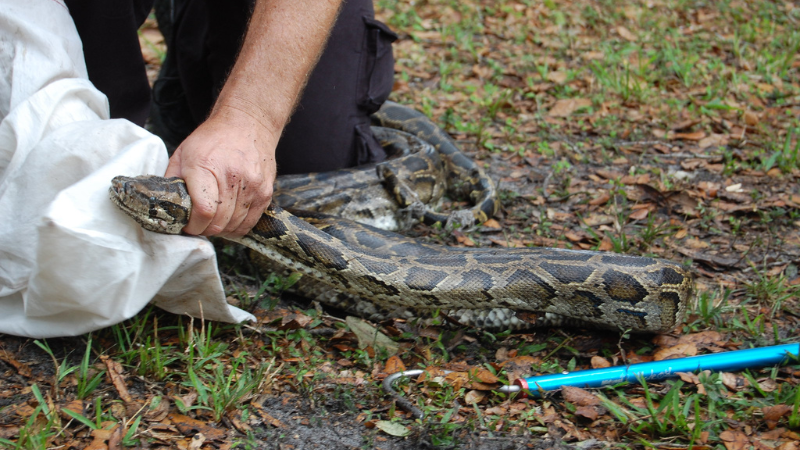

The spread of Burmese pythons beyond the Everglades is raising new questions for Florida’s trucking industry. The discovery of a breeding population in western Charlotte County, in Southwest Florida, has sparked concerns not only about environmental damage but also about potential operational risks along highways, in truck yards, and at distribution centers.
The Florida Fish and Wildlife Conservation Commission (FWC) has identified an established population near Rotonda West, Placida, Englewood East, and South Gulf Cove, communities connected to the road network linking Southwest Florida with the rest of the state.
Major transportation corridors in the region include Interstate 75 (I-75) and U.S. Highway 41 (US-41), which carry agricultural products, construction materials, consumer goods, and supplies destined for communities along the Gulf Coast.
Although Burmese pythons are not currently a documented cause of major commercial transportation disruptions, their presence in new rural and suburban areas raises questions about whether the snakes could seek shelter in parked vehicles and accidentally be transported elsewhere.
Pythons Hiding in Trucks and Trailers: A Potential Logistics Risk
One concern involves the natural behavior of Burmese pythons. These reptiles typically seek sheltered locations with limited exposure and suitable conditions for regulating their body temperature.
In logistics environments, parked trailers, vehicle undercarriages, warehouses, and areas surrounded by vegetation could potentially provide temporary hiding places.
This creates the possibility that a snake could enter part of a truck, trailer, or shipping container, particularly when equipment remains parked for extended periods at rural facilities.
The potential risk extends beyond an unexpected encounter between a driver and a snake. It also includes the accidental transportation of invasive reptiles into other regions.
A truck departing Southwest Florida can travel hundreds of miles along I-75 and connect with other interstate highways, including I-10 and I-95, which are heavily used by carriers operating throughout Florida and across state lines.
If a python remained concealed during the trip, it could potentially be transported beyond the area where it was originally detected.
However, this remains a hypothetical scenario. There is currently no evidence that commercial trucks are contributing to the spread of this newly identified python population.
Cargo Inspections and Biosecurity Measures
The potential movement of invasive species through ground transportation also raises questions about biosecurity procedures at freight terminals, distribution centers, and inspection stations.
The United States already has monitoring systems designed to prevent certain pests and invasive organisms from spreading through shipments, packaging materials, and vehicles.
However, Burmese pythons present a different challenge from the agricultural pests that typically trigger commercial transportation restrictions.
So far, there has been no confirmation that the FWC, the U.S. Department of Agriculture (USDA), or the Florida Department of Transportation (FDOT) has introduced additional truck inspections at weigh stations because of the python population in Charlotte County.
There have also been no official announcements of new transportation delays, highway restrictions, or python-specific biosecurity requirements for trucking fleets operating in the region.
Nevertheless, any future expansion of inspection procedures could affect freight operations, particularly along routes used to transport perishable products and time-sensitive shipments.
Additional inspections would need to be considered alongside the Federal Motor Carrier Safety Administration’s (FMCSA) Hours of Service (HOS) regulations, which establish driving and rest limits for commercial drivers.
Pre-Trip Inspections: What Truck Drivers Should Check
The presence of wildlife around logistics facilities also highlights the importance of inspecting trucks that have been parked overnight.
Under 49 CFR § 392.7, the FMCSA requires commercial drivers to be satisfied that their vehicles are in safe operating condition before driving.
Standard pre-trip inspections include checking brakes, tires, lights, steering mechanisms, trailer connections, and other essential safety components.
In areas where Burmese pythons have been reported, an additional precaution could involve visually checking underneath the truck, around the wheels, near the chassis, and around accessible sections of the trailer.
This is not a new federal requirement related to snakes. Rather, it is a supplemental safety precaution that trucking companies may choose to incorporate into their internal inspection procedures.
If a driver discovers a large snake, they should avoid reaching into confined spaces or attempting to remove the animal without appropriate training.
The FWC operates the Python Patrol program, which provides resources and training on identifying Burmese pythons, reporting sightings, and understanding safe handling procedures.
Road Safety and Potential Vehicle Damage
Another concern involves the possibility of encountering pythons on secondary roads, rural access routes, or areas near canals and wetlands.
Burmese pythons can grow to considerable lengths, with some individuals exceeding 13 feet.
Although there is no evidence linking these snakes to a significant number of truck crashes in Charlotte County, their presence on roadways could create hazardous situations.
A sudden maneuver to avoid an animal can be especially dangerous for a heavy commercial vehicle because of its braking distance, size, and cargo weight distribution.
The risks may be greater when transporting fully loaded trailers, oversized freight, or cargo that could shift during an abrupt maneuver.
Contact with a large animal could also potentially damage components underneath a vehicle, although there is no evidence suggesting that python encounters are a frequent cause of mechanical failures.
For truck drivers, the primary safety recommendation remains to maintain control of the vehicle, avoid sudden steering movements, and pull over only when it is safe to do so.
Nearly 28,000 Pythons Removed From Florida Since 2000
The scale of Florida’s invasive python problem helps explain why wildlife officials are concerned about the establishment of additional breeding populations.
According to the FWC, nearly 28,000 Burmese pythons had been removed from Florida’s natural environment since 2000, as reported in August 2026.
During the 2026 Florida Python Challenge alone, participants captured 280 snakes.
The species’ reproductive capacity makes population control particularly difficult. A female Burmese python can lay between 50 and 100 eggs, while the animals’ ability to remain concealed in dense vegetation complicates detection and removal efforts.
Wildlife authorities use multiple strategies to control the population, including trapping, research, monitoring, and radio telemetry.
Radio telemetry allows researchers to track individual snakes and locate additional pythons, particularly during the breeding season.
As the species expands into new regions, residents, agricultural workers, and drivers who regularly travel through affected areas may play an increasingly important role in identifying and reporting sightings.
How to Report a Python Found in a Truck
The FWC encourages the public to report Burmese pythons and other invasive species through its official reporting channels.
Truck drivers who encounter a large snake inside a logistics facility, underneath a trailer, or near a roadway can report the sighting through the state’s invasive species reporting system.
Reports can also be submitted through IveGot1.org, a platform used to document invasive species observations.
The FWC notes that transporting live Burmese pythons is prohibited. Drivers should therefore never capture a python with the intention of moving it to another location.
For trucking companies, preventive measures may include keeping parking areas clear, managing vegetation around facilities, training employees to recognize invasive snakes, and establishing procedures for reporting wildlife encounters.
The expansion of Burmese pythons illustrates how an environmental problem can create potential challenges for industries that depend on the continuous movement of vehicles and freight.
For now, there is no evidence of major disruptions to Florida’s logistics corridors caused by this species. However, the discovery of an established breeding population in Charlotte County introduces another potential risk for truck drivers, terminal operators, and fleet managers to consider, particularly when operating in rural and suburban areas of Southwest Florida.
 Business hours: Monday to Friday from 8:00 AM to 5:00 PM. California time