 Hable con un agente al (888) 572-7520
 Enviar mensaje a un agente



While the trucking industry invests in cleaner diesel engines to comply with U.S. environmental regulations, the rapid expansion of artificial intelligence (AI) data centers threatens to reverse much of the progress made in Texas over the past two decades.
The warning comes from a study by the Houston Advanced Research Center (HARC), which examined the environmental impact of the electricity required to power new technology facilities. Its findings suggest that, depending on the electricity generation methods used, nitrogen oxide (NOx) emissions could increase by nearly 400% by 2031.
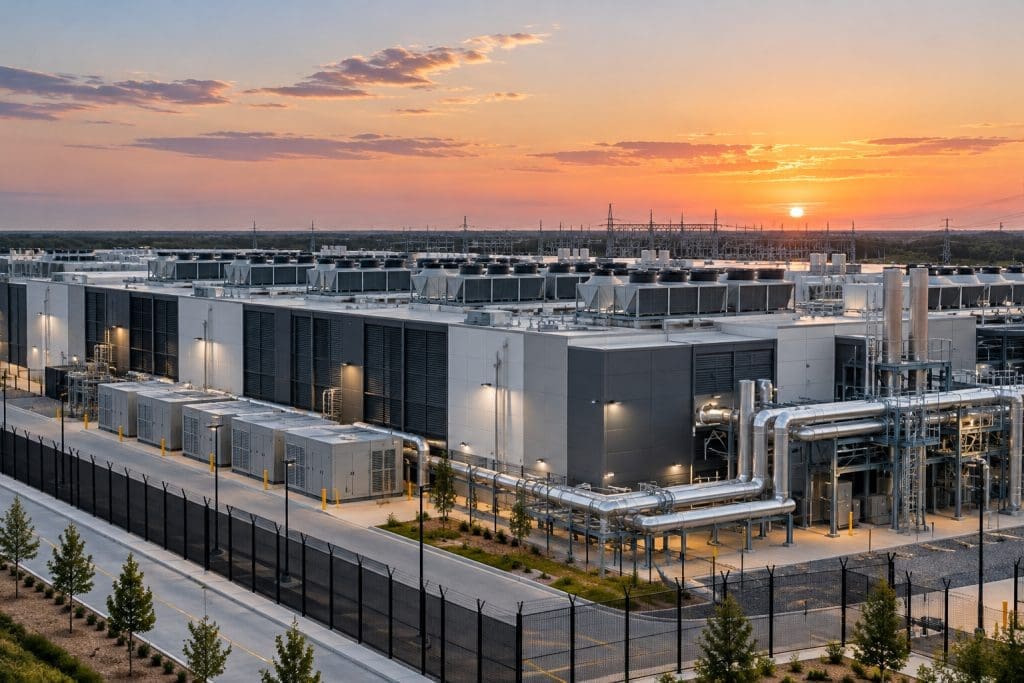
The main problem is not the computer servers themselves, but the enormous amounts of electricity required to operate and cool them. Facing delays in connecting to the Texas power grid, some developers are turning to their own natural gas-powered generators and power plants, which release pollutants into the atmosphere.
The issue is particularly significant in Houston, Dallas-Fort Worth, Austin, and San Antonio, where industrial pollution adds to vehicle emissions and where major freight corridors converge, including I-35, I-10, I-45, and US-59/I-69.
For truck drivers and transportation companies, the conflict has two dimensions: the possibility that worsening air quality could lead to stricter diesel engine requirements, and growing competition for the electrical infrastructure needed to modernize fleets and logistics terminals.
Twenty Years of Environmental Progress at Risk
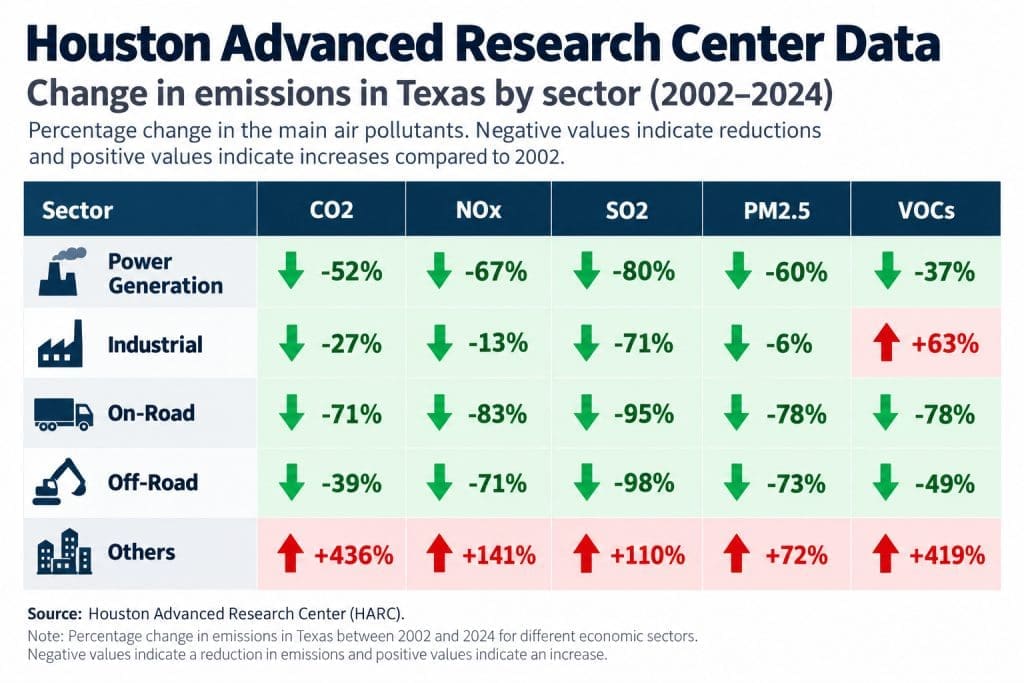
Between 2002 and 2024, Texas reduced nitrogen oxide emissions from on-road transportation by 83% and fine particulate matter emissions by 78%, according to official data compiled by HARC.
These reductions were driven by cleaner engines, improved emissions-control technologies, and stricter standards for vehicles and industrial facilities.
However, electricity demand from data centers could reverse that trend.
The report projects that if new facilities rely on the anticipated Texas electricity generation mix, NOx emissions from power generation and industrial sources could increase by 136% by 2031, approaching levels last recorded in 2004.
Volatile organic compounds could exceed 2002 levels by 32%, while fine particulate matter emissions could return to levels recorded in 2006.
More polluting scenarios, based on extensive use of on-site combustion-based power generation, show even greater increases.
HARC warns that electricity generated through on-site combustion could produce between two and ten times more NOx emissions than a combination of grid electricity, solar power, and wind energy, depending on projected demand.
Carlos Gamarra, HARC’s Vice President of Energy, Air, and Information Technology, emphasized the need to treat data centers as industrial facilities and require them to meet emissions standards comparable to those imposed on other industries.
Diesel Trucking Could Face New Requirements Because of Data Center Pollution
The primary concern for trucking fleets is that rising industrial emissions could make it more difficult for regions already struggling with pollution to meet federal air quality standards.
Houston and Dallas-Fort Worth, for example, have a history of failing to meet federal ozone standards. When a region exceeds these limits, authorities must implement plans to reduce emissions of pollutants that contribute to ozone formation.
Nitrogen oxides released by natural gas generators contribute to this problem. But so do emissions from vehicles, factories, and other sources.
As a result, if data center expansion worsens air pollution, regulators could reconsider measures affecting commercial transportation, even if most of the additional emissions originate from industrial facilities.
For diesel truck operators, this could mean stricter maintenance requirements for emissions-control systems, additional anti-idling measures, and new fleet replacement programs.
The economic impact could be especially significant for owner-operators and small trucking companies already facing the costs of maintaining selective catalytic reduction (SCR) systems, purchasing diesel exhaust fluid (DEF), and complying with federal emissions standards.
However, no regulation currently establishes new truck travel restrictions, taxes, or special inspections as a result of the HARC study or data reported by the Electric Reliability Council of Texas (ERCOT). These are potential regulatory consequences, not approved measures.
The debate centers on whether the growth of a new industry could force other sectors, which have already substantially reduced their emissions, to make additional investments to preserve air quality.
Texas Already Has Truck Idling Restrictions
The connection between pollution and trucking is not merely a future possibility. Texas already has regulations limiting how long certain heavy-duty vehicles can keep their engines running while parked.
The Texas Commission on Environmental Quality (TCEQ) establishes a general limit of five consecutive minutes of idling for certain heavy-duty vehicles in jurisdictions that have adopted local enforcement provisions, subject to regulatory exceptions.
Jurisdictions enforcing these rules include Houston, Austin, Plano, and Mesquite.
These restrictions are designed to reduce nitrogen oxide emissions, precisely the pollutants that could increase because of electricity generation for data centers.
There is also a federal regulatory dimension.
The Environmental Protection Agency (EPA) has classified Dallas-Fort Worth, Houston-Galveston-Brazoria, and San Antonio as serious ozone nonattainment areas.
In October 2026, the agency announced plans to review certain classifications and requirements, leaving the regulatory outlook uncertain.
An increase in industrial emissions could complicate efforts to improve air quality in these regions, although it would not automatically result in new trucking restrictions.
AI Is Also Competing for the Electricity Trucking Fleets Need
Pressure on Texas’ electrical infrastructure presents another challenge for transportation companies.
According to an official ERCOT report from April 2026, the grid operator had received approximately 410 gigawatts of large-load interconnection requests with a planning horizon extending to 2030.
Approximately 88% of the requested capacity was associated with data centers.
These figures represent applications and projects at different stages of evaluation, not actual electricity consumption.
For the freight transportation industry, this expansion could complicate plans for new charging stations for Class 8 electric trucks, distribution facilities, and logistics terminals equipped with electric machinery.
A high-power truck charging station requires transmission infrastructure, transformers, and sufficient distribution capacity.
If local grids need upgrades to serve data centers, industrial facilities, and logistics operators simultaneously, projects could face delays or additional costs.
At the same time, data center construction creates new opportunities for specialized freight transportation, including shipments of transformers, generators, steel structures, cooling equipment, and construction materials.
This represents a potential business opportunity for trucking companies and oversized-load carriers, although concentrated construction activity could also increase heavy truck traffic around industrial access roads.
There is currently insufficient evidence to attribute widespread congestion increases on I-35 or I-10 directly to these projects.
Who Should Pay the Environmental Cost?
The HARC report does not argue that data center expansion should stop. Instead, it warns that the technology chosen to generate electricity will largely determine the industry’s environmental impact.
Researchers maintain that data center operators should comply with industrial emissions standards and disclose their electricity consumption and energy sources.
The Data Center Coalition, meanwhile, says its member companies are working to improve energy efficiency and combine different electricity generation sources. The organization also challenges certain demand projections that it considers higher than actual requirements.
For the heavy-duty trucking industry, the debate carries significant economic implications. Any changes to environmental regulations could mean higher maintenance expenses, additional vehicle investments, or operational adjustments.
Fleets operating through Houston, Dallas-Fort Worth, and San Antonio already comply with regulations designed to reduce pollution. The expansion of data centers could place additional pressure on those same regions.
The central question raised by the research is whether Texas can control emissions from its rapidly growing technology infrastructure without imposing additional burdens on industries such as trucking, which have already made substantial progress in reducing pollution.
 Business hours: Monday to Friday from 8:00 AM to 5:00 PM. California time