 Hable con un agente al (888) 572-7520
 Enviar mensaje a un agente




Tuesday, November 3, is Election Day, when Americans will vote in the 2026 midterm elections. The election could affect trucking operations, commercial deliveries, and freight distribution, particularly in urban areas where increased traffic around polling locations may complicate delivery schedules.
Unlike Thanksgiving or Christmas, Election Day is not a federal holiday. There is no nationwide shutdown of freight operations or blanket restriction on commercial truck traffic. However, some states recognize Election Day as a state holiday, making it important for carriers to confirm operating hours with customers, warehouses, and government facilities.
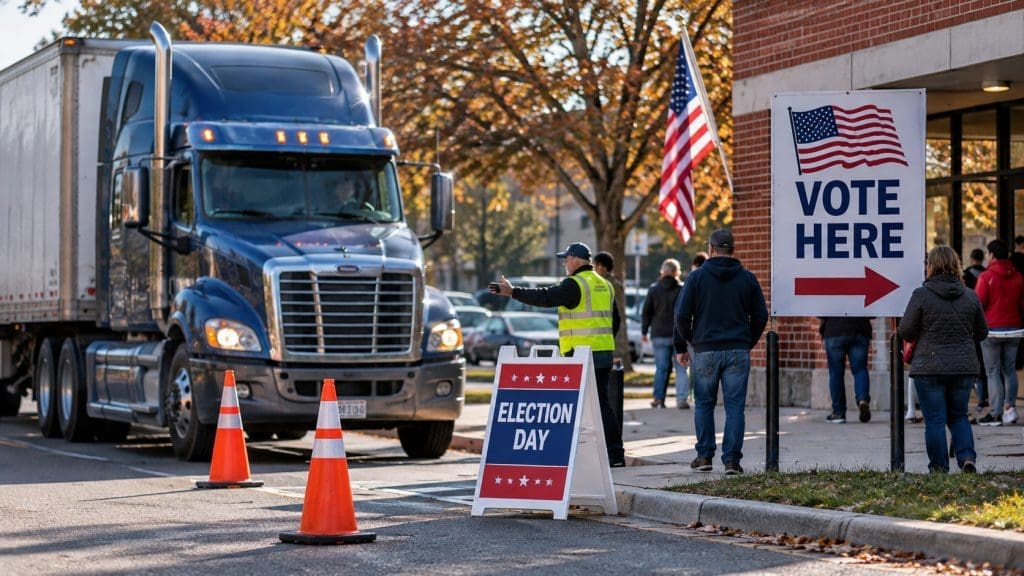
The biggest challenges are likely to affect last-mile deliveries, especially in neighborhoods where schools, community centers, and government buildings serve as polling places.
Where Truck Drivers Could Face Traffic Delays
Election Day may bring localized traffic disruptions, particularly when polling places open in the morning and during the evening commute.
Schools and public buildings that normally see limited vehicle traffic could experience heavier congestion, increased pedestrian activity, and greater demand for parking.
For delivery truck drivers, parcel carriers, and other commercial vehicle operators, these conditions could mean longer travel times and more difficult access to residential delivery locations.
Dispatchers should pay particular attention to streets surrounding polling places, government buildings, public parking areas, and locations hosting election-related activities.
Temporary parking restrictions, access controls, or detours may also be introduced near political gatherings, election offices, or vote-counting facilities.
These measures are determined by local authorities and do not amount to widespread interstate highway closures.
For carriers operating in California, Texas, Florida, New York, and other major freight markets, checking state and local traffic advisories before starting urban delivery routes will be especially important.
Will Trucks and Distribution Centers Operate Normally?
Over-the-road (OTR) trucking, regional freight transportation, and distribution services can continue operating on Election Day.
There is no federal requirement to suspend commercial trucking fleets during elections, nor is there a nationwide election-related restriction on trucks using interstate highways.
Major freight corridors, including I-5, I-10, I-35, I-75, and I-95, are not subject to any nationwide election-related closure.
However, that does not guarantee normal operating hours at every facility. Carriers should verify schedules at individual terminals, warehouses, ports, and distribution centers.
Last-mile operations may require additional adjustments, especially when regular delivery routes pass schools or public buildings being used as polling locations.
Dispatchers can reduce potential disruptions by allowing more flexible delivery windows and avoiding particularly busy polling areas during peak voting periods.
Truck Drivers Have Voting Rights, Too

Another important consideration for the trucking industry is employee scheduling.
There is no general federal law requiring private employers to provide time off to vote. However, 28 states and Washington, D.C., have some form of voting leave requirement.
Rules vary by jurisdiction. Some states require paid time off, others provide unpaid leave, and many impose conditions based on employees’ work schedules and available voting hours.
California, Colorado, Nevada, New York, and Texas are among the states that provide paid voting leave under certain circumstances.
For transportation companies, these requirements may affect scheduling for truck drivers, warehouse employees, terminal operators, and dispatchers.
Long-haul drivers face additional challenges because they may be hundreds or thousands of miles from home on Election Day.
Early voting and mail-in voting can provide alternatives, depending on each driver’s state of residence and eligibility requirements.
Carriers should coordinate voting leave requests while maintaining compliance with federal safety regulations and Hours of Service (HOS) requirements.
USPS Implements Special Election Mail Procedures
One of the country’s most important Election Day logistics operations involves the United States Postal Service (USPS), which processes, transports, and delivers millions of election-related mailpieces.
USPS confirmed that it distributed special instructions to employees on October 1 to support the proper handling of election mail.
Extraordinary measures are in effect from October 24 through November 3, covering mail acceptance, delivery, processing, distribution, and transportation.
The Postal Service also uses specific procedures to identify election-related mail. These include green identification tags for mail containing ballots and separate handling procedures for political campaign materials.
These measures help distinguish different categories of election mail throughout the postal network and support timely processing.
Ballot transportation is particularly time-sensitive because mail-in voting deadlines and ballot acceptance requirements vary by state.
USPS recommends mailing completed ballots well ahead of applicable deadlines, generally at least one week before the required receipt date.
For the logistics industry, the operation highlights the coordination required among ground transportation networks, mail-processing facilities, distribution centers, and election authorities.
How Trucking Companies Should Prepare
Although Election Day will not trigger a nationwide supply chain shutdown, fleet managers should prepare for localized disruptions.
Dispatchers can minimize potential problems by reviewing delivery routes, confirming customer receiving hours, and maintaining communication with drivers throughout the day.
Commercial vehicle parking restrictions also deserve attention, particularly near schools, community centers, and other polling locations.
For long-haul operations, trip planning should continue to account for weather conditions, road construction, scheduled closures, and existing commercial vehicle restrictions.
The biggest differences on Election Day will likely involve urban deliveries and workforce scheduling rather than interstate freight movement.
Election Day 2026 is not expected to bring freight transportation to a standstill. However, careful planning will help trucking companies keep shipments moving while millions of Americans travel to polling places across the country.
What’s on the Ballot on November 3?
The 2026 midterm elections will determine control of Congress and fill numerous state and local offices.
| Office or election | What’s at stake |
|---|---|
| President | No presidential election in 2026. |
| U.S. House of Representatives | All 435 voting seats across the 50 states. |
| U.S. Senate | 35 seats: 33 regularly scheduled elections and two special elections in Florida and Ohio. |
| Governors | 36 states, including California, Texas, Florida, New York, Georgia, Arizona, Nevada, Michigan, and Pennsylvania. |
| State legislatures | More than 6,100 legislative seats across 46 states. |
| Ballot measures | Voters in 39 states will consider statewide measures involving laws, taxes, and other public policy issues. |
| Local offices | Depending on the jurisdiction, voters will elect municipal and county officials, judges, and other local representatives. |
Beyond the immediate impact on transportation, the election results could shape future decisions involving infrastructure investment, highway funding, trucking regulations, and trade policy.
For carriers, fleet owners, and logistics companies, those policy decisions may ultimately have a greater long-term impact than Election Day traffic itself.
 Business hours: Monday to Friday from 8:00 AM to 5:00 PM. California time