 Hable con un agente al (888) 572-7520
 Enviar mensaje a un agente


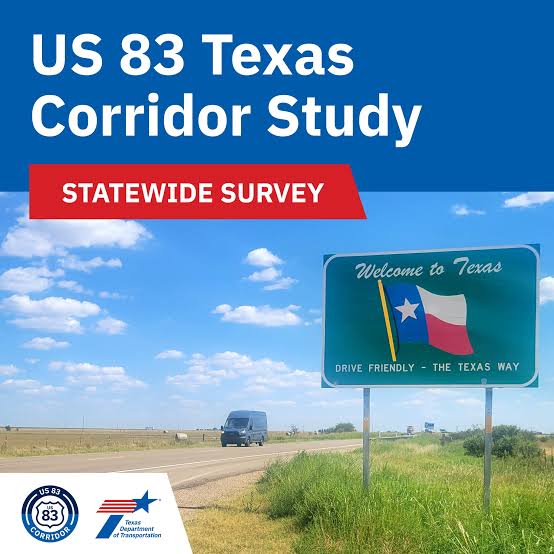

The Texas Department of Transportation (TxDOT) has launched a public consultation to help identify infrastructure and transportation priorities along US 83, one of the state’s major north-south corridors. The initiative seeks input from trucking companies, freight operators, businesses, and other road users to guide future improvements supporting the movement of goods and people.
The consultation is part of the US 83 Texas Corridor Study, a long-range transportation planning initiative covering approximately 606 miles (975 kilometers), from Carrizo Springs to the Texas-Oklahoma state line. The corridor spans six TxDOT districts, 22 counties, 23 cities, and nine metropolitan and regional planning organizations.
US 83 connects rural communities, regional economic centers, and metropolitan areas. TxDOT identifies the highway as an important freight and intermodal transportation route supporting commercial activity and regional connectivity.
The study will help determine which improvements may be needed to strengthen safety, mobility, freight capacity, and economic competitiveness over the next 25 years.
Freight Volumes Could Increase 23% by 2050

One of the study’s most significant findings involves projected freight transportation growth.
According to TxDOT’s official project fact sheet, freight tonnage within the study area is expected to increase 23% between 2023 and 2050, rising from 89 million tons to 109 million tons.
The economic value of goods transported along the corridor is also projected to increase by 54% over the same period, from $85 billion to $131 billion.
These projections highlight the importance of preparing transportation infrastructure for future logistics demand.
For trucking companies, increasing freight volumes could create challenges involving highway capacity, traffic safety, travel times, and connections with other major transportation corridors.
Long-term planning must also account for commercial vehicles sharing the highway with passenger cars, local traffic, and other road users.
According to TxDOT, only 21% of the 606-mile corridor currently consists of a divided four-lane highway.
This characteristic is particularly relevant when assessing how the roadway may need to accommodate future freight transportation demand.
International Trade and Connections to Other Highways
US 83 plays a role beyond connecting communities within Texas. Its location within the state’s transportation network links agricultural and industrial regions while providing connections to corridors supporting domestic and international trade.
The study examines freight movement, multimodal connectivity, and international commerce, along with the mobility needs of communities located along the highway.
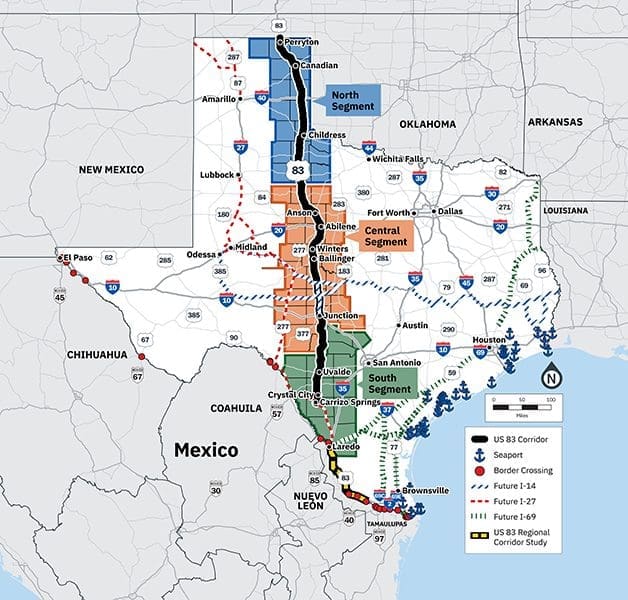
The project’s official map highlights the corridor’s geographic relationship with international border crossings, seaports, and future interstate connections, including I-14, I-27, and I-69.
These connections will help transportation planners assess how US 83 fits into the broader freight and logistics network.
The initiative also builds on findings from the US 83 Regional Corridor Study, completed in 2023, and incorporates ongoing planning related to the I-27 system in Texas.
By using previous technical studies, TxDOT aims to develop a comprehensive strategy addressing transportation and logistics needs across the state.
What TxDOT Will Evaluate to Improve US 83
The study includes a comprehensive assessment of current highway conditions and transportation needs expected over the coming decades.
Major areas of evaluation include roadway safety, traffic operations, freight movement, infrastructure conditions, and emerging transportation technologies.
TxDOT will also examine international trade, multimodal connectivity, economic development, infrastructure resilience, and environmental and social considerations affecting communities along the corridor.
For the trucking industry, these assessments are particularly important because highway conditions directly influence route planning, operating costs, and driver safety.
Lane configurations, intersections, traffic capacity, and pavement conditions can all affect commercial transportation efficiency.
TxDOT will also conduct economic analyses to identify transportation needs, infrastructure deficiencies, and potential improvement priorities.
No specific construction projects, investment amounts, or construction schedules have been announced. The initiative remains in the planning phase, with the goal of identifying improvements that could be implemented in the future.
Trucking Companies Can Help Shape Future Transportation Priorities
A notable feature of the initiative is TxDOT’s explicit inclusion of trucking industry organizations among the stakeholders invited to participate.
The consultation also includes representatives from agriculture, the energy industry, economic development organizations, local governments, private businesses, and surrounding communities.
Public participation will help transportation officials understand how people and businesses use US 83 and identify their most pressing concerns.
For freight carriers, the process provides an opportunity to highlight issues involving heavy commercial vehicle operations, highway safety, travel times, and transportation connectivity.
TxDOT’s public survey includes an interactive map where participants can share information about how and when they use US 83, identify problem areas, and communicate transportation priorities.
The public comment period will remain open through December 19, 2026.
Feedback will be considered alongside technical analyses and input from other stakeholders to help identify potential highway improvements.
A Corridor Study Divided Into Three Regions
To organize the assessment of this nearly 1,000-kilometer transportation corridor, TxDOT has established three geographic study segments.
The southern segment extends from the US 277 intersection in Carrizo Springs to the Kerr-Kimble county line.
The central segment runs from the Kerr-Kimble county line to the Stonewall-King county line.
The northern segment continues from the Stonewall-King county line to the Texas-Oklahoma state border.
Each region will have a working group responsible for providing information and recommendations to the study’s steering committee.
The process includes four rounds of stakeholder meetings between winter 2026 and summer 2027.
Throughout the study, transportation officials will assess existing conditions, identify infrastructure needs, develop potential strategies, and establish priorities for a long-range implementation plan.
This approach will allow TxDOT to address the specific characteristics of each region while evaluating US 83 as an integrated transportation corridor.
Long-Term Planning Expected to Continue Through 2027
TxDOT expects to complete the US 83 Texas Corridor Study by late 2027. Its findings will provide guidance for future transportation infrastructure decisions.
The initiative aims to establish a long-term strategy capable of responding to projected freight growth while improving roadway safety, mobility, and economic development opportunities.
For trucking companies, the public consultation represents an opportunity to contribute before infrastructure priorities are established along a highway connecting communities, industries, and regional logistics networks.
Interested participants can review technical information, maps, and previous research through the official US 83 Texas Corridor Study website.
The public can also participate through TxDOT’s interactive survey until December 19, 2026.
With freight tonnage projected to increase 23% and the economic value of transported goods expected to grow 54% by 2050, the future of US 83 is increasingly important to highway freight transportation, regional connectivity, and Texas commerce.
 Business hours: Monday to Friday from 8:00 AM to 5:00 PM. California time