 Hable con un agente al (888) 572-7520
 Enviar mensaje a un agente




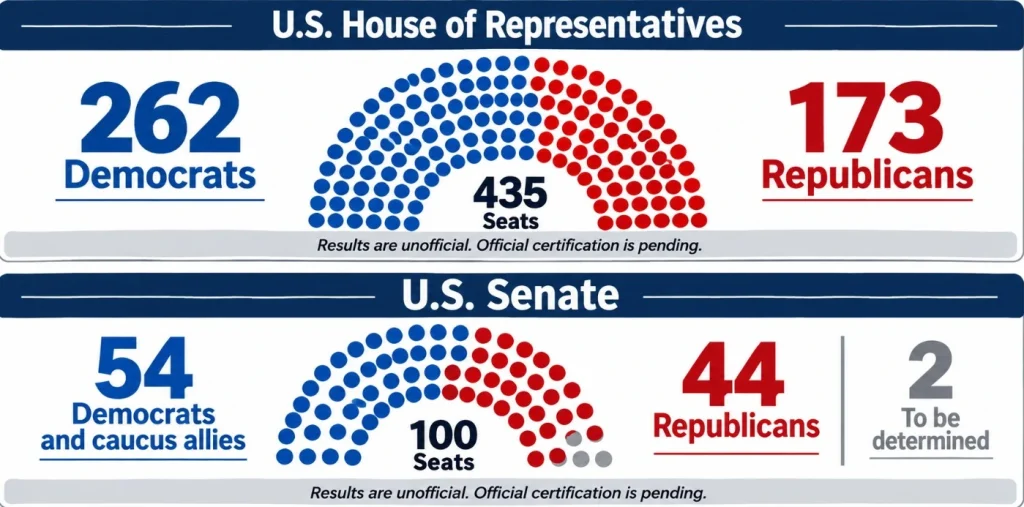
The midterm elections left an indelible mark on the political architecture of the United States. The Democratic Party regained control of both chambers of Congress, substantially narrowing President Donald Trump’s legislative maneuvering room for the second half of his term. However, among small and medium-sized enterprises (SMEs), independent entrepreneurs, and the truck drivers on the nation’s highways, the perspective is more pragmatic and cautious. A shift in majorities on Capitol Hill does not automatically translate into a transformation of the everyday economy.
Trump remains in the White House with his veto power intact, alongside broad executive authority over administrative regulations, energy policy, and tariffs. According to election analyses from prominent outlets—such as Reuters, The Wall Street Journal, and The Washington Post—the new Congress will be able to launch investigations into government agencies, hold public hearings, subpoena officials, and exert influence over budget allocations. It will not, however, have the power to enact legislation that overrides a presidential veto. For the real economy, the question is not merely who won, but rather how this new distribution of power might affect operating costs, revenue, profit margins, and consumer spending.
A Strengthened Congress, a White House with Executive Muscle
Any sweeping legislation or structural reform will require consensus between Congress and the executive branch. Reuters notes that while Democrats may be able to stall, condition, or challenge the administration’s initiatives, the White House retains the prerogative to act unilaterally—through executive orders—on matters concerning customs, deregulation, and foreign trade.
Following the elections, a prolonged period of institutional tension is expected. Immediate points of conflict will likely include the federal budget, the authorization to raise the debt ceiling, the debate over incentives for renewable energy versus fossil fuels, and the review of environmental and financial deregulation measures implemented to date. For businesses, this dynamic does not necessarily signal a drastic regulatory shift, but rather a variable that is more difficult to manage: greater uncertainty in the medium term. Doubt regarding the continued validity of a regulation, a tax exemption, or a tariff can be just as paralyzing for investment as a direct tax increase.
Unlike other electoral upheavals—often triggered by recessions or banking crises—the U.S. economy currently displays remarkable strength. According to Reuters, the unemployment rate remains at historically low levels, averaging 4.2%, and the gross domestic product continues to grow at a sustained pace. Business investment in capital goods grew at an annualized rate of 12.7% in the quarter leading up to the election, driven by massive outlays in artificial intelligence and digital infrastructure. Meanwhile, major Wall Street indices posted solid gains throughout the year.
Nevertheless, The Washington Post highlights a profound gap between these economic indicators and public perception. Nearly nine out of ten voters surveyed at the polls cited the high cost of living as a central or decisive factor in their vote. While year-over-year inflation has fallen from the peaks seen in previous years, it continues to erode household purchasing power and drive up production costs. The rising prices of food, housing and commercial rent, utilities, and gasoline are straining family budgets, and cumulative inflation has become the primary fuel for political discontent.
Elections, Diesel, Inflation, and Partisan Politics
Independent freight transport serves as a sensitive barometer for commerce and distribution. For truck drivers and small fleets, the price of diesel is a matter of commercial survival. Rising prices have been a key driver of discontent in agricultural and industrial regions, turning energy policy into a campaign issue. However, the expectation that the new Congress might lower fuel prices through legislation runs counter to market mechanics. Prices are shaped by global factors, such as OPEC+ supply levels, refinery capacity, maritime shipping costs, and geopolitical volatility in major producing regions.
Similar constraints apply to inflation and credit. While Congress holds broad authority over taxes, the budget, and subsidies, monetary policy falls exclusively under the purview of the Federal Reserve—an institution with strict operational autonomy. With the Consumer Price Index still above the official 2% annual target, the Fed must carefully calibrate its benchmark interest rate to solidify the cooling of inflation without triggering a sharp economic slowdown. The new Democratic-led Senate may confirm or reject appointments to the Board of Governors and summon the Fed Chair for oversight hearings, but it cannot mandate changes to interest rates.
For an SME looking to finance machinery, expand facilities, or bolster its working capital—or for an independent truck driver wanting to replace their vehicle—Fed interest rates carry more weight, and have a more immediate impact, than most of the initiatives debated on Capitol Hill. In this arena, the central bank—not Congress—is the primary influence on short-term decision-making. Keeping borrowing costs high stifles investment and compresses net margins.
Budget, Tariffs, and Artificial Intelligence
Sovereign debt and the inherited deficit are set to become major flashpoints for partisan conflict following the elections and throughout the next two years. Reports from Allianz, echoing analyses by Reuters, warn of complex disputes over the federal budget and the Treasury’s debt ceiling. Nevertheless, Wall Street reacted with optimism: following the confirmation of a Democratic victory, stock markets rallied broadly, while yields on long-term Treasury bonds saw a moderate decline. According to Axios, investors view the return of “divided government” as a safeguard against excessive fiscal expansion or unfunded tax cuts—a dynamic that encourages budgetary discipline without necessitating abrupt structural shifts.
Regarding foreign trade, the White House retains delegated authority to impose tariffs, adjust customs classifications, or apply sanctions—citing national security concerns or unfair competitive practices. Democrats are expected to leverage their oversight powers to investigate how these measures affect consumer prices, and they may seek to mitigate their impact through budgetary conditions or compensatory proposals.
For SMEs, tariffs on imported inputs immediately drive up the costs of spare parts, tools, electronic components, and raw materials. For the trucking industry, any significant shift in trade patterns could alter cargo volumes moving through Pacific or Gulf Coast ports, potentially reshaping the most profitable shipping routes. Artificial intelligence introduces another variable, independent of the elections. The wave of investment in data centers, semiconductors, and digital infrastructure has been the primary driver of recent corporate expansion, yet it faces significant bottlenecks: the availability of electrical power, transmission networks, suitable land, and massive capital requirements.
A Democratic-controlled Congress could intensify scrutiny regarding the sector’s environmental impact, its water and energy consumption, and data privacy. While this would not halt the technology, it could extend approval timelines and increase compliance costs. Furthermore, analysts at Reuters warn of a potential downward adjustment to the sector’s lofty profitability expectations. A drastic recalibration of valuations could lead to a contraction in capital expenditure and impact projected growth through 2027.
Elections, Operational Continuity, and Uncertainty
The elections have redrawn the power map in Washington, yet they have not substantially altered the forces that drive the real economy. A period of necessary negotiation, rigorous legislative scrutiny of the executive branch, and the likely blocking of major tax or regulatory reforms now begins. For small and medium-sized enterprise (SME) owners and independent freight operators, the decisive variables remain the same as they were before the polls opened: the trajectory of Federal Reserve interest rates, the containment of inflation regarding input costs, trends in diesel prices, and the resilience of household consumption.
If the economy continues to expand and employment remains robust, opportunities for revenue generation and freight demand within the logistics sector will persist. Should energy costs stabilize at lower levels, the profit margins of thousands of small businesses will improve. However, if credit remains expensive and political uncertainty stifles corporate investment, financial strain will continue to be felt on company balance sheets. The political landscape has undeniably shifted. The answers regarding the day-to-day economy will emerge gradually, as Washington translates its new power dynamics into concrete decisions concerning the budget, taxes, regulation, and foreign trade.
 Business hours: Monday to Friday from 8:00 AM to 5:00 PM. California time