 Hable con un agente al (888) 572-7520
 Enviar mensaje a un agente


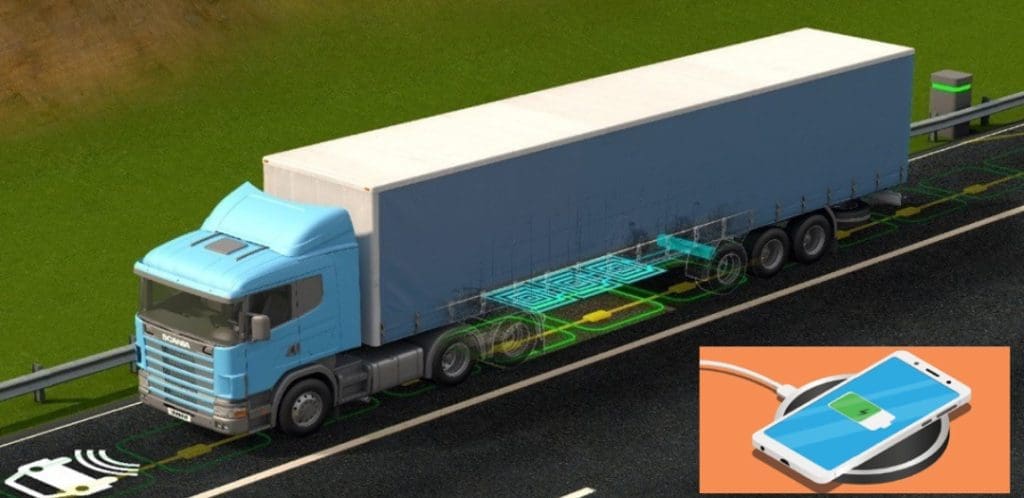

A highway in Indiana has become the first in the United States to wirelessly charge a heavy-duty electric truck while it was driving, without requiring the vehicle to stop or connect to a charging station. The demonstration marks a significant step forward for the future of trucking, opening the possibility of commercial vehicles receiving electricity directly from the pavement while traveling.
The test was conducted by the Indiana Department of Transportation (INDOT) and Purdue University, with the participation of engine and power technology manufacturer Cummins. During October, a heavy-duty electric truck traveled at 65 miles per hour (approximately 105 km/h) along a quarter-mile experimental roadway, roughly 1,300 feet long, built along US 52 and US 231 in West Lafayette.
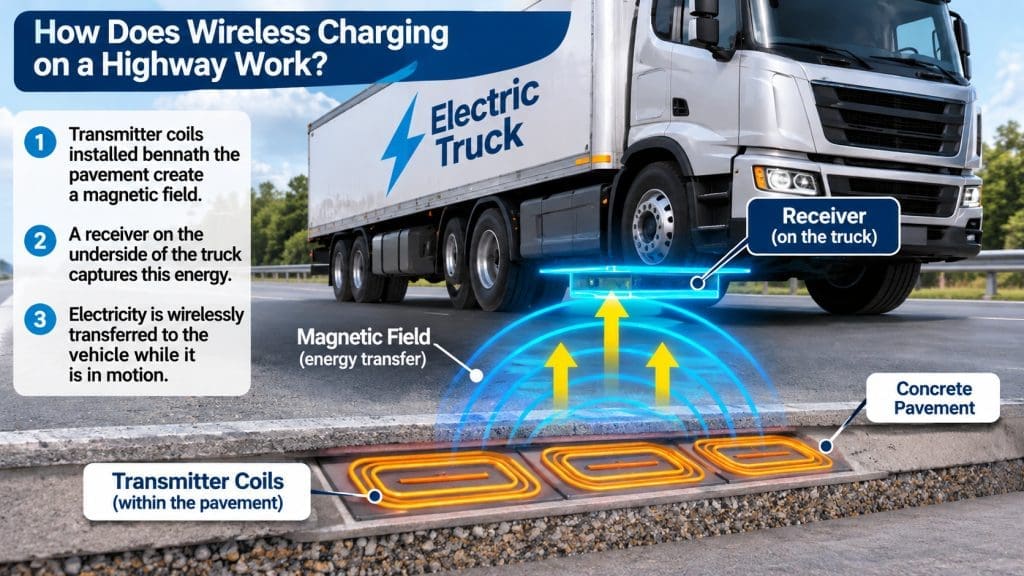
The innovation uses a technology known as Dynamic Wireless Power Transfer (DWPT), which transfers electricity to moving vehicles through magnetic fields, eliminating the need for cables or physical connections.
A Highway That Works Like a Wireless Charger
The system operates on principles similar to the wireless chargers used for smartphones. The difference is that instead of placing a device on a charging pad, the vehicle receives electricity while traveling down the road.
To make this possible, White Construction installed transmitting coils beneath the concrete pavement in specially equipped traffic lanes. These coils generate magnetic fields that transfer electricity to a receiver mounted underneath the truck.
This allows the vehicle to receive power without stopping or making physical contact with the roadway infrastructure.
Purdue’s system differs from other international experiments because of its ability to transfer large amounts of electricity, an essential requirement for powering heavy-duty commercial vehicles.
During the demonstration, the roadway delivered 190 kilowatts (kW) of power to the Cummins truck while it traveled at 65 mph.
To put that amount of power into perspective, project officials explained that 200 kW represents a level of electricity demand comparable to that of approximately 100 homes.
Although other states and countries have experimented with electrified roads, Purdue’s development achieved power levels higher than those previously demonstrated in the United States using this type of technology.
What Could This Mean for Trucking?
One of the biggest challenges facing heavy-duty truck electrification is battery range and the availability of sufficient charging infrastructure for long-distance operations.
Commercial trucks require substantial amounts of energy to transport freight, particularly when carrying heavy loads over hundreds of miles.
The batteries needed for these operations can account for a significant portion of a vehicle’s weight and overall cost.
If trucks could recharge their batteries while traveling along designated highway corridors, they could operate with smaller battery packs, reduce vehicle weight, and increase the capacity available for carrying freight.
This possibility could have a direct impact on trucking economics.
A truck equipped with lighter batteries could dedicate more of its payload capacity to freight, while the ability to receive electricity during a trip could reduce its dependence on stationary charging facilities.
It could also reduce downtime associated with battery charging, an especially important consideration for carriers managing scheduled deliveries and long-haul logistics operations.
INDOT officials believe the technology could help lower the cost of building electrified highways and make future expansion more feasible.
“The successful test demonstrates a key technology that could help reduce the costs of building electrified highways capable of charging electric vehicles of all sizes across the country,” said Lyndsay Quist, INDOT commissioner.
Technology Designed for Heavy-Duty Trucks
The amount of power required to operate a commercial truck is considerably greater than what a passenger vehicle needs.
For this reason, one of the research project’s primary objectives was to develop a system capable of transferring substantial amounts of energy without requiring multiple receivers installed along the vehicle.
Some earlier proposals considered installing several receiving devices underneath trailers to achieve the necessary power levels.
Purdue’s approach aims to simplify that configuration through a single receiver assembly mounted underneath the vehicle, capable of capturing electricity transmitted by coils embedded in the pavement.
This feature could make the technology easier to adapt to different vehicle categories while reducing the complexity of the equipment required.
The system was also designed with passenger vehicles in mind, although future research will need to evaluate its performance with other types of vehicles.
For electric passenger cars, electrified highways could make smaller batteries possible and help reduce drivers’ concerns about running out of power during a trip.
A Project That Began in 2018
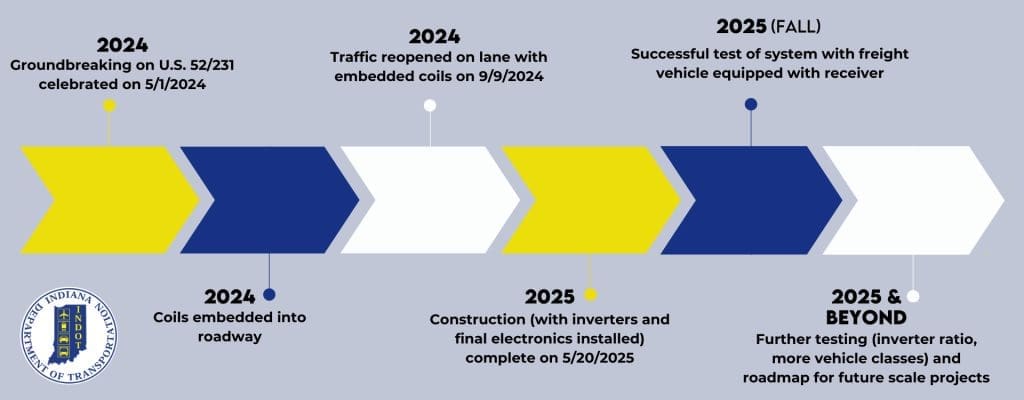
The October demonstration is part of a multistage research program that Purdue University and the Indiana Department of Transportation launched in 2018.
The project is supported by Purdue’s Joint Transportation Research Program and is connected to ASPIRE, a National Science Foundation engineering research center focused on developing electrified roadway infrastructure.
Several engineering and technology companies have also participated, including AECOM and PC Krause and Associates, along with White Construction, which installed the transmitting components beneath the pavement.
The research aims to address technical challenges involving energy transfer, compatibility between vehicles and roadways, and the feasibility of deploying these systems under real-world driving conditions.
One important consideration is that the electrical infrastructure must be integrated into the roadway’s design, creating new requirements for highway construction, maintenance, and transportation corridor operations.
When Could Trucks Start Charging on Highways?
Indiana’s demonstration remains an experimental technology project and does not yet represent the commercial deployment of highways capable of charging electric trucks on a large scale.
Researchers will continue testing the system with additional vehicle categories and working toward industry standards for wireless power transfer to moving vehicles.
Establishing common technical standards will be essential to ensuring that vehicles from different manufacturers can operate with this infrastructure.
Several questions also remain unresolved, including installation costs, project financing, electrical system maintenance, and the expansion of highway lanes equipped with the technology.
For trucking companies, the eventual adoption of this system will depend on whether the infrastructure can support reliable and economically competitive operations.
Still, the Indiana demonstration has already proven one important capability: delivering 190 kW of power to a heavy-duty electric truck traveling at highway speed.
In an industry where driving range, vehicle weight, and operating time directly affect profitability, this technology introduces a new possibility for the future of freight transportation.
The next major breakthrough in electric trucking could be hiding beneath the pavement: highways that do more than carry trucks, supplying the electricity they need to keep moving.
 Business hours: Monday to Friday from 8:00 AM to 5:00 PM. California time