 Hable con un agente al (888) 572-7520
 Enviar mensaje a un agente


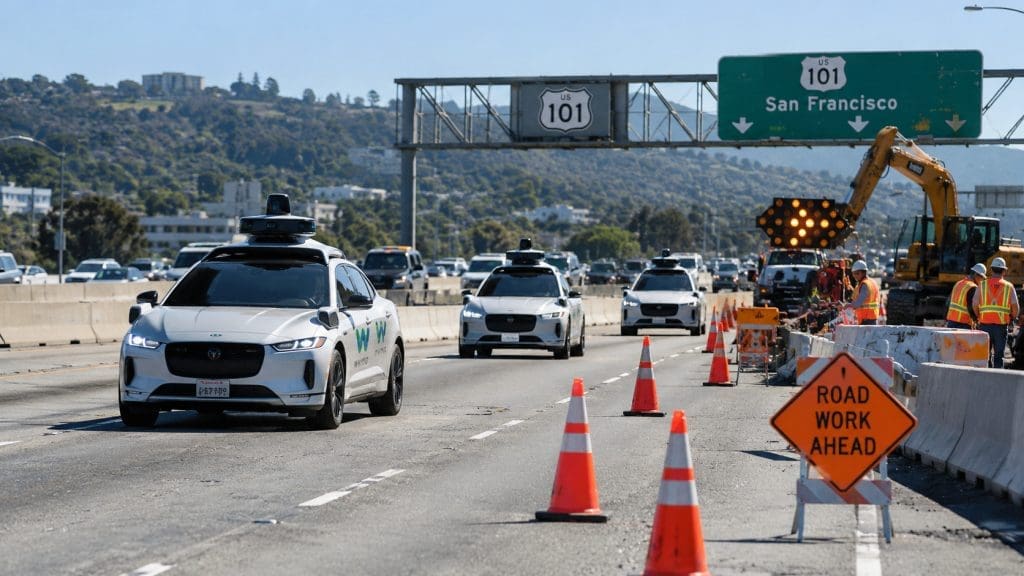

Waymo, Alphabet’s self-driving vehicle company, temporarily pulled its robotaxis off highways across the United States after the California Department of Motor Vehicles (DMV) prohibited the company from operating on the state’s highways over safety concerns.
The decision followed a series of incidents that exposed the challenges artificial intelligence still faces when interpreting unexpected traffic situations, particularly those involving road construction, detours, and police operations.
For the trucking industry, the incidents raise a fundamental question: How much trust can be placed in autonomous systems that still struggle to interpret unusual highway conditions when the vehicle involved is a fully loaded tractor-trailer? Imagine the potential consequences of a heavy truck losing control and striking road signs, highway workers, or even nearby buildings.
Although the vehicles involved were autonomous passenger cars rather than commercial trucks, the situations that prompted regulatory intervention are part of everyday freight transportation.
What Happened With Waymo’s Self-Driving Vehicles?
California’s DMV justified its intervention by describing certain vehicle behaviors as an “imminent danger to public safety.”
One incident occurred on U.S. Highway 101, where three Waymo vehicles entered a section of roadway closed for maintenance. The vehicles drove into an area that was supposed to remain off-limits to traffic while crews were working. According to the company, the incidents did not result in crashes or injuries.
Another incident was captured in a video circulated on November 6. The footage showed an autonomous Waymo vehicle attempting to pass two California Highway Patrol (CHP) vehicles on Interstate 280 in San Francisco.
The officers were conducting a maneuver known as a traffic break, in which patrol vehicles deliberately slow traffic to control the flow of vehicles or create a safe environment for an operation on the roadway.
The incident highlighted a particularly important challenge for autonomous driving systems: recognizing that an unusual maneuver may actually be a safety directive that must be followed.
Following these events, the DMV temporarily prohibited Waymo from testing and operating its vehicles on California highways until the company implements effective corrective measures.
Waymo voluntarily extended the highway restriction to its other operating markets across the United States.
Company spokesperson Chris Pappas explained that the decision was intended to evaluate the performance of its systems in these environments while maintaining its safety principles.
The suspension applies to highway driving and does not mean that Waymo has shut down all of its urban robotaxi services.
Police in Phoenix are investigating a crash involving two driverless Waymo vehicles after a pickup truck slammed into a stopped car at 80 mph in a 35 mph zone. Three people were hospitalized. https://t.co/AQlsDZJ676
— CBS Evening News with Tony Dokoupil (@CBSEveningNews) November 16, 2026
When Traffic Rules Change, AI Faces a Different Challenge
Autonomous driving systems rely on cameras, radar, sensors, and artificial intelligence software to identify vehicles, pedestrians, traffic signs, lanes, and obstacles.
These technologies can process enormous amounts of information and perform driving maneuvers without direct human intervention.
However, highways do not always operate under predictable conditions.
A construction zone can completely change normal traffic patterns. Cones may shift travel lanes, temporary signs may override permanent markings, and a road worker may direct traffic in a way that differs from the instructions painted on the pavement.
Human drivers interpret these situations through experience, context, and instructions from authorities.
For an autonomous system, the challenge is identifying those changes correctly and responding without compromising safety.
The Interstate 280 incident is particularly revealing. A patrol vehicle deliberately slowing traffic is not necessarily obstructing the roadway. It may be performing a protective maneuver intended to keep everyone behind it safe.
The technology must be able to distinguish between an ordinary slowdown and a police operation that requires an immediate adjustment in driving behavior.
Why This Matters for the Trucking Industry
Heavy-duty vehicle automation is advancing in the United States, with companies developing autonomous trucks capable of traveling along designated freight corridors with varying levels of human involvement.
Developers aim to improve efficiency, increase operational availability, and reduce certain driving-related risks.
Yet the Waymo incidents demonstrate that staying within a lane and maintaining a safe following distance are not enough to guarantee safe autonomous operation under every possible condition.
For trucking, the stakes are considerably higher.
A fully loaded tractor-trailer requires a much longer stopping distance than a passenger vehicle, particularly at highway speeds. Vehicle weight, pavement conditions, cargo distribution, and brake performance all affect how quickly a truck can respond.
If an autonomous system detects a lane closure too late or misinterprets instructions from a police operation, the potential consequences can be far more severe when a heavy commercial vehicle is involved.
Construction zones present another major challenge. Across the United States, professional truck drivers regularly travel through corridors where roadwork requires reduced speeds, lane changes, and compliance with directions from flaggers and highway crews.
These situations demand the ability to recognize temporary signs and anticipate the movements of other vehicles, even when conditions change without warning.
The ability to respond safely to the unexpected is one of the most important capabilities autonomous systems must demonstrate before their use expands throughout commercial transportation.
Autonomous Trucks: Moving From Testing to Commercial Operations
Developing driverless trucks involves much more than proving that a vehicle can travel long distances on a highway.
It also requires determining what happens when the system encounters a situation it cannot safely handle.
One approach being explored by the industry is the hub-to-hub model, which organizes freight transportation between logistics facilities connected by predefined highway corridors.
Under some operating models, autonomous trucks handle highway segments while human drivers manage urban connections, terminal maneuvers, and other more complicated portions of the journey.
This approach allows automated operations to remain within specific environments while limiting exposure to particularly challenging situations.
Other systems incorporate remote assistance or procedures designed to bring a vehicle to a safe stop when conditions exceed its operating capabilities.
The regulatory action against Waymo does not establish a general prohibition on autonomous trucks, nor does it mean that every driverless system has the same limitations.
Each technology has its own capabilities, operating conditions, and evaluation procedures.
Still, the incidents provide a concrete example of the problems that must be addressed before autonomous vehicles can operate reliably in increasingly complex environments.
A driverless Waymo vehicle with no passengers onboard smashed through a railroad crossing barrier after getting stuck on active train tracks in San Diego. https://t.co/t1rYvSitHD https://t.co/9CgbE5WSdE
— ABC News (@ABC) November 18, 2026
Safety and Accountability in the Next Era of Trucking
The expansion of autonomous vehicles also raises important questions about safety and accountability for motor carriers and logistics operators.
In conventional trucking operations, driver and carrier responsibilities are closely tied to traffic law compliance, vehicle maintenance, and safe operating practices.
When an autonomous driving system takes control, additional questions arise concerning software performance, sensor data, technology updates, and the vehicle’s response to extraordinary circumstances.
An incident in a construction zone may involve decisions made by the automated driving system, temporary traffic controls, visibility conditions, and the actions of other road users.
Determining responsibility requires examining the specific circumstances of the operation and the applicable regulatory framework.
The safety of an autonomous fleet depends not only on its mechanical components but also on the software’s ability to recognize hazards, interpret instructions, and execute appropriate maneuvers.
Waymo’s experience also underscores the importance of software updates and corrective action. Earlier in 2026, the company had to update the software in thousands of its robotaxis after some vehicles drove onto flooded roads.
These incidents demonstrate why autonomous driving performance must be continuously evaluated, even after the technology enters commercial service.
Autonomous Trucking vs. Professional Driving Experience
Waymo’s temporary withdrawal from U.S. highways is a significant development for the autonomous vehicle industry.
Technological advances have already enabled driverless vehicles to complete commercial trips, recognize obstacles, and navigate complex traffic environments.
But highways still present situations that cannot always be resolved by following familiar driving patterns. And this is where the experience, judgment, and professionalism of a skilled truck driver become invaluable.
An unexpected construction zone, a police maneuver, an improvised detour, or a flooded roadway can change driving conditions in a matter of seconds.
For heavy-duty transportation, where stopping distances are longer and a single mistake can endanger multiple road users, these situations are especially important.
The challenge for artificial intelligence is not simply to drive correctly when everything goes according to plan. It is to make safe decisions when the road no longer behaves the way the system expects.
That ability will be one of the deciding factors in determining how quickly, and under what conditions, autonomous trucks can become a larger part of long-haul freight operations in the United States.
 Business hours: Monday to Friday from 8:00 AM to 5:00 PM. California time