 Hable con un agente al (888) 572-7520
 Enviar mensaje a un agente




Thanksgiving week 2026 is shaping up to be one of the busiest travel periods of the year on U.S. highways. According to projections from the American Automobile Association (AAA) and mobility analytics firm INRIX, approximately 81.5 million people are expected to travel during the holiday, including 72.9 million who will take to the roads. This surge will directly affect major interstate highways and commercial trucking operations.
The heaviest traffic is expected on Tuesday, November 24, and Wednesday, November 25, as millions of travelers head out ahead of Thanksgiving, which falls on Thursday, November 26. Return trips are also expected to create significant congestion on Sunday, November 29, and Monday, November 30.
Although overall travel volume is projected to be slightly lower than in 2025, forecasts indicate that travel times on certain corridors could increase by more than 100%.
For the trucking industry, the surge in passenger vehicle traffic presents additional challenges for route planning, delivery schedules, and access to major logistics hubs and metropolitan areas.
Busiest Thanksgiving Travel Days and Hours
INRIX estimates identify the periods when traffic volumes are expected to be highest throughout the holiday week.
On Tuesday, November 24, the worst delays are expected between 2 p.m. and 8 p.m. On Wednesday, November 25, congestion will be heaviest from noon to 7 p.m.
Traffic is expected to be significantly lighter on Thanksgiving Day, Thursday, November 26. However, congestion will increase again over the weekend as millions of travelers begin heading home.
For commercial drivers, these forecasts can help anticipate delays and identify travel windows outside peak hours while remaining compliant with hours-of-service regulations.

New York and Los Angeles: Delays Exceeding 120%
New York and Los Angeles are among the metropolitan areas expected to experience the most severe congestion, with some trips taking more than twice as long as usual.
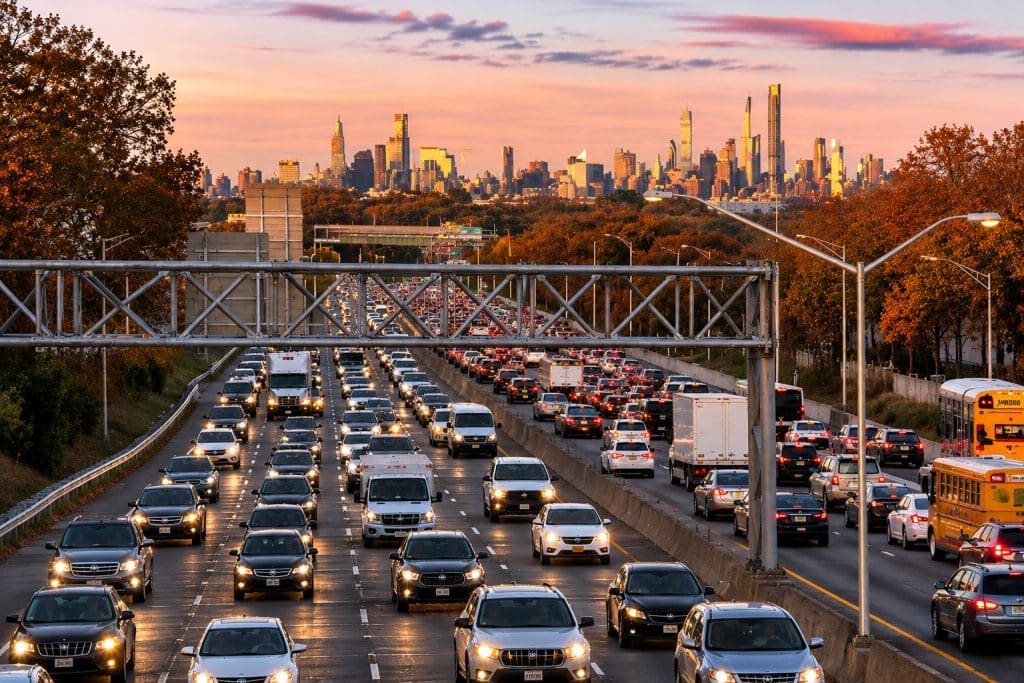
In New York, the eastbound Long Island Expressway toward the Hamptons is expected to experience its worst congestion on Tuesday, November 24, at approximately 4:30 p.m. The trip could take up to 4 hours and 15 minutes, representing a 138% increase over normal travel times.
In California, one of the most heavily affected corridors will be Interstate 5 (I-5), particularly the southbound route from Bakersfield to Los Angeles.
On Saturday, November 28, at approximately 7:15 p.m., INRIX projects that the trip could take 3 hours and 4 minutes, a 121% increase over typical conditions.
I-5 is one of the West Coast’s most important freight corridors, connecting major distribution centers, industrial areas, and consumer markets.
Heavy congestion along this route could disrupt freight operations across Southern and Central California, particularly when holiday travel overlaps with regular commercial truck traffic.
Texas and Florida Will Also Face Heavy Congestion
In Texas, one of the routes expected to experience significant delays connects Houston and Austin via westbound Interstate 10 and westbound State Highway 71.
On Sunday, November 29, at approximately 1 p.m., travel time could reach 3 hours and 36 minutes, a 62% increase.
This corridor plays an important role in regional freight movement, connecting industrial areas, commercial centers, and distribution facilities.
In Florida, forecasts point to significant congestion along Interstate 75 (I-75), particularly between Tampa and Gainesville.
On Saturday, November 28, at approximately 3 p.m., the trip could take up to 2 hours and 50 minutes, a 73% increase over normal conditions.
I-75 is a major freight route connecting Florida with Georgia and other southeastern states. During periods of heavy holiday travel, truck drivers must share this corridor with substantially higher volumes of passenger vehicles.
Other Highways Expected to Experience Major Delays
AAA and INRIX projections also identify several critical corridors across other regions of the country.
In Washington, D.C., the route to Baltimore via the Baltimore/Washington Parkway could experience a 132% increase in travel time on Tuesday, November 24.
In Boston, northbound Interstate 95 toward Portsmouth could see delays increase by 104% on Monday, November 30. Meanwhile, the Chicago-to-Indianapolis route along southbound Interstate 65 is expected to experience an 80% increase.
Other routes facing significant congestion include:
- California: San Diego to Palm Springs via northbound I-15, with a projected 78% increase on Wednesday, November 25.
- California: San Francisco to Sacramento via eastbound I-80, with delays increasing by 85% on Tuesday, November 24.
- Washington: Seattle to Bellingham via northbound I-5, with an expected 83% increase on Tuesday, November 24.
- Oregon: Eugene to Portland via northbound I-5, with a projected 64% increase on Wednesday, November 25.
- Colorado: Pueblo to Denver via northbound I-25, with delays increasing by 63% on Tuesday, November 24.
- Georgia: Atlanta to Savannah via eastbound I-16, with an expected 40% increase on Sunday, November 29.
These estimates apply to specific routes and peak travel times. They do not necessarily reflect traffic conditions along the entire highway throughout the day.
How Thanksgiving Traffic Will Affect Trucking
Increased traffic during Thanksgiving can create operational challenges for trucking companies, especially along corridors connecting major cities, ports, warehouses, and distribution centers.
One of the most significant consequences is reduced predictability in travel times. A trip that normally takes just a few hours may require substantial additional time when it coincides with heavy holiday departures.
Delays may also develop near metropolitan entrances, highway interchanges, and interstate connections, particularly during the afternoon and early evening.
For truck drivers, route planning should account for congestion forecasts, weather conditions, road construction, and any restrictions imposed by state transportation authorities.
Traffic delays can also disrupt delivery coordination, scheduled receiving windows, and the availability of commercial truck parking.
During the holiday, carriers should also consider potential changes to operating hours at warehouses, distribution centers, and commercial facilities.
Recommendations for Commercial Truck Drivers
With traffic volumes expected to increase across major highways, advance planning will be essential to minimize delays and improve road safety.
AAA and INRIX recommend avoiding peak congestion periods and, whenever possible, beginning trips early in the morning.
For heavy-duty commercial vehicles, this recommendation must be balanced with operational requirements and federal hours-of-service regulations.
Drivers should also check official traffic information systems operated by state departments of transportation before departure and throughout the busiest travel days.
Real-time traffic applications can help identify incidents, closures, and delays. However, any alternate route must be checked to ensure it is suitable for large commercial trucks.
Thanksgiving 2026 will once again test the capacity of America’s busiest highways. With nearly 73 million people expected to travel by road and delays potentially more than doubling normal travel times along certain corridors, advance planning will be critical to keeping freight moving during one of the busiest travel weeks of the year.
 Business hours: Monday to Friday from 8:00 AM to 5:00 PM. California time