 Llame al (888) 572-7520 para hablar con un agente
 Enviar mensaje a un agente
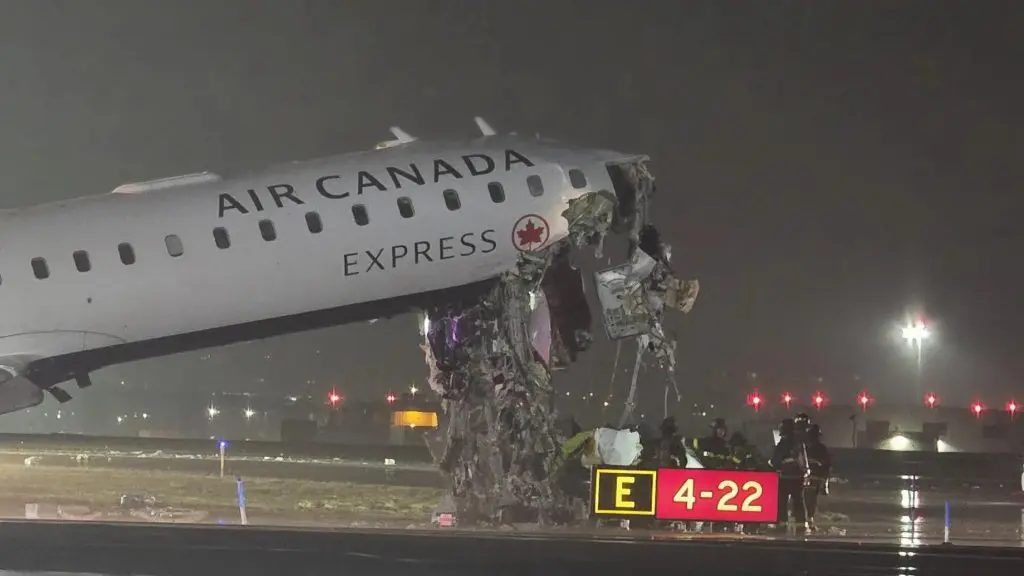

The incident at New York’s LaGuardia Airport, where an Air Canada Express jet struck an airport fire truck during landing, has placed a spotlight on a critical yet often overlooked aspect of aviation logistics: the role and coordination of ground vehicles operating alongside aircraft.
While aviation is typically associated with aircraft and flight operations, the reality on the ground is far more complex. Airports function as tightly coordinated logistics hubs where trucks and specialized vehicles are constantly in motion, supporting everything from fueling and maintenance to catering and emergency response.
”What is that bright red spot on the wreckage of the Air Canada plane? This angle is terrifying. Doesn’t even look real. https://t.co/82F0jhHPRI pic.twitter.com/gFF4vnPB2t
— Matt Wallace (@MattWallace888) March 23, 2026
How trucks operate inside airports
Unlike highway or urban driving, trucks operating within airports do not move independently. Every movement is governed by strict procedures and requires explicit authorization.
Drivers must remain in constant communication with air traffic control or ground control teams. Their responsibilities include:
- Requesting clearance before entering any operational area
- Confirming instructions using standardized radio phraseology
- Following predefined routes within the airport layout
- Adhering to strict speed limits and restricted zones
Entering an active runway is considered one of the most critical operations. Under standard conditions, no vehicle should be present on a runway during an aircraft’s landing or takeoff phase.
Who drives these vehicles
Airport trucks are not operated by conventional drivers. Personnel assigned to these roles undergo specialized training tailored to the aviation environment. Fire trucks, in particular, are part of Aircraft Rescue and Fire Fighting (ARFF) units.
These drivers are trained in:
- Basic aviation regulations
- Runway and taxiway signage
- Radio communication with control towers
- Emergency response and evacuation protocols
They are also required to have in-depth knowledge of airport layouts, including access points, high-risk zones, and operational boundaries.
ATC audio captures moment Air Canada Express flight AC8646 collided with the truck. pic.twitter.com/WsoAUT4P4j
— Breaking Aviation News & Videos (@aviationbrk) March 23, 2026
Air Canada CRJ-900 has collided with a fire truck while landing at La Guardia Airport.
— Breaking Aviation News & Videos (@aviationbrk) March 23, 2026
The plane, a Jazz Aviation flight operating on behalf of Air Canada, struck a Port Authority vehicle that was responding a separate incident around 11:40 p.m., according to the Port Authority… pic.twitter.com/6fiEDMTMIj
What is designed to prevent these incidents
Modern airports rely on multiple layers of safety systems to prevent conflicts between aircraft and ground vehicles. These include:
- Mandatory clearance from air traffic control before runway access
- Continuous radio communication to confirm every movement
- Visual and lighting systems marking operational boundaries
- Surface monitoring systems such as ground radar and sensors
Operationally, the rule is clear: a runway must be completely clear before an aircraft lands or departs.
What may have gone wrong
Without drawing definitive technical conclusions, incidents of this nature typically point to a breakdown in coordination. Common contributing factors in such scenarios may include:
- Unauthorized or mistimed runway entry
- Miscommunication or incomplete radio exchanges
- Misinterpretation of instructions between driver and control
- Increased operational complexity due to weather or traffic volume
Reports indicated that weather conditions prior to the incident included rain and reduced visibility at times, which can add pressure to both ground crews and control teams.
A high-risk environment measured in seconds
Unlike trucks on highways, aircraft on final approach have limited ability to maneuver. At speeds exceeding 200 km/h, any obstacle on the runway becomes a critical hazard within seconds.
This makes coordination between air and ground operations not just important, but absolute. Pilots, controllers, and ground vehicle operators all rely on precise execution and clear communication.
Impact on logistics and freight operations
For the transportation sector, incidents like this have immediate ripple effects. The temporary closure of LaGuardia resulted in:
- Disruptions to air cargo operations
- Delays across time-sensitive supply chains
- Flight diversions and cancellations
- Increased congestion at nearby airports
Airport logistics are an extension of the global freight network, and trucks operating within these environments play a vital, though often invisible, role.
More than an isolated event
While rare, events involving runway incursions—unauthorized presence on an active runway—remain a key focus area in aviation safety worldwide.
For the trucking and logistics industry, the incident underscores a broader takeaway: even in highly regulated environments, operational coordination is the decisive factor. When that coordination breaks down, consequences can unfold in seconds.
Casualties and incident overview
The aircraft involved, a Bombardier CRJ-900 operated by Air Canada Express, was carrying 72 passengers and four crew members. Following the collision with the fire truck, both the captain and first officer were transported to a hospital, where they later died from their injuries.
Dozens of individuals were reported injured. Initial reports indicate that 41 people received medical attention, with 32 later discharged and others remaining hospitalized under varying conditions.
The incident forced a full shutdown of LaGuardia Airport for several hours, affecting both passenger flights and cargo operations at one of the busiest air transport hubs in the United States.
 Business hours: Monday to Friday from 8:00 AM to 5:00 PM. California time