 Llame al (888) 572-7520 para hablar con un agente
 Enviar mensaje a un agente
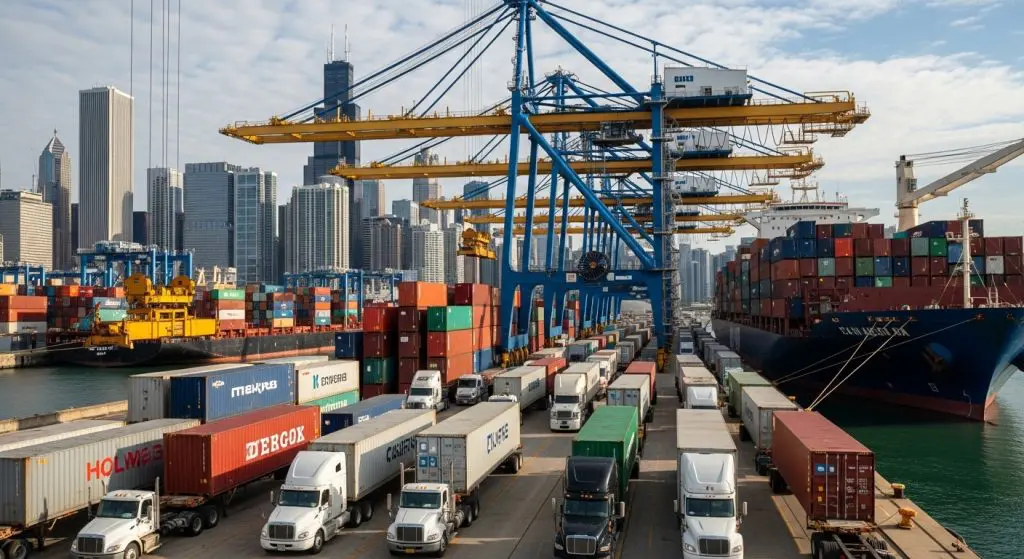

Trucking activity in the United States posted a significant gain in February 2026, pushing freight volumes to their highest level in three years and offering a much-needed sign of recovery for an industry that has faced a prolonged downturn.
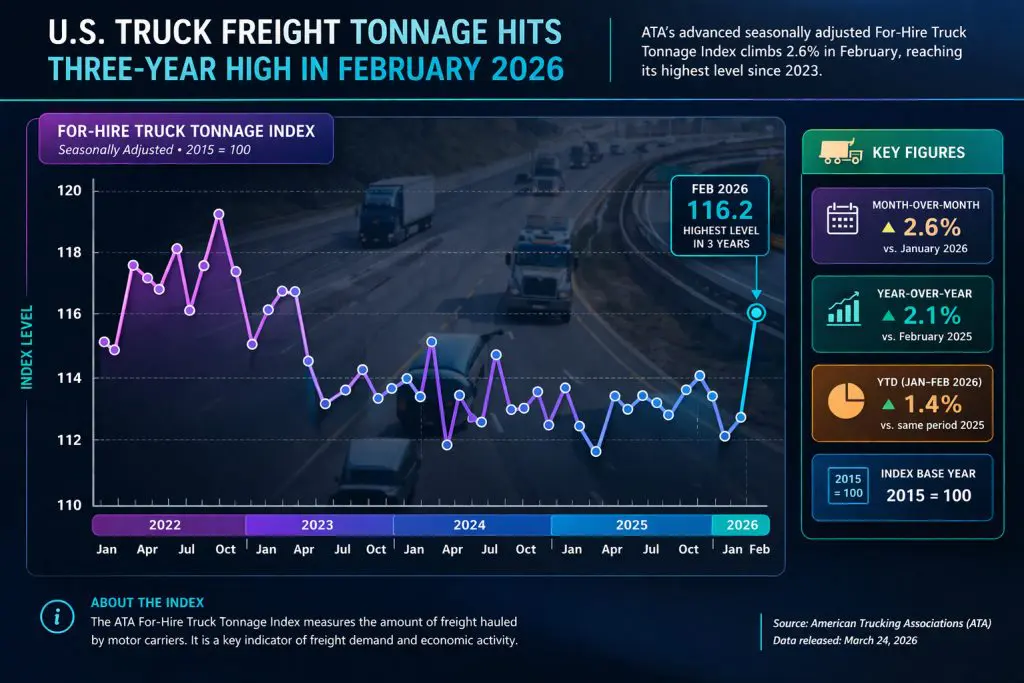
According to the American Trucking Associations (ATA), its advanced seasonally adjusted For-Hire Truck Tonnage Index rose to 116.2 in February, up from 113.3 in January, representing a 2.6% month-over-month increase. The January figure itself had already shown momentum, with a revised 0.7% gain over December.
This latest increase not only marks the strongest monthly performance in recent months, but also places the index at its highest level since 2023, reinforcing the idea that freight demand may be stabilizing after a difficult period.
A key indicator of economic activity
The ATA’s tonnage index, which uses 2015 as its base year (100), is widely considered a leading indicator of real economic activity. It measures the volume of freight hauled by motor carriers and reflects the movement of goods across the country.
In February, the index increased 2.1% compared to the same month in 2025, marking the largest year-over-year gain since October 2022. Over the first two months of 2026, tonnage was up 1.4% compared to the same period last year, suggesting that the improvement is not limited to a single month.
Despite these gains, the broader context remains relevant. In 2025, the tonnage index was essentially flat compared to the 2024 average, underscoring how gradual and uneven the recovery has been.
Capacity constraints and cautious optimism
Industry experts note that the February increase, while encouraging, may be partially influenced by reduced capacity in the market.
ATA Chief Economist Bob Costello pointed out that the strength of the gain should be interpreted carefully, particularly after an extended freight recession.
“February’s robust gain is great to see, but the size of the gain is likely magnified due to lower industry capacity,” Costello said. “With that said, particularly after a very prolonged freight recession, improving volumes in any manner is welcomed.”
This dynamic highlights a key tension in the current market: while demand may be improving, the available supply of trucking capacity has tightened, amplifying the impact of any increase in freight volumes.
Mixed signals in raw data
While the seasonally adjusted index showed strong growth, the not seasonally adjusted (NSA) index, which reflects raw freight movement, told a slightly different story.
The NSA index stood at 106.9 in February, which is 1.5% lower than January’s 108.5 reading. This divergence suggests that while underlying demand is improving, seasonal factors still play a role in shaping month-to-month fluctuations.
The backbone of U.S. freight transportation
The significance of these figures extends beyond the trucking industry itself. Trucking remains the dominant mode of freight transportation in the United States, accounting for 72.7% of all domestic freight tonnage, including manufactured and retail goods.
In 2024 alone, trucks hauled 11.27 billion tons of freight, generating $906 billion in revenue, which represents 76.9% of total revenue across all transportation modes.
These figures underscore the central role trucking plays as both a logistics backbone and an economic barometer. When truck freight volumes rise, it often signals broader improvements in production, consumption, and distribution.
Looking ahead
The February data provides a cautiously optimistic outlook for the months ahead. After a prolonged period of weak demand and excess capacity, even modest gains in freight volumes are significant.
However, the path forward remains uncertain. Factors such as fuel costs, economic growth, consumer demand, and capacity adjustments will continue to shape the trajectory of the industry.
Still, reaching a three-year high in tonnage is a milestone that few in the industry would have expected just months ago. For carriers, brokers, and insurers alike, it represents a potential turning point.
If sustained, this upward trend could mark the beginning of a broader recovery for the U.S. trucking sector—one that has been long overdue.
 Business hours: Monday to Friday from 8:00 AM to 5:00 PM. California time