 Llame al (888) 572-7520 para hablar con un agente
 Enviar mensaje a un agente

The constant use of a vehicle causes wear on its components, so knowing when it is time to replace them is essential for proper maintenance. One of the parts that can deteriorate the most is the shock absorber, which is responsible for controlling the movement of the spring and the suspension. A shock absorber in good condition ensures that the tires remain in constant contact with the road surface; however, a worn one destabilizes the suspension and can cause the vehicle’s system to work harder and under less favorable conditions.
The importance of the shock absorber is directly related to safety and stability while driving. A damaged shock absorber can lead to a loss of maneuverability, affecting the driver’s ability to control the vehicle. When it does not function properly, the car may bounce excessively or sway abruptly when taking a turn. For this reason, it is important to recognize the signs that indicate when maintenance or replacement is necessary.
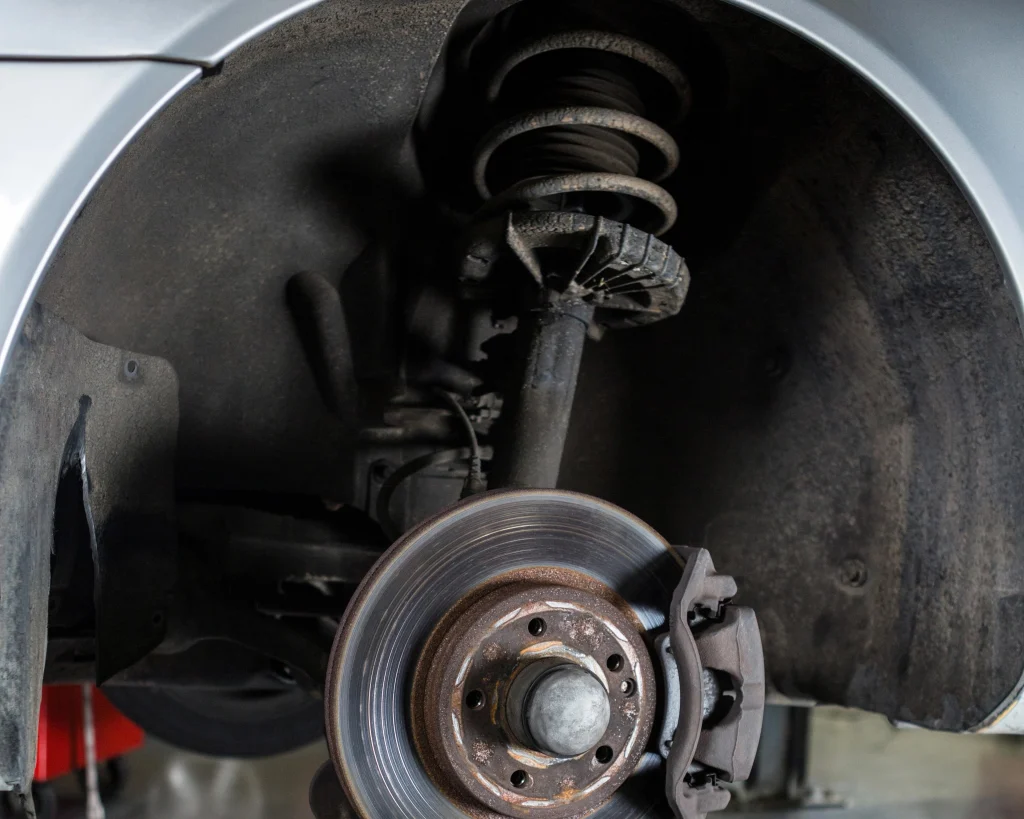
How does a shock absorber work?
Before exploring the topic further, it is important to understand how a shock absorber works. It operates by converting the kinetic energy generated by the spring’s movement into thermal energy, or heat. This process occurs through a piston valve and a set of rods located inside the shock absorber’s fluid chamber.
The amount of resistance, or damping, depends on several factors, such as the speed at which the suspension moves and the number and size of the holes in the piston valve.
Shock absorbers are often confused with struts; however, both serve different functions within the suspension system. The main difference is that, unlike a shock absorber, a strut is also a structural component of the vehicle’s suspension.
There are two basic types of shock absorbers, plus an additional type:
Twin-tube shock absorbers – Also known as telescopic shocks, these have two cylinders: an inner and an outer one. The inner cylinder, or working tube, is where the piston valve and rod move up and down, while the outer cylinder serves as a reservoir for the hydraulic fluid.
Monotube shock absorbers – This type has a single cylinder that contains a chamber of hydraulic fluid, a chamber of pressurized gas, and a piston valve/rod assembly. A piston and a free-floating seal separate the oil from the gas.
Air shock absorbers – Some vehicles use air shocks that, instead of hydraulic fluid, use air inside their chambers to control the suspension. By adjusting air pressure, these systems can change the vehicle’s ride height to compensate for heavy loads or towing.

How do you know if a shock absorber needs maintenance?
Sometimes it can be difficult to recognize shock absorber wear, since drivers often get used to how their vehicle handles—especially when driving a relatively new vehicle. However, sudden failures can often be prevented by regularly inspecting your vehicle for early warning signs.
Observe, listen, and pay attention to the following signs while driving:
- Excessive vibration in the steering wheel.
- Constant steering corrections due to instability when driving at highway speeds.
- Vehicle leaning when taking tight curves.
- Excessive front-end dive during hard braking.
- The front of the vehicle lifting and/or the rear sinking during sudden acceleration.
- Excessive bouncing or rattling in the suspension after driving over small bumps or potholes.
If you have not noticed any of these signs but still feel that something may be wrong, start by checking the following:
- Uneven tire wear caused by lack of stability and irregularities in the tread.
- Fluid leaks: damaged shock absorbers often leak hydraulic fluid, visible as oily stains near each shock absorber.
Remember that consistent vehicle maintenance helps prevent malfunctions and even potential accidents while driving. Schedule regular inspections with your trusted mechanic, or perform routine checks before heading out on the road.
 Business hours: Monday to Friday from 8:00 AM to 5:00 PM. California time