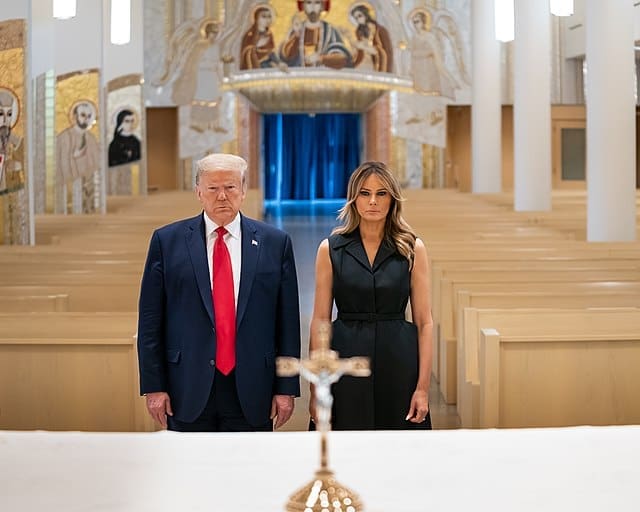
The president of the United States asserts that those who believe in God or defend life have faced discrimination all this time
President Trump announced his plan to combat what he described as “anti-Christian bias” in the United States, revealing the formation of a task force led by Attorney General Pam Bondi. The initiative aims to investigate and address discrimination against Christians.
During events surrounding the National Prayer Breakfast in Washington, Trump stated that the task force would focus on eliminating any perceived targeting of Christians within federal agencies, including the Department of Justice, the IRS, and the FBI. He emphasized that the task force’s mandate is to “immediately halt all forms of anti-Christian discrimination” and to “prosecute anti-Christian violence and vandalism.”
The announcement followed Trump’s participation in the National Prayer Breakfast, a longstanding bipartisan tradition in Washington. Addressing lawmakers, Trump spoke about how his faith had deepened after surviving two assassination attempts the previous year. He urged Americans to “bring God back” into their lives.

Later that day, at a separate event, Trump took a more assertive stance, revealing plans to establish a commission on religious liberty. He criticized the Biden administration for prosecuting anti-abortion advocates, calling it a “persecution” of religious believers. Additionally, he celebrated his administration’s efforts to curtail diversity, equity, and inclusion programs and to limit transgender participation in women’s sports.
Trump’s remarks and new initiatives drew immediate backlash from advocacy groups. Americans United for Separation of Church and State condemned the task force, with its president, Rachel Laser, asserting that it would “misuse religious freedom to justify bigotry, discrimination, and the subversion of civil rights laws.”
At the Capitol, Trump defended his stance, arguing that people “can’t be happy without religion.” He called for a renewed national focus on faith, stating, “Let’s bring God back into our lives.”
Criticism also came from religious leaders such as the Rev. Paul Brandeis Raushenbush, head of the progressive Interfaith Alliance, who accused Trump of hypocrisy. He cited the administration’s policies, including immigration raids in churches and actions against faith-based charities, as evidence of government overreach infringing on religious freedoms.
Additionally, Trump announced the creation of a White House faith office, to be led by Paula White-Cain, a longtime pastor in the charismatic Christian movement. White-Cain, a strong supporter of Trump since his 2016 campaign, previously led his Faith and Opportunity Initiative in 2019.
The National Prayer Breakfast, which split into two events in 2023 due to organizational concerns, saw Trump attending both the official gathering on Capitol Hill and a larger private event at a hotel. Reflecting on a near-fatal attack at a rally in Butler, Pennsylvania, Trump credited divine intervention for saving his life, saying, “It was God that saved me.”

Trump, who identifies as a nondenominational Christian, reiterated his commitment to religious liberty, calling it “part of the bedrock of American life.” However, his administration’s policies have already sparked tensions with some religious leaders. His opposition to Rev. Mariann Budde’s sermon advocating for LGBTQ+ rights and immigration reform, as well as Vice President JD Vance’s disputes with Catholic leaders over immigration policies, have intensified debates about the role of faith in governance.
Concerns have also emerged over the administration’s decision to remove churches from the sensitive-areas list, allowing federal authorities to conduct immigration enforcement actions at places of worship.
As Trump continues to emphasize religion in his policies, his approach remains a point of contention between supporters who see him as a defender of Christian values and critics who argue that his actions undermine religious freedom and civil rights.

Nevada’s Runaway Ramps Save Lives
Runaway ramps on highways help stop vehicles experiencing brake failure, saving lives on the road.

California Highway Patrol Inspections: What They Check on Commercial Trucks and How to Prepare
Learn what the California Highway Patrol checks on commercial trucks in California, including brakes, tires, documents, hours of service, and safety.

Indiana, the RV Capital of the World: The Business Behind America’s RV Industry
Indiana accounts for the vast majority of RV manufacturing in the United States. But behind the factories is a lesser-known business: delivering brand-new recreational vehicles to dealerships across the country. Who are the drivers making these trips, how does the delivery business work, and when is a commercial driver’s license (CDL) required?

Texas Warns of Flooded Roads as El Niño Approaches
The Texas Department of Transportation (TxDOT) is warning drivers about hidden dangers beneath floodwaters, penalties for ignoring road closures, and precautions truckers should take ahead of a potentially wetter and stormier 2026–2027 winter.

The United States is growing, but sustaining that growth is becoming increasingly difficult
The country continues its economic expansion, but debt, interest rates, and inflation are driving up the cost of financing for businesses, households, and even the government itself.
USDOT Announces More Than $1.6 Billion to Rebuild Damaged Infrastructure
The United States will allocate more than $1.6 billion to repair roads, bridges, and transportation infrastructure damaged by hurricanes and floods.