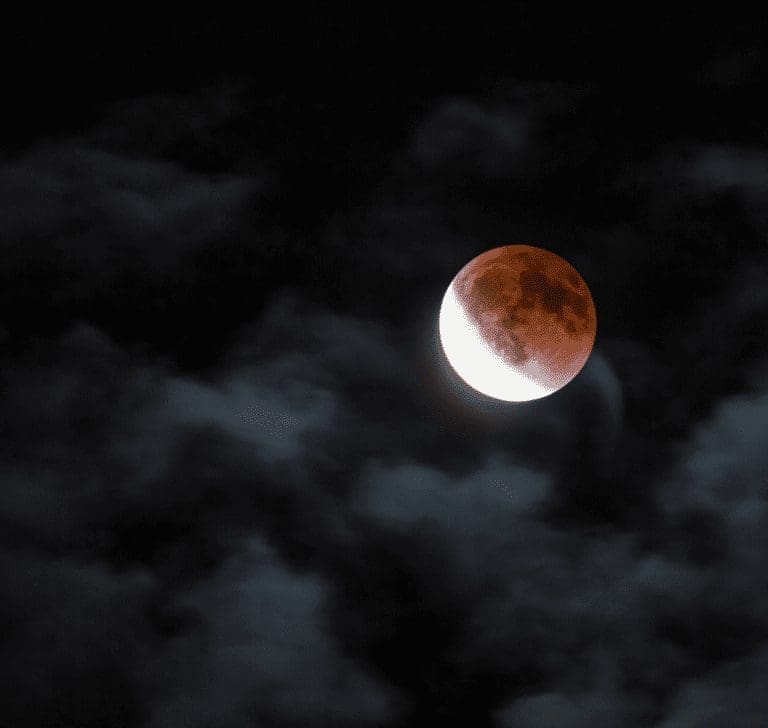
On March 13 and 14, North America will be tinged with a reddish hue due to a lunar eclipse, known as the “Blood Moon.”
Three years after the last occurrence, North America’s sky will turn reddish due to a lunar eclipse. Known as the “Blood Moon,” the event will take place after midnight on March 14 in the eastern U.S. and Canada, and before midnight on March 13 in the western part of the continent.
According to National Geographic, a lunar eclipse occurs when the Earth is positioned directly between the Sun and the Moon. This phenomenon casts a shadow on the lunar surface, gradually darkening it until it reaches its most intense phase, turning reddish. This effect occurs because sunlight filters through Earth’s atmosphere, allowing longer wavelengths (red) to reach the Moon, the same phenomenon that causes sunsets to have reddish hues.

Time and place to view the eclipse
The total lunar eclipse on March 13-14, 2025, will last for six hours, with the most spectacular phase—the total eclipse—lasting 66 minutes. During this time, the Moon will take on a deep red hue due to Earth’s shadow. It will be visible primarily in North and South America, and only 13% of the world’s population will be able to witness the event, which will be most impressive under clear skies.
The most dramatic moment of the eclipse will occur between 1:26 and 2:31 a.m. CDT on Friday, March 14, 2025, or 11:26 p.m. PDT on Thursday, March 13, when the Moon will completely enter Earth’s shadow, displaying reddish, coppery, or orange tones.
The best way to enjoy the eclipse is to go outside, find a location with a clear view of the sky, and watch the Moon slowly change color. Unlike solar eclipses, special glasses are not required.

Interesting facts about the March 2025 lunar eclipse
1. It’s similar to sunrise and sunset colors
A total lunar eclipse occurs when the full Moon passes through Earth’s shadow, causing it to lose much of its brightness. During totality, the Moon turns reddish due to the refraction of light. Sunlight reaching the Moon passes through Earth’s atmosphere, where longer wavelengths (red) pass through more easily, while shorter wavelengths (blue) scatter. This phenomenon causes the Moon to take on reddish hues, similar to the colors of a sunrise or sunset on Earth, as explained by NASA.
2. Spica and Regulus will be more visible
Throughout the event, the sky around the Moon will darken enough to reveal stars that are usually hidden by the Moon’s light. Spica, a bright blue star located 250 light-years away, and Regulus, located 78 light-years from Earth, will be particularly visible during the eclipse.

3. It’s one of the smallest full Moons of 2025
Although this Moon will experience an eclipse for 66 minutes, it is actually one of the smallest full moons of the year. Just as there are supermoons when the Moon is closer to Earth and appears larger, there are also full moons that are farther away, making them appear smaller.
4. The best view will be in the Galápagos Islands
All of North America, and much of South America, will have an excellent view of the total lunar eclipse. However, the best place to witness this celestial event will be the Galápagos Islands in Ecuador. The eclipse will begin totality there at 00:26 GALT.

When will the next lunar eclipse be?
The excitement doesn’t end here, as another total lunar eclipse is expected to occur on September 7-8, 2025. This event will be visible in Europe, Asia, Australia, Africa, western North America, and eastern South America. Another total eclipse will take place between March 2-3, 2026, visible in Eastern Europe, Asia, Australia, North America, South America, and similar oceanic and polar areas.
Additionally, there will be a near-total lunar eclipse on August 27-28, 2026, where Earth’s shadow will cover 93% of the Moon. This partial eclipse will be visible from parts of Europe, Western Asia, Africa, North America, South America, various oceans, and Antarctica.

Polar Vortex in the U.S.: Northeast Could Become the Coldest Place on Earth Before Christmas
A powerful polar vortex could make the Northeast the coldest place on Earth, bringing life-threatening cold just days before Christmas.

Midwest states declare fuel emergencies
Fuel supply disruptions trigger emergencies in the Midwest. A combination of fuel supply disruptions and winter weather conditions is significantly affecting the supply chain in

Tell us how you decorate your Christmas tree and we’ll tell you your personality
The way you decorate your Christmas tree is a wonderful reflection of who you are. Which personality represents you best? The Christmas tree is one

Fatigue Monitoring 2025: New Federal Changes Ahead
Federal agencies are reassessing fatigue monitoring technologies and HOS standards, signaling potential regulatory changes for the trucking industry.

A guide to “angry eyes” rules every driver should know
The recent wave of traffic stops in Wisconsin and California for trucks using green LED “angry eyes” lights has reignited a national debate: what modifications are allowed, and which ones are strictly prohibited, under U.S. trucking regulations? This angry eyes crackdown highlights a growing issue in the industry—confusion about what is actually legal on the road.

Truck drivers are at high risk of developing diabetes
About 11% of the adult population meets the criteria for prediabetes, and there is a particular group at high risk: truck drivers. Diabetes rates in