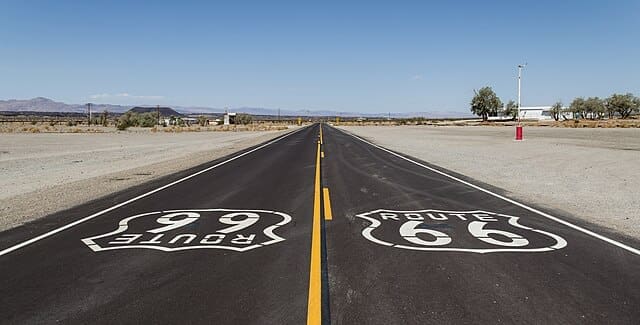
The iconic highway faces a new challenge: adapting to the electric trucking revolution and the push to decarbonize the freight industry.

Route 66, known as “The Mother Road” of the United States, was for decades a symbol of progress, commerce, and adventure in freight transportation. Today, nearly a century after its inauguration, this iconic highway faces a new challenge: adapting to the electric trucking revolution and the push to decarbonize the freight industry.
From Diesel Legends to Electric Power
Companies like Tesla, Volvo, and Freightliner are leading the charge with long-haul electric truck models. The Tesla Semi, for instance, promises up to 500 miles per charge—enough to cover significant stretches of Route 66, which crosses eight states from Chicago to Santa Monica.
But the challenges are significant. Range anxiety and infrastructure gaps create uncertainty for transport companies. “Route 66 runs through vast rural areas where finding charging stations is nearly impossible,” says Robert Hill, an electric mobility analyst at EV Transportation Insight, in an interview with Transport Topics (2024).
“Without a solid network of fast chargers, truckers can’t plan their routes as freely as they do with diesel. That threatens the efficiency of electric freight along historic routes like this,” Hill adds.

Infrastructure: The Biggest Challenge in America’s Heartland
Currently, heavy-duty charging infrastructure is scarce across much of middle America. While efforts are underway to install stations along major corridors like I-40 —which in many stretches replaced the old Route 66— investment levels remain insufficient.
Speaking to FreightWaves, Melissa Bowen, Director of Network Development at ChargePoint, explained: “Electrifying freight transport requires massive investments in strategic locations. It’s not just about installing chargers; we need to rethink rest stops and the entire logistics system for long-haul routes.”
Environmental Impact and the Changing Trucking Lifestyle
The shift to electric trucks promises significant environmental benefits. According to a 2023 report by the Environmental Protection Agency (EPA), electrifying freight along routes like the 66 could reduce up to 40 million tons of CO₂ annually. However, this technological change also affects the daily life of truckers.
In an interview with Overdrive Online, veteran trucker Mike Sanders, who has driven Route 66 for over two decades, shared his perspective: “We used to worry about driving hours and weight checks. Now we have to think about battery charging, plan even more, and adapt to new tech. A lot of us feel like we’re going to have to learn everything all over again.”
Is Route 66 Ready for the Future?
While the U.S. debates timelines for the energy transition, Route 66 remains a symbol of the highways that built America. Adapting it for electric trucks will be costly and time-consuming, but it also presents a unique opportunity to breathe new life into this historic road—while looking to the future.
“The challenge is huge, but it’s necessary,” Hill concludes in Transport Topics. “The question isn’t if Route 66 will be ready for electric trucks, but when and how we’ll make it happen.”

The best roadside attractions for truckers in the U.S.
America’s highways hide unique places that break up the routine, don’t hesitate to check out these roadside attractions along the way. The road is much

The trucker style: comfort, function, and identity
Truckers’ style is much more than workwear; it’s an identity. These are the most commonly worn garments among truckers. Truckers’ style is much more than

Chaos on Highway 61: Viral Wrong-Way Truck Video Reignites the CDL Debate
An 80-ton tractor-trailer traveling miles in the wrong direction on Missouri’s Highway 61 has reignited a nationwide debate over Commercial Driver’s License (CDL) standards, training

How technology affects driver retention
Friend or foe? 52% of drivers say technology directly influences their decision to stay with or leave a fleet. Fleet telematics company Platform Science published

Dalilah Law seeks to remove non-english speaking commercial drivers
President Donald Trump proposed the “Dalilah Law,” an initiative aimed at prohibiting undocumented immigrants from obtaining commercial driver’s licenses. On February 24, President Donald Trump

FORMULA 1 and the AI That Could Transform Transportation in the U.S.
The artificial intelligence system that Formula 1 implemented to monitor every car on every turn is opening the door to new applications in trucking, logistics,