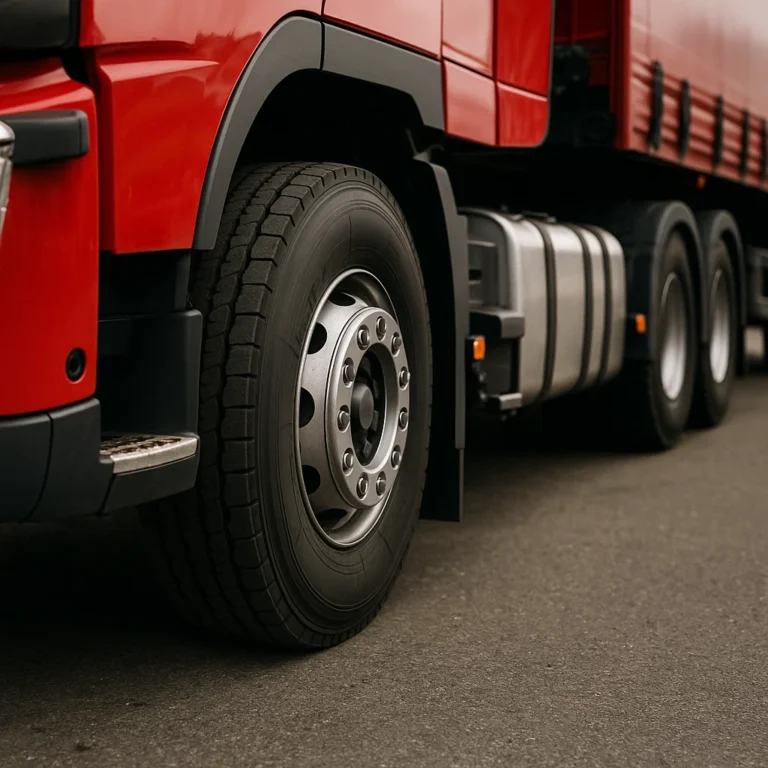
Truck fleets across the United States will soon face steeper replacement tire prices as international trade tensions and tariffs ripple through the industry. Major tire manufacturers have announced upcoming price increases, adding further pressure to an already strained freight sector.
Beginning May 1, at least two global tire makers — Yokohama Tire and Sumitomo Rubber North America — will raise prices on replacement truck tires sold in the U.S., with hikes reaching up to 10%. Sumitomo will also increase prices on passenger and light truck tires by as much as 25%.
Yokohama’s Chief Operating Officer Stan Chandgie cited “unprecedented cost increases” tied to materials and finished goods as the reason for the adjustment. Goodyear, meanwhile, plans to raise U.S. and Canadian prices on certain passenger vehicle tires, although it has not yet announced changes for truck tires.

Tariff Pressures Intensify for Tire Makers
The core challenge: U.S. tire manufacturers rely entirely on imported natural rubber, as domestic conditions do not support its cultivation. Thailand leads global production, followed by Indonesia, Vietnam, India, and China. New reciprocal tariffs announced in early April include steep rates: 37% for Thailand, 32% for Indonesia, 46% for Vietnam, 26% for India, and a staggering 145% for China.
On top of these import tariffs, the price of natural rubber has been climbing — from 94.75 cents per pound in July 2024 to 108.63 cents per pound in March 2025, according to IMF data — though global economic slowdown fears have recently cooled prices.

Industry Uncertainty Clouds Freight Recovery
Economic forecasts have been downgraded as trade tensions escalate. The International Monetary Fund now projects U.S. growth at 1.8% for 2025, down from 2.7% estimated earlier in the year. Global growth expectations have similarly dropped to 2.8% in 2025 and 3% in 2026.
For trucking carriers, the situation introduces unwelcome uncertainty. A senior executive at a top 15 for-hire carrier described the situation as “walking through a maze blindfolded in the dark,” highlighting the unpredictable nature of the shifting cost landscape.
Global Tire Makers Weigh Their Options
For manufacturers like Apollo Tires, which produces in India, the Netherlands, and Hungary, baseline 10% tariffs already apply to U.S. imports. Apollo National Sales Head Gavin Broussard said the company is working to minimize the impact on customers but acknowledges that some increased costs may need to be passed through.
While Apollo has not yet made tariff-related price adjustments, Broussard emphasized the company’s commitment to the U.S. market and noted that there is no announced timeline for a domestic production facility.
Closures Tighten Domestic Supply
The U.S. tire manufacturing landscape has also been hit by plant closures. Sumitomo Rubber USA shut down its Tonawanda, N.Y., plant in November, citing high costs and mounting losses. In January, Bridgestone Americas closed its LaVergne, Tenn., facility, though it continues to produce medium- and heavy-duty truck tires at its Morrison, Tenn., plant.
Michelin, which operates a commercial truck tire facility in Spartanburg, S.C., said it is still evaluating the impact of the latest tariff announcements and has not yet provided specifics on pricing adjustments.
More Price Hikes Likely on the Horizon
According to ING analyst Rico Luman, it is highly unlikely the U.S. will roll back the automotive parts tariffs — meaning fleets should brace for further increases. As competition from imports tightens and manufacturing costs rise, the tire industry faces an unavoidable squeeze, one that will ripple through to the carriers and shippers who depend on affordable replacement tires to keep their operations moving.

$170 billion at stake: 1,500 companies demand tariff refunds
Companies have challenged the global tariffs imposed by President Donald Trump, asking federal courts to reactivate proceedings to begin the refund process. The companies that

In brief: enforcement measures target speeding, CDL training gaps and more
Major enforcement actions across the U.S., including speeding, CDL fraud, and chain violations Colorado launches Speed Enforcement Program The Colorado Department of Transportation (CDOT) has

Chinese Vehicles Raise Espionage and Remote Sabotage Concerns
Investigations into Chinese technology in connected vehicles warn of espionage risks, massive data transmission, and potential remote access vulnerabilities that concern U.S. transportation and security

Between the Court and the Fed: the market redefines its roadmap for 2026
Trade policy in limbo as markets price in 2026 rate cuts and Supreme Court strikes down Trump tariff plan. In the latest episode of the

New 10% U.S. import tariff takes effect amid legal and market uncertainty
The implementation of these new tariffs has generated global uncertainty among exporters, increasing confusion around U.S. trade policy. The United States has implemented a new

Military Trucks That Moved a Base in Syria
Convoys of advanced HEMTT and PLS military trucks carried armored vehicles, prefabricated base structures, mobile workshops and heavy equipment during the U.S. withdrawal from northeastern