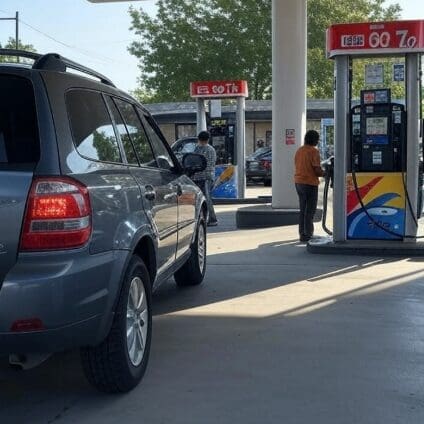
Truckers and travelers will find some welcome news on the road: fuel prices are set to hit their lowest levels since 2021, offering relief to owner-operators and fleet managers alike amid rising operational costs.
As nearly 40 million Americans prepare to hit the road this Memorial Day weekend, they’ll find some relief at the pump: gas prices are headed to their lowest level for the holiday since 2021.
According to projections from fuel savings app GasBuddy, the national average for a gallon of regular gasoline is expected to hover around $3.08, a sharp drop from $3.58 at the same time last year and well below the $4.60 peak seen in 2022.

This decline in fuel costs is emerging as one of the rare bright spots in the U.S. economy, which continues to grapple with trade tensions and concerns about slowing growth.
“This is a win for consumers. If trends hold, we could even see national averages fall below $3 later this summer,” said Patrick DeHaan, head of petroleum analysis at GasBuddy, in an interview with CNN.
Adjusted for inflation, this year’s gas prices would mark the lowest Memorial Day rates since 2003, excluding the unique dip during the pandemic. In practical terms, Americans are spending less of their paycheck to fill up their tanks.

Still, part of the reason for the muted energy prices is broader economic uncertainty. Analysts warn that President Trump’s aggressive tariff policies could slow both domestic and global economic activity.
Holiday traffic is expected to be heavy. The AAA predicts 39.4 million drivers will take to the roads this Memorial Day weekend — a 3% increase over last year and nearly 5% higher than 2019 levels.
In that context, lower gas prices offer a visible and immediate form of relief for American families, many of whom remain frustrated with the overall cost of living.
“People notice gas prices more than anything. A drop in fuel prices feels like a psychological tax cut,” said Bob McNally, president of Rapidan Energy Group.
The recent dip has already helped temper inflation data for March and April. And the trend may continue — GasBuddy estimates gas will average $3.02 per gallon from Memorial Day through Labor Day.
Fuel prices have also declined following policy shifts. Since taking office for a second term, President Trump has focused on lowering energy costs by pushing for increased domestic production and calling on Saudi Arabia and OPEC to boost supply.
U.S. oil prices have fallen about 20% under Trump’s second term. Experts credit a mix of increased OPEC output and Trump’s vocal appeals, including a high-profile speech at the World Economic Forum in Davos.
McNally, a former White House energy adviser, noted that Trump’s current approach with OPEC has been more measured than his pressure campaigns on other targets like China, Walmart, or the Federal Reserve.
“He’s using a lighter touch this time,” McNally said of Trump’s behind-the-scenes efforts to influence oil production.
However, the downside of cheaper crude is that it reflects growing concern over the global economy and lack of follow-through on sanctions against Russia’s energy sector, which the Biden administration had proposed in its final days.
Despite falling oil prices, gasoline hasn’t dropped as dramatically. The reason? U.S. refineries are producing less gasoline than before, anticipating lower demand amid the rise of electric vehicles.
“As Mark Twain said, the reports of gasoline’s death are greatly exaggerated. It’s not dead, but we are definitely making less of it,” McNally concluded.

What Are the 5 Most Expensive Highways for Trucks in the U.S.?
These five U.S. highways have some of the highest toll costs for trucks, adding hundreds of dollars to a single trip.

Truckers in Washington: How to adapt to the new economy and come out ahead
The transportation market in Washington state is transforming. This article outlines the key factors and best strategies for optimizing routes, reducing costs, and capturing the most profitable loads.

Florida Raises Crash Reporting Threshold to $2,000
Starting October 1, Florida will quadruple the property-damage threshold that triggers the requirement to immediately report a crash. For truck drivers, however, the dollar value of the damage is not the only factor that matters.

Frequently Asked Questions About Trucking in Washington
100 questions and answers for truck drivers operating in the state of Washington.

Washington updates its freight corridors: how truck navigation will change on I-5, I-90, and other key routes.
The State of Washington is updating its planning for the state’s most important freight corridors with a clear goal: improving commercial truck traffic, strengthening supply

Washington speeds up new logistics hub development to strengthen freight transportation and trade with Canada
Washington is expanding its network of logistics hubs through investments in ports, highways, and distribution centers to streamline freight transportation.