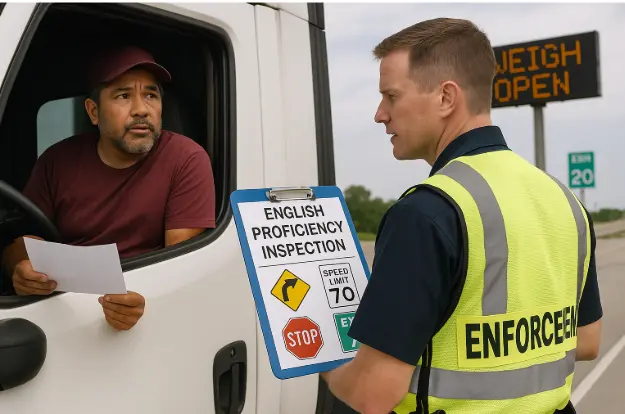
The new policy immediately disqualifies drivers who cannot demonstrate sufficient English skills, sparking concerns in the industry over a potential labor shortage during peak freight season.
As of Wednesday, June 25, a new federal regulation is in effect across all U.S. states, significantly tightening language requirements for truck drivers. In compliance with an executive order signed by president Donald Trump, the Department of Transportation (DOT) has begun enforcing a policy that immediately disqualifies commercial drivers who fail to demonstrate adequate command of the English language—raising alarms throughout the trucking industry about the possible removal of thousands of active workers.
What the New Rule Requires
The measure, announced weeks ago by Transportation Secretary Sean Duffy, mandates that drivers be able to read road signs, understand digital highway alerts, and effectively communicate in English with roadside inspectors.
“A driver who doesn’t understand English will not operate a commercial vehicle in this country. Period,” Duffy stated during the official announcement of the policy.
The rule applies to both truckers and bus drivers operating across state lines. Its stated goal is to enhance road safety and prevent accidents linked to misinterpretation of signage or verbal instructions.

How the Inspections Work
Inspections can be triggered by any technical or administrative reason—such as a broken taillight or a routine weigh station check. If the inspector suspects the driver lacks English proficiency, they are required to immediately conduct a two-part assessment:
- Oral interview to determine whether the driver understands questions about documents, cargo, trip origin and destination, and hours of service.
- Sign recognition test involving physical road signs and electronic message boards.
The use of interpreters, translation apps, mobile tools, cheat cards, or any external aids is strictly prohibited during the evaluation.
Who May Be Affected?
The new regulation directly impacts a large segment of drivers who learned English as a second language—many of whom currently operate with basic communication skills or rely on translation apps.
In states like New Jersey and Texas, some drivers have already started taking language classes, studying technical phrases, or watching English videos to improve fluency. Still, many fear that even a minor slip-up, a misunderstanding, or a strong accent could be enough to disqualify them.
At the Flying J Travel Center in New Jersey, several truckers voiced support for the rule. One of them, Kassem Elkhatib, said:
“We try to talk about the load or the route, and some guys just can’t speak at all. In this job, that can be dangerous.”
On the other hand, labor rights and immigrant advocacy groups warn that the rule could lead to arbitrary or discriminatory enforcement, as no clear benchmarks have been published to define acceptable English proficiency. In fact, that section was redacted from the public version of the official guidance.
Industry Impact
The primary concern is that strict enforcement of the policy could cause an immediate drop in driver availability. This could lead to:
- Delivery delays,
- Higher logistics costs,
- Route coverage issues during peak freight season.
The Owner-Operator Independent Drivers Association has expressed support for the rule but also urged the government to provide educational resources to help workers meet the new standards.

Why Summer is the Most Dangerous Season for Your Truck
During summer, extreme heat, increased traffic, road construction, and mechanical stress create a combination of risks for your truck and your load.

GHOSTRUCK Act to Curb Foreign Manipulation of Truckers’ ELDs
The new bill aims to close a regulatory loophole involving foreign manipulation of ELDs.

Florida Will Mark Certain Drivers With Code 775.261
Starting in October, Florida will identify certain drivers with the code 775.261 on their licenses. What it means for CDL holders, how it could influence insurance evaluations, and the new requirements affected drivers must follow.

Amazing goals from the World Cup! Soccer moves trucks and brings billions to the US economy
The biggest sporting championship in history is injecting billions of dollars into the economy, driving up demand for heavy freight. More tourists spending, more need for services, and more jobs.

What Are the Most Expensive Trucks in the World?
With the Thor 24 leading the list at more than $13 million, these are the most expensive and exclusive trucks on the planet.

Invisible Heroes: The Silent Sacrifice of Fathers Who Move America
Despite the fact that the engine of the economy depends on their tireless work on the roads, thousands of truckers celebrate their day far from home, facing the harsh reality of distance.