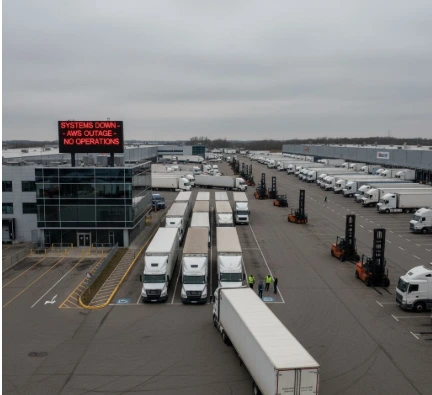
The recent AWS outage exposed critical vulnerabilities in U.S. logistics and trucking operations, highlighting how cloud failures can disrupt fleet coordination, freight tracking, and delivery workflows. As logistics and trucking companies grow increasingly cloud-dependent, experts warn that fleets must adopt new prevention strategies to avoid operational chaos
The latest AWS outage exposed major risks for U.S. logistics and trucking by forcing cloud-dependent platforms offline, interrupting dispatch systems, freight visibility tools, and digital delivery operations across multiple states. As more logistics and trucking companies shift their operations to Amazon Web Services (AWS) and other cloud platforms, the outage has sparked an industry-wide debate about whether fleets are prepared—or dangerously unprotected—when critical cloud infrastructure fails.
A Single Cloud Failure, Global Consequences
Amazon confirmed Monday afternoon that its systems had returned to normal after a disruption originating in its US-EAST-1 data cluster in Northern Virginia, one of its largest and most frequently used regions. The outage temporarily affected major platforms in payments, communications, gaming, banking, and customer-facing apps.
While many users experienced only inconvenience, logistics professionals immediately raised alarms. Transportation management systems (TMS), warehouse management systems (WMS), freight booking platforms, fleet routing apps, and digital proof-of-delivery tools rely heavily on AWS-based APIs. When they stall—even for an hour—entire schedules, freight handoffs, and delivery windows can collapse.
“Supply chains can’t afford digital blackouts,” said logistics technology analyst Michael Hartwell. “When AWS goes down, it’s not just a tech issue—it threatens on-time delivery commitments, driver productivity, and customer trust.”

How Trucking Operations Were Potentially Affected
While not every trucking company publicly reported disruptions, logistics experts noted that cloud failures like this can cause cascading inefficiencies across fleets. Typical risks during a cloud outage include:
✅ Route assignment delays
✅ Frozen TMS dashboards and freight-matching platforms
✅ Inability to sync tracking and ELD data
✅ Digital bills of lading (eBOL) going offline
✅ Failure of automated dispatching tools
✅ Loss of real-time communication between brokers, carriers, and drivers
In cases where drivers rely on mobile apps hosted on AWS, sudden app timeouts can leave drivers without updated pickup instructions, route changes, or schedule modifications.
“Trucks may still move—but blind,” Hartwell added. “When the cloud stops, fleet visibility stops.”
A Recurring Point of Failure: The US-EAST-1 Cluster
This is not the first time the Northern Virginia AWS region has caused a global internet slowdown. In fact, this marks at least the third major outage in five years tied to this specific cluster.
Amazon reported that the issue originated in a malfunction within its internal EC2 networking system, which affected the Domain Name System (DNS) resolution for key database services like DynamoDB. This prevented many apps from correctly routing traffic, leading to service timeouts and cascading failures.
The dependency on a single primary region—without redundancy—proved to be a weak link for many companies.
Experts Warn: This Could Happen Again
With more carriers and logistics providers migrating to AI-based routing, cloud-based load optimization, and automated documentation processes, reliance on AWS continues to grow.
Ken Birman, a computer science professor at Cornell University, warned that developers often fail to configure systems with multi-region or multi-cloud tolerance. “AWS provides the tools for resilience, but many SaaS vendors do not implement proper failover strategies,” he explained. “When one region goes down, entire industries feel the impact.”
How Fleets Can Protect Themselves from Future AWS Outages
To build resilience, logistics and trucking operators are encouraged to take proactive measures such as:
🚨 1. Multi-region or multi-cloud redundancy
Run critical dispatch and telematics systems across different AWS regions—or even across AWS, Azure, and Google Cloud.
📲 2. Offline-capable mobile apps for drivers
Ensure apps pre-load routing, shipper contacts, and delivery instructions so drivers can keep operating if networks go down.
📄 3. Maintain paper-based failover plans
Digital bills of lading are efficient—but fleets should keep printable versions on standby.
☎️ 4. Manual dispatch procedures
Train dispatchers on how to assign loads via SMS, phone, or radio in emergency situations.
🔁 5. Conduct outage simulation drills
Practice running operations during controlled system downtime to test backup readiness.
Cloud Dependency Requires Smarter Backup Culture
The AWS outage is more than a technical failure—it’s a strategic alert for the trucking and logistics industry. As fleets accelerate digital transformation using AI-powered dispatch, real-time customer tracking, digital customs clearance, and predictive routing, a single point of cloud failure could pose multi-million-dollar risks.
In a world where freight must move 24/7, carriers can no longer afford to treat business continuity planning as optional.
“Technology is the engine of modern logistics,” Hartwell said. “But if you don’t build a spare, your entire fleet is one blackout away from chaos.”

Why Soccer is Conquering Hearts and Businesses in the U.S.
Messi’s presence in stadiums and the hosting of the next World Cup, along with other global tournaments, have transformed it into a new entertainment giant. The gradual growth of the National Team motivates the public. Million-dollar businesses, brands, and a lot of passion.

The Asphalt Code of Honor: The Invisible Social Network That Saves Lives
On U.S. highways, truck drivers often communicate through a silent language of signals, headlights, and hand gestures. This informal system of road communication helps warn others about hazards, coordinate safe passing, and reinforce a culture of safety and solidarity among professional drivers

What if the Oscars were about trucking? Hollywood characters reimagined as truckers
This week marks the 98th Academy Awards, what if the categories were inspired by the transportation industry?

TCA Professional Drivers of the Year 2026: 5 drivers who paved the road
TCA Professional Drivers of the Year selects drivers with the greatest impact, outstanding safety records, and individuals with inspiring stories that made a difference.

Unusual Stories from the Road: When Reality Outruns Logistics
From a giant magnet moving down the highway like a spacecraft to millions of bees taking over a highway, the world of freight transportation is full of events that are as strange as they are real. Some of these stories went viral, others became legends among drivers, but all of them reveal the unexpected side of logistics.

The safest, most reliable and crash-resistant cars for protecting you on the road
Based on ratings from the NHTSA and the IIHS evaluation system, this list shows some of the safest and most crash-resistant cars.