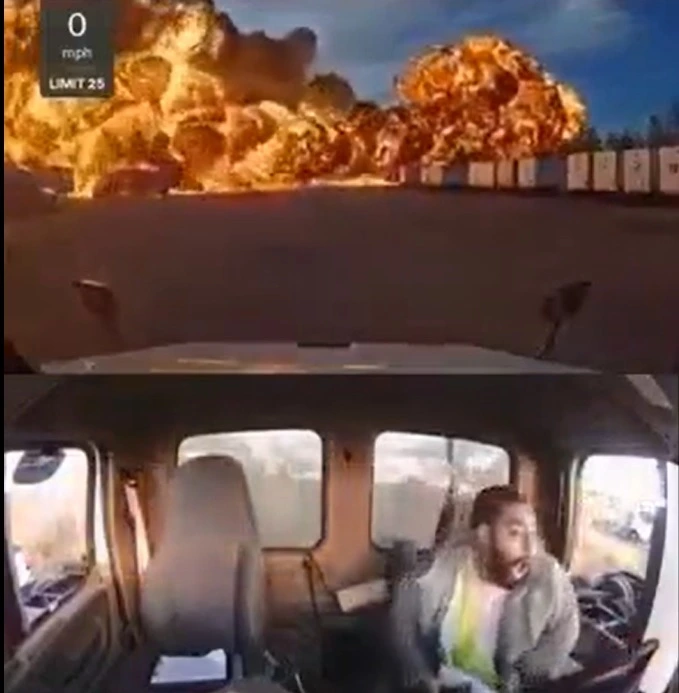
The UPS crash in Kentucky highlighted how truck drivers often become first witnesses to major incidents, with dashcam footage providing essential evidence for investigators, fleet managers, and insurers
Newly released dashcam footage recorded by a truck driver near Muhammad Ali International Airport in Louisville captured the initial moments of the UPS Flight 2976 crash, involving a McDonnell Douglas MD-11 cargo aircraft. The plane, bound for Honolulu, was unable to gain altitude during takeoff and went down close to the runway, resulting in a post-impact fire and significant debris across the area.
The Federal Aviation Administration (FAA) confirmed the crash, and emergency response teams from the city were deployed immediately. Local authorities reported at least seven fatalities and eleven injured, including individuals on the ground near the impact zone.
The National Transportation Safety Board (NTSB) has begun its investigation, and the dashcam video recorded from the truck has become an important piece of the initial evidence chain. The visual documentation offers investigators an objective, real-time reference for analyzing the sequence of events.
WATCH: Dashcam footage shows truck driver reacting to deadly UPS plane crash in Louisville, Kentucky.pic.twitter.com/WbJX0k1fae
— AZ Intel (@AZ_Intel_) November 5, 2025
Dashcams as Reliable, Objective Evidence
Dashcams are increasingly recognized as one of the most valuable tools for documenting incidents in transportation environments, particularly where multiple modes of logistics interact—such as around airports, ports, warehouses, and industrial corridors.
Unlike verbal witness accounts, dashcam footage:
- Captures the event as it unfolds, without subjective interpretation.
- Provides clear timestamps and environmental context.
- Offers continuous visual perspective, enabling accurate time-sequence analysis.
- Reduces discrepancies in testimony during later legal or insurance review.
In this case, the truck driver did not approach or intervene—yet their position on the road and continuous recording made them a key observer.
Truck Drivers as Trained Observers in Emergency Situations
Truck drivers frequently operate in transportation hubs and are often among the first to witness critical incidents. For this reason, fleets benefit from preparing drivers with simple, standardized emergency reporting procedures, prioritizing safety and clarity of communication.
Recommended best practices for fleets include:
- Annual emergency observation and reporting training.
- Clear instructions to never approach hazardous scenes.
- Use of dashcams with automatic cloud upload for secure preservation.
- Defined scripts or checklists for communicating with 911 or facility security.
The goal is not intervention—it is accurate, safe reporting, which helps emergency services respond faster and helps investigators build a precise timeline of events.
UPS Flight 2976 crashed around 5:15 p.m. local time on Tuesday, Nov. 4, after departing from Louisville Muhammad Ali International Airport in Kentucky. The McDonnell Douglas MD-11 was headed to Daniel K. Inouye International Airport in Honolulu. The FAA and NTSB will investigate.…
— The FAA ✈️ (@FAANews) November 4, 2025
Insurance and Risk Management Implications
For the trucking insurance sector, the UPS crash reinforces a key principle:
dashcams reduce disputes, clarify liability, and protect drivers and fleets.
Fleets that incorporate high-quality video systems see benefits such as:
- Faster claims resolution
- Stronger defense against false or speculative claims
- Reduced legal costs
- Better driver coaching and risk reduction over time
Insurers increasingly favor fleets that implement:
- Video telematics
- Collision avoidance systems
- Structured safety training programs
because these directly correlate with lower incident frequency and severity.
When an event occurs, having independent visual evidence protects the carrier, the driver, and the insurer alike.
The UPS crash in Kentucky underscores how truck drivers, equipped with dashcams and proper safety protocols, play a vital role as impartial first witnesses in large-scale incidents. As logistics networks grow more interconnected, the combination of:
- Continuous video recording,
- Clear emergency reporting procedures,
- and proactive safety culture
strengthens operational resilience and supports more transparent collaboration among fleets, insurers, and regulatory authorities.
Truck driver: stop choosing the worst route

$170 billion at stake: 1,500 companies demand tariff refunds
Companies have challenged the global tariffs imposed by President Donald Trump, asking federal courts to reactivate proceedings to begin the refund process. The companies that

In brief: enforcement measures target speeding, CDL training gaps and more
Major enforcement actions across the U.S., including speeding, CDL fraud, and chain violations Colorado launches Speed Enforcement Program The Colorado Department of Transportation (CDOT) has

Chinese Vehicles Raise Espionage and Remote Sabotage Concerns
Investigations into Chinese technology in connected vehicles warn of espionage risks, massive data transmission, and potential remote access vulnerabilities that concern U.S. transportation and security

Between the Court and the Fed: the market redefines its roadmap for 2026
Trade policy in limbo as markets price in 2026 rate cuts and Supreme Court strikes down Trump tariff plan. In the latest episode of the

New 10% U.S. import tariff takes effect amid legal and market uncertainty
The implementation of these new tariffs has generated global uncertainty among exporters, increasing confusion around U.S. trade policy. The United States has implemented a new

Military Trucks That Moved a Base in Syria
Convoys of advanced HEMTT and PLS military trucks carried armored vehicles, prefabricated base structures, mobile workshops and heavy equipment during the U.S. withdrawal from northeastern