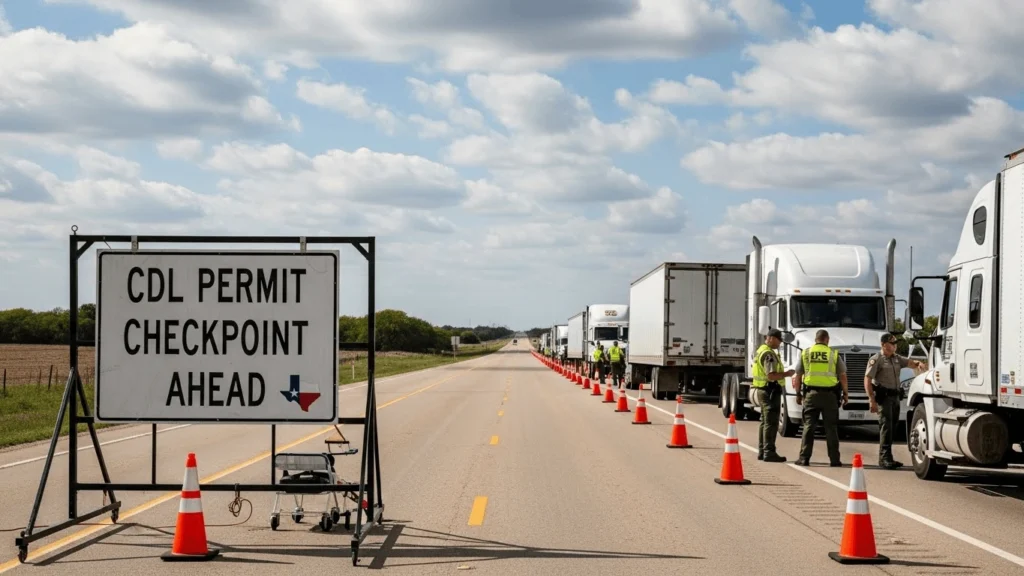
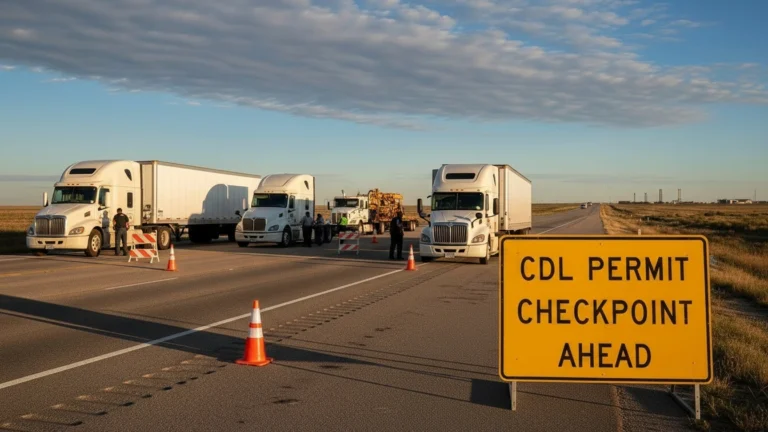
The review of commercial licenses is part of a federal audit process and updated administrative criteria aimed at aligning work permits, driving credentials, and compliance standards. For the transportation sector, this new licensing landscape marks a phase of regulatory adjustment, greater predictability, and reinforced safety conditions on highways and major freight corridors.
Since November 2025, the state of Texas has revoked more than 6,400 commercial driver’s licenses (CDLs) held by asylum seekers, refugees, and recipients of the DACA program. The decision is part of a broader national review led by the U.S. Department of Transportation (DOT), whose stated goal is to strengthen road safety standards, streamline registration systems, and ensure a clear alignment between immigration status, work authorization, and the legal requirements to operate heavy commercial vehicles.
While the number of revoked licenses represents only a fraction of the more than 718,000 active CDLs in Texas, the effects have been particularly noticeable in certain segments of the market—especially among owner-operators, small fleets, and companies that relied on drivers with temporary immigration status.
For many operators, this process marks the beginning of a new phase of regulatory oversight, but also a period of greater clarity around compliance rules.
The origin of the measure: audits and document alignment
The immediate trigger for this policy was a nationwide audit launched by the DOT following a series of serious accidents in 2025, including a major multi-vehicle crash on I-35 near Austin that involved 17 vehicles and resulted in five fatalities.
In reviewing these incidents, federal authorities identified a recurring administrative issue: in several states, commercial licenses had been issued with expiration dates that did not match the validity periods of the drivers’ work authorizations. In practical terms, this meant that some drivers held valid CDLs even though they were no longer legally authorized to work in the United States.
From the federal government’s perspective, this misalignment represented a systemic risk. It complicated enforcement, weakened traceability, and created gray areas in compliance and oversight.
As a result, states were instructed to review their databases and correct any inconsistencies. Texas moved quickly to implement these changes, becoming one of the first states to carry out a large-scale cleanup of its CDL records.
A federal rule, a court block, and continued enforcement
At the same time, U.S. Transportation Secretary Sean Duffy introduced an emergency rule that would prevent asylum seekers, refugees, and DACA recipients from renewing or obtaining new long-haul trucking licenses.
Although this rule was temporarily blocked by a federal court, Texas officials maintain that other federal directives tied to the audit remain in force. As a result, the state has continued enforcing the license revocations already carried out.
In practice, this has created a complex situation: drivers who previously held valid licenses now find themselves outside the system, with no immediate path to reapply.

Road safety at the center of the policy
The central argument from authorities is that these measures are intended to strengthen safety on highways by ensuring that all commercial drivers meet the same legal and administrative standards.
DOT officials acknowledge that there is no conclusive evidence linking immigration status to a higher risk of traffic accidents. Federal data shows that immigrant drivers make up roughly 5% of CDL holders nationwide but account for only about 0.2% of fatal truck crashes.
However, the focus of the policy is not on the profile of the driver, but on documentation consistency: making sure that each CDL aligns with valid work authorization, residency terms, and eligibility requirements.
From the government’s point of view, this alignment is essential to building a more reliable and enforceable regulatory framework.
What this means for owner-operators and fleets
Beyond the political debate, the operational impact is very real. Many of the drivers affected by the revocations were owner-operators or part of small, family-run fleets. In many cases, they had invested heavily in equipment, training, insurance, and leasing contracts under the assumption of long-term stability.
With their licenses revoked, they are no longer able to operate—but their financial obligations remain.
For trucking businesses, this can translate into:
• Reduced operating capacity
• Difficulty covering long-haul routes
• Higher driver turnover
• Increased recruitment and onboarding costs
• Added pressure on the existing labor pool
In an industry already facing a structural driver shortage, even small regulatory shifts can create ripple effects across the supply chain.
Support from parts of the industry
Not all responses have been negative. Some industry groups have publicly supported the review process.
John Esparza, president of the Texas Trucking Association, said the measures could help improve overall safety and strengthen the integrity of the licensing system. From this perspective, the goal is to ensure that every driver operating heavy vehicles does so under the same legal, technical, and administrative conditions.
Over time, many operators see this as a step toward a more professionalized and predictable environment.
A new regulatory landscape
Texas’ actions may signal what lies ahead for other states. If federal audits continue, more jurisdictions could follow suit and reassess their CDL systems.
For truck owners and fleet managers, the message is clear: documentation traceability is becoming increasingly important. Experience and training will always matter, but so will strict alignment between licenses, work permits, and immigration status.
In this sense, the current process can be viewed as a transitional phase toward a more standardized, transparent, and compliance-driven system.
Despite the short-term challenges, the industry now has an opportunity to adapt to a clearer framework—one with more defined rules, stronger oversight, and greater long-term predictability.

DOT unveils possible AI strategy to enforce CDL regulations
The DOT is looking to adopt AI and advanced data analytics to improve the accuracy and effectiveness of enforcement measures. On January 14, the 105th

U.S. Trucking Defies the January Slowdown
Contrary to seasonal patterns, the U.S. trucking market entered 2026 without the traditional January slowdown. Capacity, pricing, and demand indicators suggest the industry remains tighter than expected, driven by inventory shifts, resilient consumer spending, and a reconfiguration of supply chains.

Using one of these ELD? FMCSA updates revoked device list
The FMCSA continues its safety campaign against electronic logging devices (ELD) that do not comply with the regulations established by the agency. The Federal Motor

Digital Freight Forwarding Is Reshaping Global Logistics
Digital freight forwarding is transforming the logistics industry through artificial intelligence, automation, and cloud-based platforms. According to DataM Intelligence, the global market is expected to surpass US$50 billion by 2031, while the U.S. alone will reach US$15.04 billion, driven by e-commerce growth, nearshoring, and the digitalization of supply chains.

Texas Has Revoked 6,400 Commercial Licenses to Strengthen Road Safety
The review of commercial licenses is part of a federal audit process and updated administrative criteria aimed at aligning work permits, driving credentials, and compliance standards. For the transportation sector, this new licensing landscape marks a phase of regulatory adjustment, greater predictability, and reinforced safety conditions on highways and major freight corridors.

$75,000 brokers bond rule now in effect
The FMCSA has the authority to suspend the operating license of transportation brokers whose minimum financial security falls below $75,000 After numerous debates, mixed opinions,