 Hable con un agente al (888) 572-7520
  Enviar mensaje a un agente



The transportation sector in the United States is undergoing a profound transformation that, despite its difficulties and challenges, directly benefits our community. According to the most recent data from the American Trucking Associations (ATA), the Truck Tonnage Index reached 116.2 points in February 2026. This indicator is crucial because it measures the gross weight of cargo transported by fleets, and reaching this level represents the highest point in the last three years.
For those behind the wheel, this is not just a number, but confirmation that more goods are moving on the roads and that demand is finally picking up after a period of decline. The ATA serves as the industry’s official voice before Congress and regulatory bodies, giving these figures significant weight in planning future investments.
Truck drivers are the driving force behind this change. And Latinos already represent 30% of the sector’s workforce, according to the Bureau of Labor Statistics. This government agency is responsible for tracking the labor market, and its data confirms that the presence of this segment on critical routes, especially from Texas to California, is vital to the national economy.
The transportation recovery we see today is driven by solid industrial production, which is measured by the Federal Reserve (Fed). The Fed, which acts as the country’s central bank, reported a production index of 102.5 in February, which automatically translates into more freight that needs to be moved from factories to distribution centers.
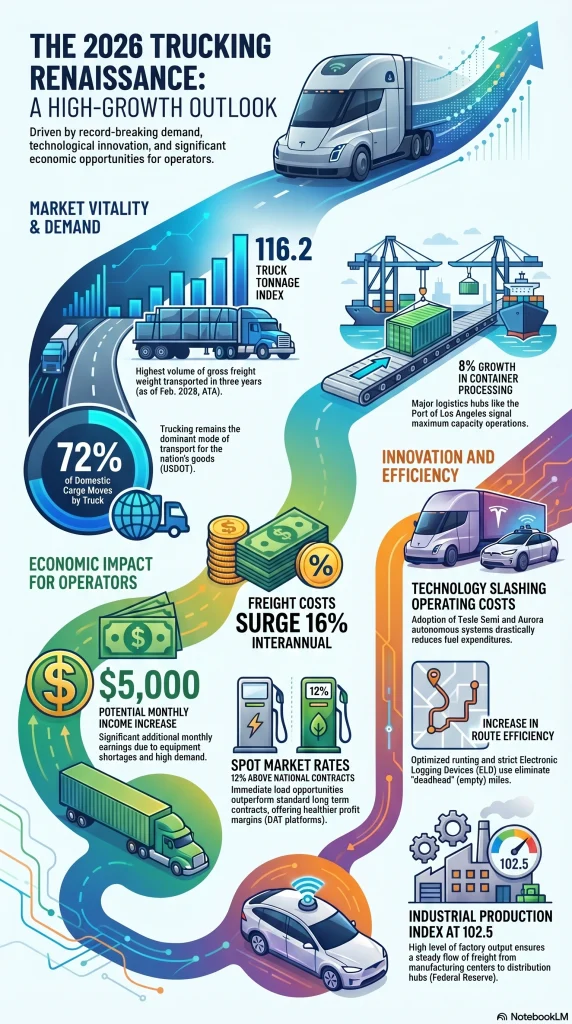
For independent carriers or small fleet owners, this recovery comes with an adjustment in freight costs that benefits the operator. Reports from the logistics firm C.H. Robinson indicate that costs rose 16% year-over-year in April 2026. This is because there are fewer trucks available for the amount of freight being generated, a situation of tight capacity that allows drivers to negotiate better rates per mile.
The shortage of available equipment, also validated by the ATA, puts those with their units ready to roll in a strong position, projecting additional income of up to $5,000 per month for a typical long-haul operator.
The Bureau of Transportation Statistics (BTS) also supports this positive trend. The BTS is the federal agency responsible for collecting and analyzing data on freight movement and infrastructure efficiency. Their reports show that ports of great importance to Hispanic carriers, such as Los Angeles, have seen an 8% increase in container processing. This means that major logistics hubs are operating at full capacity, ensuring that the workflow will not be interrupted in the coming months.
New Transportation Challenges
Despite political challenges and immigration restrictions that have reduced the supply of drivers, new legal initiatives are seeking to pave the way. The ATA is actively promoting laws such as the “Dalilah Law,” designed to standardize Commercial Driver’s License (CDL) training. This is crucial for new Hispanic drivers seeking to enter the freight transportation market with qualified training. Furthermore, specialized consulting firms like ACT Research predict that this expansion phase will continue throughout the rest of the year, transitioning from a downward cycle to one of sustained growth that will provide stability for families who depend on this sector.
The U.S. Department of Transportation (USDOT), through its annual “Freight Facts and Figures” report, confirms that trucks continue to move 72% of domestic freight in the country. With a projected 3.5% growth in total volumes this year, Latino fleets have a golden opportunity in the spot or immediate freight markets.
According to the DAT platform, rates in this market are 12% higher than the domestic contract rate, allowing those operating dry vans or refrigerated units to achieve much healthier profit margins.
Technology is also playing a role in this new era of transportation. The introduction of vehicles like the Tesla Semi and autonomous systems like Aurora are drastically reducing fuel operating costs. Although automation raises concerns, the ATA points out that it will open new jobs specializing in technical maintenance, where skilled workers can find high-paying positions.
The social impact is undeniable: trucking generates five indirect jobs for every driver, revitalizing the economies of our communities in key states like Florida and Texas.
To capitalize on this boom, it’s vital to stay informed and comply with the regulations of the Federal Motor Carrier Safety Administration (FMCSA), the agency that regulates trucking safety. Using compliant electronic logging devices (ELDs) and optimizing routes to avoid empty or “deadhead” trips are strategies that can increase your efficiency by 20%.
The trucking industry’s recovery by 2026 isn’t just a statistic; it’s a tangible reality in the pockets of every Latino trucker who chooses to accelerate with intelligence and a forward-thinking vision.
 Business hours: Monday to Friday from 8:00 AM to 5:00 PM. California time