 Hable con un agente al (888) 572-7520
  Enviar mensaje a un agente



Starting April 20, importers and their agents will be able to request refunds if they paid tariffs imposed without constitutional authority by President Donald Trump. In its official statement, the United States Supreme Court said that qualifying companies will have the opportunity to submit their requests through an online portal.
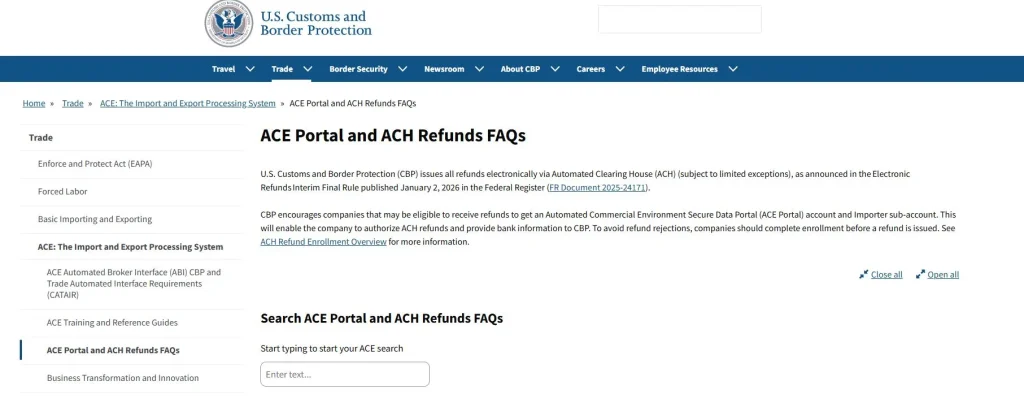
According to U.S. Customs and Border Protection (CBP), the agency responsible for administering the system, importers will be able to apply for refunds through the online portal “Consolidated Administration and Processing of Entries” (CAPE) starting Monday, April 20 at 8 a.m.
To receive a refund, companies must file declarations listing the products for which they paid import duties, limited to those taxes invalidated by the court. If approved by CBP, the refund will be completed within 60 to 90 days prior to approval, the agency said.
CAPE system: tariff refunds
The government could owe companies up to $175 billion, according to CBS News, after the Supreme Court ruled in February that the tariffs had been imposed illegally under the International Emergency Economic Powers Act (IEEPA).
Amid numerous lawsuits and appeals, CBP launched the CAPE online system as a mechanism for companies to request compensation. The system also limits refund requests to “unliquidated tariffs,” meaning estimated duties that can still be adjusted, as well as tariffs confirmed by CBP within the past 80 days.
CAPE may be used to request tariff refunds by the following parties:
- Companies that paid tariffs under IEEPA
- Customs brokers who paid duties on behalf of an importer
Only the importer of record will be entitled to the refund. For example, consumers affected by higher prices for imported goods cannot submit tariff refund claims, CBP explained.
According to a CBP court filing, about 330,000 importers had paid approximately $166 billion in tariffs. However, not all of them meet the criteria to receive refunds in the first phase of the refund system. Only tariffs subject to IEEPA are eligible for refunds, with some restrictions.
Refunds to companies, not consumers
Tariffs are paid by importers, and some companies pass those costs on to consumers through higher prices. The CAPE system, which is currently active, is designed to return tariffs directly to the companies that paid them, without requiring those companies to pass the money on to customers. However, some class-action lawsuits seeking to force companies to refund consumers are moving forward in the United States.
According to The Associated Press, consumers are more likely to receive refunds from shipping companies such as FedEx and UPS, which collected tariffs directly from customers on imports. In response, FedEx has said it will refund those charges to its customers once it receives the funds from CBP.
The CAPE system represents the first phase of the U.S. Customs and Border Protection refund plan.
 Business hours: Monday to Friday from 8:00 AM to 5:00 PM. California time